Choosing Pallet Rack Beam Length for Your Warehouse Needs
August 2, 2026
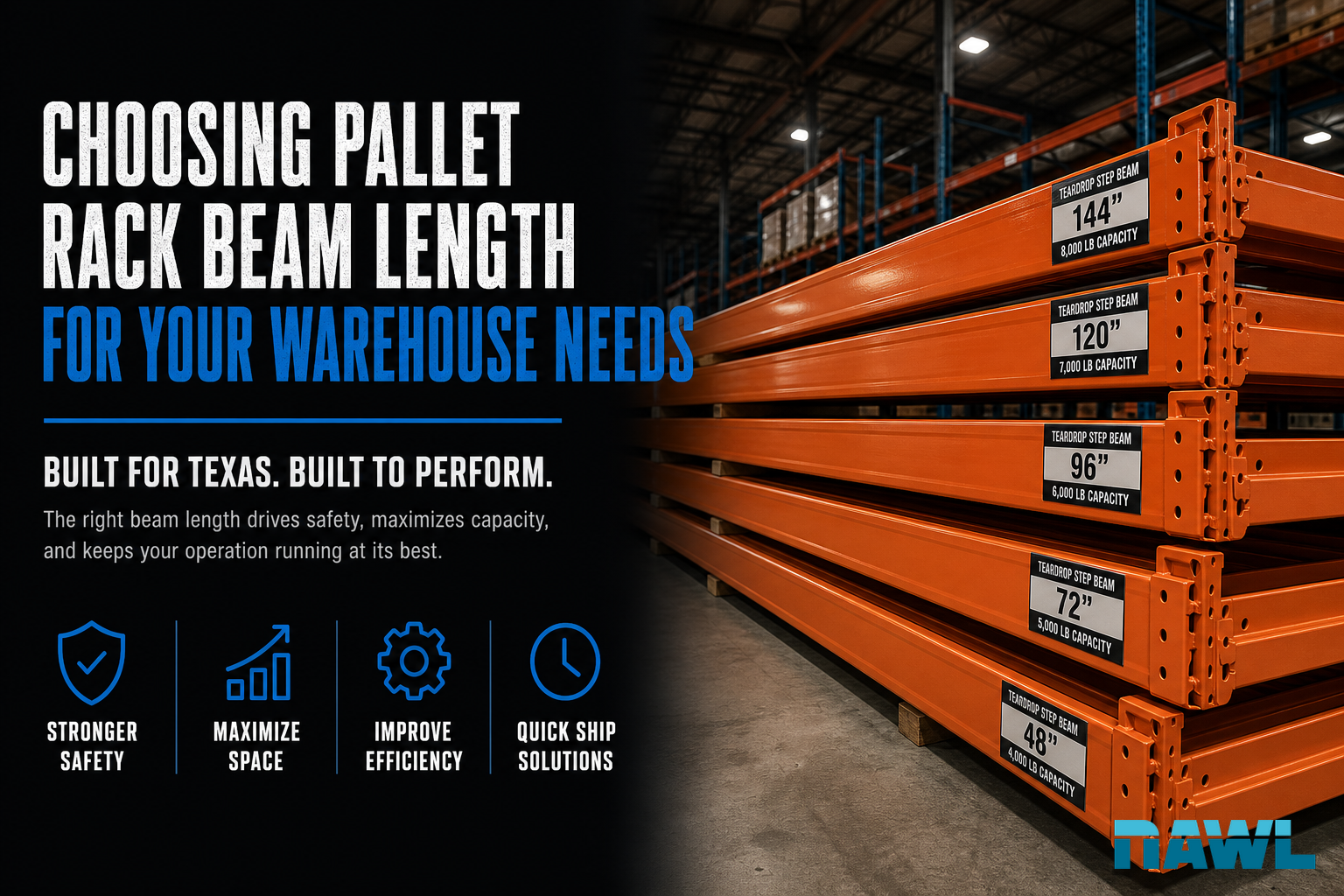
Selecting the correct pallet rack beam length is a critical decision that impacts your warehouse's efficiency, safety, and storage capacity. An improperly sized beam can lead to wasted space, structural instability, or operational bottlenecks.
Beam length looks simple on a quote, but it drives the width of every bay, the number of pallet positions per level, the aisle rhythm, and the amount of steel required for the job. For dealers, choosing pallet rack beam length correctly also reduces field changes, returned material, and install delays. The right answer comes from matching the load, the pallet, the forklift, and the rack system instead of choosing a common size by habit.
Understanding Beam Length Measurements
Pallet rack beam lengths refer to the clear span between the uprights, which is set alongside your frame height. This measurement is crucial because it dictates how many pallets can be stored side by side within a single bay. Accurate measurement ensures a proper fit and safe operation for your specific pallet dimensions.
In pallet rack beam sizing, the stated beam length is not the overall length of the steel including connector plates. It is the nominal bay opening from upright to upright. If you are replacing existing beams, do not measure the outside of the beam end connector and assume that is the order size. Measure the clear bay width between the inside faces of the frames, or confirm the original beam label and rack drawings if available.
This is especially important with teardrop rack. Teardrop beam sizing must match both the beam length and the upright connection style. A beam can be the correct length and still be wrong if the connector does not seat properly in the upright column. Before ordering, confirm upright depth, frame height, column style, beam profile, beam length, and required capacity.
A practical field check for an existing bay is:
| Item to confirm | What to look for | Why it matters |
|---|---|---|
| Clear beam span | Inside face of frame to inside face of frame | Determines bay width and replacement beam length |
| Beam connector | Teardrop, structural, or other style | Must match the upright connection |
| Beam profile | Step beam, box beam, structural beam | Affects decking, capacity, and accessories |
| Beam elevation | Distance from floor to top of beam | Controls pallet clearance and usable storage height |
| Beam condition | Bent faces, cracked welds, damaged locks | Damaged beams should not be reused without review |
Clear beam span
- What to look for
- Inside face of frame to inside face of frame
- Why it matters
- Determines bay width and replacement beam length
Beam connector
- What to look for
- Teardrop, structural, or other style
- Why it matters
- Must match the upright connection
Beam profile
- What to look for
- Step beam, box beam, structural beam
- Why it matters
- Affects decking, capacity, and accessories
Beam elevation
- What to look for
- Distance from floor to top of beam
- Why it matters
- Controls pallet clearance and usable storage height
Beam condition
- What to look for
- Bent faces, cracked welds, damaged locks
- Why it matters
- Damaged beams should not be reused without review
Factor One: Pallet Width and Overhang
The primary determinant for beam length is the width of the pallets you intend to store. Standard pallet sizes vary, but common dimensions include 40 inches (GMA standard) and 48 inches (export). You must account for a minimum of 4–6 inches of clearance between pallets and between the pallet and the upright frame. This ensures forklifts can easily place and retrieve loads without damaging the rack structure or adjacent product.
Calculate the total width required by multiplying your pallet width by the number of pallets per bay, then adding the necessary clearances. For example, two 40-inch-wide pallets side by side require at least 80 inches of pallet width, plus 4–6 inches of clearance per side and between pallets.
For standard GMA pallets, the key distinction is orientation. A 48 x 40 GMA pallet is often stored with the 40-inch side facing the aisle and the 48-inch depth running into the rack. In that layout, the beam length for GMA pallets is usually based on a 40-inch pallet width. Two GMA pallets across the bay require 80 inches of product width before clearance is added, which is why 96 inch pallet rack beams are so common.
A simple clearance formula is:
Required beam length = pallet width across bay + pallet width across bay + center clearance + left clearance + right clearance
For two 40-inch pallets with 5 inches at the left upright, 5 inches between pallets, and 5 inches at the right upright:
40 + 40 + 5 + 5 + 5 = 95 inches
That points to a 96-inch beam in many standard applications. If your pallets are routinely bowed, shrink-wrapped beyond the pallet footprint, or handled by less experienced operators, additional clearance can be worth more than squeezing the rack layout tighter.
Pallet overhang matters too. Many pallets carry product that extends past the wood deck. If a 40-inch pallet becomes a 42-inch load because of cases, bags, drums, or stretch wrap, the rack should be sized for the load envelope, not the pallet footprint. Measuring only the pallet can lead to tight openings, product damage, and slower forklift cycles.
Factor Two: Number of Pallets Per Bay
Decide how many pallets you need to store across each beam level. This decision is driven by your inventory profiles, material handling equipment capabilities, and overall storage strategy. Most common configurations involve storing two or three standard GMA pallets per bay.
Once you’ve determined the number of pallets, apply the necessary clearance rules systematically. Overlooking clearance requirements can lead to operational delays and potential safety hazards. Always build in a small margin of error for practical warehouse operations.
Two-pallet bays are common because they balance storage density, beam capacity, forklift visibility, and flexibility. A two-wide bay also makes it easier to slot heavier pallets without creating long spans that require deeper or heavier beams. Three-pallet bays can improve density and reduce the number of upright frames, but they require longer beams and careful attention to capacity.
The pallet rack bay width also affects how operators work. A very tight bay may look efficient on paper, but the lift truck driver has less room to correct alignment. A bay with reasonable side clearance may reduce rack impacts and speed up putaway. This is one reason warehouse rack beam guide discussions should include the operations team, not just the person drawing the layout.
Use this planning table as a starting point:
| Pallet or load width across bay | Pallets per beam level | Typical beam length starting point | Notes |
|---|---|---|---|
| 40 in. GMA pallet width | 2 | 96 in. | Common for two GMA pallets with clearance |
| 48 in. pallet or export load width | 2 | 108 in. | Useful when the 48-inch side faces the aisle |
| 40 in. GMA pallet width | 3 | 120 in. | Common three-wide GMA layout; verify clearance and capacity |
| Small or nonstandard loads | Varies | 48 in., 60 in., 72 in., or custom | Often used for hand stack, carton flow, or specialty storage |
40 in. GMA pallet width
- Pallets per beam level
- 2
- Typical beam length starting point
- 96 in.
- Notes
- Common for two GMA pallets with clearance
48 in. pallet or export load width
- Pallets per beam level
- 2
- Typical beam length starting point
- 108 in.
- Notes
- Useful when the 48-inch side faces the aisle
40 in. GMA pallet width
- Pallets per beam level
- 3
- Typical beam length starting point
- 120 in.
- Notes
- Common three-wide GMA layout; verify clearance and capacity
Small or nonstandard loads
- Pallets per beam level
- Varies
- Typical beam length starting point
- 48 in., 60 in., 72 in., or custom
- Notes
- Often used for hand stack, carton flow, or specialty storage
The table is a guide, not a substitute for a layout. Always compare the actual unit load width, forklift attachment, aisle width, and beam capacity before finalizing a bill of material.
Common Beam Lengths and Their Applications
Industry-standard beam lengths are designed to accommodate common pallet configurations. For example, 96-inch beams are often suitable for two 40-inch-wide pallets with proper clearance. 108-inch beams might accommodate two 48-inch pallets or sometimes three smaller pallets. 120-inch beams (10 feet) can typically hold three 40-inch pallets.
Always verify these recommendations against your specific pallet dimensions and operational needs. Custom beam lengths are also available for highly specialized applications, though standard sizes often provide the most cost-effective and readily available solutions.
Shorter beam lengths, including 48 inch pallet rack beams, are typically used where the application does not require two full pallets across. They may support narrow loads, picking locations, maintenance storage, tool cribs, or mixed carton storage. In those cases, the rack may still be pallet rack, but the storage objective is different. The beam may need decking, wire mesh, pallet supports, or other accessories depending on what is being stored.
96 inch pallet rack beams remain a common baseline because they fit many two-wide GMA pallet applications. They are also familiar to installers and warehouse teams, which can simplify future additions. However, a 96-inch beam should not be treated as universal. If the customer stores 48-inch-wide loads across the bay, oversized packaged goods, or pallets with inconsistent stacking, 96 inches may be too tight.
108-inch beams provide more bay width and can be a good fit for two 48-inch loads when clearance is accounted for. They may also be selected where the customer wants extra handling room around 40-inch loads. The tradeoff is that wider bays can reduce the number of bays in a row and may require beams with higher section properties to meet the same load requirement.
120-inch beams are common when three GMA pallets are stored side by side. This can create efficient storage for lighter to moderate loads, but it places more demand on the beam. Three pallets per level also means the operator must place a center pallet accurately. If inventory turnover is high and forklift traffic is heavy, the added width should be paired with good training and routine rack inspections.
Safety and Structural Considerations
An incorrect beam length can compromise the structural integrity of your pallet rack system. Beams that are too long reduce efficiency and can lead to excessive sway if not properly secured. Beams that are too short simply won't fit your desired configuration safely. Always adhere to manufacturer specifications and load capacities.
Regular inspections should confirm that beams are properly seated in the upright slots and that no undue stress is being placed on the connections. A robust rack system built with correctly specified beams ensures the safety of your inventory and personnel.
Beam capacity by length is not interchangeable. With the same beam profile and steel, a shorter span generally carries more load than a longer span. As span increases, deflection and bending demand increase. That is why you should not replace a damaged 96-inch beam with a longer beam of the same face size and assume the capacity is unchanged.
Capacity must be checked for the pair of beams at a given level, not for a single beam in isolation. The load on the beam level includes pallet weight, product weight, and any concentrated loading from containers, skids, or point loads. If pallets are not evenly distributed, the beam pair can be stressed differently than expected. For unusual loads, drums, bins, machinery, or partial pallets, review the load pattern before selecting the beam.
Common safety mistakes include:
- Ordering beam length from the outside dimension of an existing beam instead of the clear bay width.
- Ignoring product overhang beyond the pallet footprint.
- Mixing beam styles or connector types without confirming compatibility.
- Assuming all beams of the same length have the same capacity.
- Removing safety clips, beam locks, or connector hardware during reconfiguration and not replacing them.
- Setting beam elevations too close together and leaving inadequate lift-off clearance above the pallet.
During installation, beams should be fully seated in the upright slots, and locking devices should be engaged. Beam levels should be square and level, and frames should be properly anchored according to the rack design and site conditions. If a beam connector is bent, the beam face is twisted, or the welds show visible damage, the component should be removed from service until it is evaluated.
Inspections should look beyond obvious impact damage. Check for beams that have been overloaded, beams with permanent deflection after unloading, missing locks, disengaged connectors, damaged upright columns near beam connections, and pallets striking the rear beam. These issues often show up first in busy pick aisles, end-of-row locations, and areas where new operators are training.
Why Dealers Choose NAWL Quick Ship
As a dealer, your clients expect rapid solutions. NAWL provides quick-ship inventory from Venus, TX, ensuring that common beam lengths and other pallet rack components are available when you need them. This commitment to ready availability minimizes lead times, streamlines your project timelines, and allows you to better serve your customers with reliable, high-quality products. We understand the importance of efficient logistics in the warehouse industry, and our processes are designed to support your business.
Quick-ship availability is especially valuable when a project depends on standard beam lengths. A layout built around common stocked sizes can move faster than a layout that relies on special fabrication. That matters for new warehouse openings, rack repairs, tenant improvements, phased expansions, and dealer inventory replenishment.
For dealers, the best way to reduce lead-time risk is to confirm the beam schedule early. Identify how many beam pairs are needed at each length, beam face size, and capacity. Confirm whether the project requires wire decking, pallet supports, row spacers, anchors, column protectors, or replacement safety hardware. A clean bill of material helps the order move faster and reduces back-and-forth after the customer is ready to proceed.
When working with a customer, ask these questions before quoting:
| Question | Why it matters |
|---|---|
| What pallet or load size is stored across the beam? | Determines the required bay opening |
| How many pallets per beam level? | Sets the beam length and capacity requirement |
| What is the maximum pallet weight? | Determines beam and frame capacity needs |
| Are loads uniform or do they overhang? | Affects clearance and damage risk |
| What forklift type is used? | Influences handling clearance and aisle layout |
| Is the rack new, existing, or an add-on? | Confirms compatibility and replacement requirements |
What pallet or load size is stored across the beam?
- Why it matters
- Determines the required bay opening
How many pallets per beam level?
- Why it matters
- Sets the beam length and capacity requirement
What is the maximum pallet weight?
- Why it matters
- Determines beam and frame capacity needs
Are loads uniform or do they overhang?
- Why it matters
- Affects clearance and damage risk
What forklift type is used?
- Why it matters
- Influences handling clearance and aisle layout
Is the rack new, existing, or an add-on?
- Why it matters
- Confirms compatibility and replacement requirements
Standardization can also lower long-term cost. If a facility uses a small group of common beam lengths, future reconfigurations are easier. Spare beams are more useful, dealers can respond faster, and the customer avoids a warehouse full of one-off sizes that are difficult to match later.
FAQ
What is the typical clearance needed between pallets on a beam?
A minimum of 4–6 inches of clearance is typically recommended between pallets and also between the end pallets and the upright frames, to allow for safe forklift operation. More clearance may be appropriate for overhanging loads, high-turnover aisles, or operators handling irregular pallets.
Can I use the same beam length for different pallet sizes?
It's possible, but not ideal. Beam length should be specifically chosen to optimize for your primary pallet size, as using different pallet sizes on the same beam length can lead to wasted space or insufficient clearance. If mixed pallet sizes are unavoidable, size the bay for the largest regular load envelope.
What happens if my beams are too long for my pallets?
Beams that are too long result in excessive unused space within the bay, reducing storage density and overall warehouse efficiency. They do not pose a direct safety risk if load capacity is observed, but they are not optimal. Longer spans may also require a different beam profile to maintain the needed capacity.
How do 96-inch and 108-inch beams typically compare?
96-inch beams are commonly used for two 40-inch-wide GMA pallets, while 108-inch beams often accommodate two 48-inch-wide pallets or three smaller pallets, providing more flexibility for certain applications. The right choice depends on actual load width, clearance, and beam capacity.
Does NAWL offer custom beam lengths?
While NAWL primarily stocks standard, quick-ship beam lengths from Venus, TX, to meet most common needs, discuss specific custom requirements with your NAWL representative for potential solutions.
How should I measure an existing beam for replacement?
Measure the clear bay opening between upright frames and confirm the connector style, beam profile, and capacity. Do not rely only on the overall steel length, because beam end connectors can make the physical length different from the nominal pallet rack beam length.
Ready to spec a system? Request a quote and our team will size it with you.