How Much Weight Can a Pallet Rack Hold? Capacity by Beam, Upright & Configuration
July 27, 2026
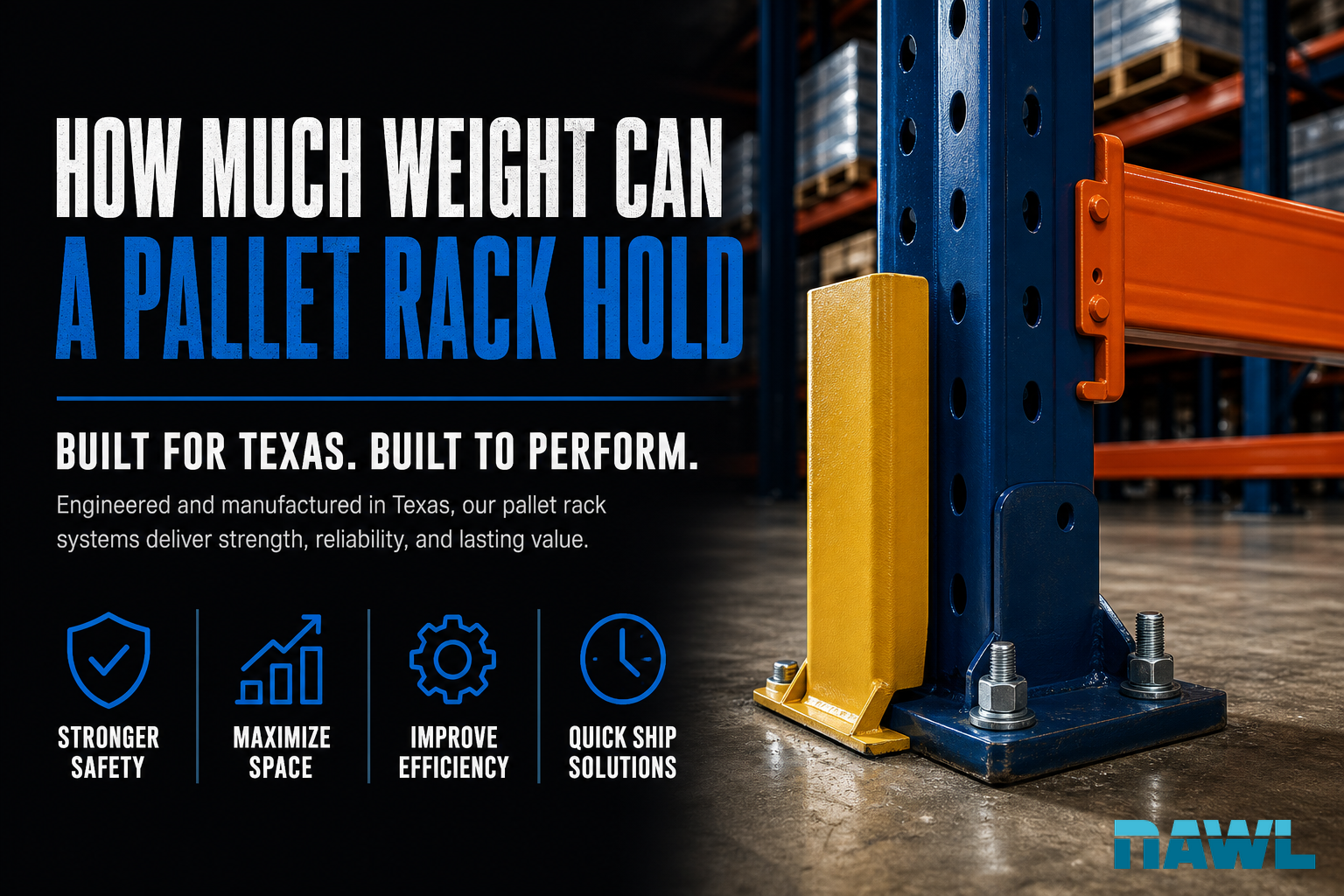
Pallet rack step beams are engineered to hold roughly 900–9,900 lbs per pair, and bolted teardrop upright frames carry 9,240–30,580 lbs total, depending on beam length, tube gauge, pin configuration, frame depth, and first-beam-level height. There's no single answer — capacity is set by the weakest link in the system, and every rack should carry a load placard showing the rated limit for that exact configuration.
Below is a breakdown of real engineered capacity ranges by component, pulled from NAWL's own capacity charts, plus what actually determines the number and how to check the safe working load for your own setup.
Quick Answer: Typical Capacity Ranges
| Component | Typical Capacity | Notes |
|---|---|---|
| Step beam pair (16Ga) | 882–4,426 lbs | Drops as beam length increases (60"–144") |
| Step beam pair (15Ga) | 1,285–6,325 lbs | 3-pin mill tube, length-dependent |
| Step beam pair (14Ga) | 2,233–9,900 lbs | Heaviest gauge, up to 4-pin, 6" mill tube |
| Bolted teardrop upright frame | 9,240–30,580 lbs total | By steel gauge (15–12Ga) and first-beam-level height |
| Cantilever column (8', 9.7" profile) | Up to 14,300 lbs per side | Drops with arm length |
| Cantilever column (12', 11.7" profile) | Up to 18,170 lbs per side | Drops with arm length and height |
| Cantilever arm | 2,640–3,960 lbs | By arm length and spec |
| Wire mesh decking | 1,500–3,000 lbs | Per deck panel, not a substitute for beam rating |
Step beam pair (16Ga)
- Typical Capacity
- 882–4,426 lbs
- Notes
- Drops as beam length increases (60"–144")
Step beam pair (15Ga)
- Typical Capacity
- 1,285–6,325 lbs
- Notes
- 3-pin mill tube, length-dependent
Step beam pair (14Ga)
- Typical Capacity
- 2,233–9,900 lbs
- Notes
- Heaviest gauge, up to 4-pin, 6" mill tube
Bolted teardrop upright frame
- Typical Capacity
- 9,240–30,580 lbs total
- Notes
- By steel gauge (15–12Ga) and first-beam-level height
Cantilever column (8', 9.7" profile)
- Typical Capacity
- Up to 14,300 lbs per side
- Notes
- Drops with arm length
Cantilever column (12', 11.7" profile)
- Typical Capacity
- Up to 18,170 lbs per side
- Notes
- Drops with arm length and height
Cantilever arm
- Typical Capacity
- 2,640–3,960 lbs
- Notes
- By arm length and spec
Wire mesh decking
- Typical Capacity
- 1,500–3,000 lbs
- Notes
- Per deck panel, not a substitute for beam rating
Ranges reflect NAWL's engineered teardrop frame, step beam, and cantilever capacity charts — always confirm the exact rating for your configuration before loading.
These numbers are working load ratings for properly installed rack, not a rough guess at steel strength. They assume the correct beam-to-frame connection, plumb installation, proper anchoring, sound concrete, and an evenly distributed static load. Forklift impact, damaged columns, missing safety pins, out-of-plumb frames, or concentrated point loads can reduce the safe capacity even when the original components were rated correctly.
The Two Numbers That Actually Matter
Every pallet rack system has two separate capacity ratings, and the lower of the two governs what you can safely load:
Beam capacity is the maximum weight a pair of beams can carry at one level, assuming the load is spread evenly across both beams. A beam pair rated at 5,000 lbs means 5,000 lbs combined — not 5,000 lbs per beam, and not 5,000 lbs per pallet if you're running two pallets per level.
Upright frame capacity is the maximum weight the vertical columns can carry across all levels combined. This number isn't fixed — it changes with beam spacing. The more vertical space between beam levels, the lower the frame's capacity, because each unsupported span acts like a longer, more flexible column. Add more beam levels (more support points) and the frame capacity actually goes up.
Because these two ratings interact, a rack that looks "heavy-duty" can still be overloaded if beam levels are spaced too far apart for the frame's rating.
A simple way to think about it is this: beams limit each storage level, while frames limit the whole bay. If a bay has three beam levels and each level is loaded with 4,000 lbs, the upright frame is carrying 12,000 lbs of product load in that bay, plus the rack's own dead load. If the beams are rated for 5,000 lbs per pair, the beam levels are acceptable. But if the frame's capacity for that first-beam-level height is only 9,240 lbs total, the bay is still overloaded.
Worked example: two pallets per level
Assume a bay has two pallets per level, and each pallet weighs 2,200 lbs including product, pallet, packaging, and any overhang. The load per beam level is:
| Item | Calculation | Result |
|---|---|---|
| Pallets per level | 2 | 2 pallets |
| Weight per pallet | 2,200 lbs | 2,200 lbs |
| Total level load | 2 × 2,200 | 4,400 lbs |
| Minimum beam pair rating needed | Greater than 4,400 lbs | Confirm on chart |
Pallets per level
- Calculation
- 2
- Result
- 2 pallets
Weight per pallet
- Calculation
- 2,200 lbs
- Result
- 2,200 lbs
Total level load
- Calculation
- 2 × 2,200
- Result
- 4,400 lbs
Minimum beam pair rating needed
- Calculation
- Greater than 4,400 lbs
- Result
- Confirm on chart
If that bay has four loaded levels, the total product load on the upright frame is 17,600 lbs. The beam rating and frame rating both have to clear the actual load. If either one does not, the storage plan has to change: use shorter or heavier beams, reduce pallet count per level, change beam spacing, or move to a higher-capacity frame.
What Determines a Rack's Weight Capacity
- Beam length, tube size, and gauge — Capacity drops sharply as beam length increases. On NAWL's step beam chart, a 14Ga 6" mill tube beam holds up to 9,900 lbs at 60" but falls to about 6,337 lbs at 144"; a lighter 16Ga 3" beam falls from 4,426 lbs at 60" to just 882 lbs at 144".
- Pin configuration — 4-pin mounting consistently outrates 3-pin on the same beam profile, since the load is anchored at more points along the frame.
- Frame depth and steel gauge — On the teardrop frame chart, moving from 15Ga to 12Ga tube at the same first-beam-level height raises total column capacity from roughly 17,600 lbs to 30,580 lbs.
- First-beam-level height (unsupported span) — The higher the first beam sits off the floor, the lower the frame's total capacity — NAWL's chart shows capacity stepping down from 30,580 lbs at a 36" first level to 19,580 lbs at 96" on the same 12Ga frame.
- Number of beam levels — More levels above the first create more support points along the column, which is why total frame capacity is rated differently than any single level's share of it.
- Anchoring and seismic zone — Ratings assume the rack is anchored per spec, per NAWL's column installation drawing; unanchored or improperly anchored racks don't meet their rated capacity.
- Rack type — Roll-formed teardrop rack, structural rack, and cantilever rack all carry different capacity profiles (see below).
Load placement matters too. Pallet rack beam ratings generally assume a uniformly distributed load across the beam pair. In real warehouses, that means the pallet should sit squarely on both front and rear beams, with the pallet runners oriented correctly. A heavy machine base, drum cluster, die, or gaylord box with small contact points may create a concentrated load that needs additional support, such as decking, pallet supports, or a purpose-built rack design.
Deflection is another practical check. Beams are designed to flex within allowable limits under load, but permanent sag, twisting, cracked welds, damaged beam connectors, or loose lock pins are red flags. If a beam stays bowed after unloading, remove it from service and verify the rack before reloading.
Capacity by Rack Type
Roll-formed (teardrop) pallet rack is the standard, most cost-effective option for palletized loads. NAWL's step beams range from about 882 lbs per pair (16Ga, 144" length) up to 9,900 lbs (14Ga, shorter lengths, 4-pin), and bolted upright frames carry 9,240–30,580 lbs total depending on gauge and first-beam-level height.
Roll-formed rack is commonly selected when the load is palletized, repeatable, and handled in standard warehouse aisles. The teardrop connection makes beam height changes straightforward, but every height change can affect the frame capacity. If a dealer or end user re-slots a warehouse and raises the first beam to clear taller floor-level product, the original placard may no longer apply.
Structural pallet rack uses hot-rolled structural steel channel instead of roll-formed steel, built for higher-impact, higher-capacity environments — the right call for heavy pallets, high-traffic aisles, or facilities with frequent forklift contact. Ask NAWL for structural-specific capacity data on your configuration.
Structural rack is often specified for freezer buildings, bulk storage, drive-in systems, heavy manufacturing, and applications where equipment impact is a known operating condition. It is not automatically unlimited capacity; it still needs engineered beam and upright ratings for the exact bay width, height, connection type, and loading pattern.
Cantilever rack isn't rated the same way because it doesn't carry palletized loads — it's built for long, awkward items like lumber, pipe, and steel bar. NAWL's columns range up to 20,000 lbs per side on shorter, heavier profiles, dropping as column height and arm length increase (a 16' column with 72" arms falls to roughly 10,780 lbs, for example). Arms are rated 2,640–3,960 lbs depending on length and spec. If your inventory is longer than it is wide, cantilever — not pallet rack — is the right system; see our cantilever rack guide and cantilever capacity chart for full specs.
With cantilever, capacity is checked at two places: each arm and the column side. Do not add arms until the combined arm loads exceed the column rating. For example, if four arms on one side are each loaded to 3,000 lbs, that side is carrying 12,000 lbs before considering impact or uneven loading. The column side rating must support that total, and the base must be installed and anchored correctly.
Download the Full Engineered Capacity Charts
The ranges above cover common configurations — for the exact rated capacity of your beam length, gauge, pin count, or column height, use NAWL's full engineered charts:
- Teardrop Frame Capacity Chart (PDF) — upright ratings by gauge and first-beam-level height
- Step Beam Loading Capacity Chart (PDF) — beam ratings by length, gauge, and pin count
- Cantilever Rack Capacity Chart (PDF) — arm and column ratings by length and height
- Column Installation Drawing (PDF) — anchor pattern and footplate detail required to hit rated capacity
Or see the full Resource Center for the current Quick Ship inventory alongside all spec sheets.
When reading a capacity chart, match the part exactly. A 96" beam is not the same as a 108" beam. A 14Ga beam is not the same as a 16Ga beam. A 3-pin connector is not the same as a 4-pin connector. If the beam stamp, label, or original order paperwork is missing, measure the beam length, beam face height, frame depth, and first beam elevation, then verify the component series before assigning a rating.
How to Check Your Rack's Actual Capacity
- Look for the load placard. Every properly installed rack should have one at eye level showing the rated capacity per level and per bay. Missing or illegible placards are a code violation and a sign the rack should be inspected before it's loaded further.
- Match the placard to your actual configuration — beam length, frame height, and beam spacing all have to match what's printed, not just what looks similar.
- Calculate your load per level: multiply pallet weight by the number of pallets per level, and compare against the beam rating — not the frame rating.
- Build in a safety margin. Don't spec loads to the exact rated limit; leave headroom for uneven distribution, impact loading, and measurement error.
- If you don't have documentation, don't guess — contact the manufacturer or a rack engineer with your beam length, gauge, and frame height to get an accurate rating before loading.
A good field check starts at the floor and works up. Confirm anchor bolts are present, tight, and installed in the correct footplate holes. Look for crushed column bases, torn metal, missing shims, bent braces, and signs that frames have been hit by lift trucks. Then check every beam connector for full engagement in the teardrop slots and make sure safety locks are present. Finally, compare actual pallet weights to the posted load placard, not to an estimate from a purchasing list.
| Field item to verify | Why it matters |
|---|---|
| Beam length and face height | Determines beam pair capacity |
| Beam gauge and connector style | Affects load rating and compatibility |
| First beam height | Controls upright frame capacity |
| Number of loaded levels | Adds to total frame load |
| Anchors and footplates | Required for rated performance |
| Damage or out-of-plumb frames | Can reduce safe working capacity |
| Decking or pallet supports | Supports pallets but does not increase beam rating |
Beam length and face height
- Why it matters
- Determines beam pair capacity
Beam gauge and connector style
- Why it matters
- Affects load rating and compatibility
First beam height
- Why it matters
- Controls upright frame capacity
Number of loaded levels
- Why it matters
- Adds to total frame load
Anchors and footplates
- Why it matters
- Required for rated performance
Damage or out-of-plumb frames
- Why it matters
- Can reduce safe working capacity
Decking or pallet supports
- Why it matters
- Supports pallets but does not increase beam rating
Common Mistakes That Lead to Overloading
- Treating a beam pair's total rating as the capacity per beam
- Assuming frame capacity stays constant regardless of beam spacing
- Loading racks that are missing placards or have illegible ratings
- Mixing components from different manufacturers or rack lines without re-verifying the combined rating
- Skipping anchoring, which invalidates the rated capacity entirely
Other common mistakes are less obvious. One is using wire mesh decking as if it raises the rack's load rating. Wire decking helps support pallets, cartons, and hand-stacked product, and NAWL decking ranges from 1,500–3,000 lbs per deck panel, but the beam pair still governs the level. Another mistake is changing storage from light cartons to dense product without updating the placard. The rack did not change, but the load did.
Dealers and facility teams should also watch for mixed bays after relocations or used-rack additions. Similar-looking teardrop rack can have different column gauges, hole patterns, beam connectors, and safety locks. If components are mixed, the system rating should be verified as a system, not assumed from the highest-rated part.
Cost and lead-time context for capacity decisions
The cheapest rack on paper is not always the cheapest rack in service. If beam capacity is too light, the user may lose pallet positions, need more bays, or create unsafe workarounds. If frame capacity is too light, increasing beam levels later may not solve the problem unless the first-beam-level height and total bay load are still within the chart.
For quick-ship projects, the practical question is usually not "What is the strongest rack available?" It is "What stock beam and frame combination safely supports the pallet weights, bay widths, clear heights, and aisle plan?" Shorter beams and heavier gauges generally raise capacity, while longer spans improve selectivity and pallet count. The right choice balances capacity, density, forklift access, and available inventory.
Before ordering, gather these details:
| Required detail | Example |
|---|---|
| Maximum pallet weight | Include pallet and packaging |
| Pallets per level | Usually 2 or 3, depending on bay width |
| Desired beam length | Match pallet width and handling clearance |
| Frame height and depth | Based on building clear height and pallet depth |
| First beam level | Floor clearance or tunnel requirements |
| Number of levels | Total loaded levels per bay |
| Rack type | Roll-formed, structural, or cantilever |
Maximum pallet weight
- Example
- Include pallet and packaging
Pallets per level
- Example
- Usually 2 or 3, depending on bay width
Desired beam length
- Example
- Match pallet width and handling clearance
Frame height and depth
- Example
- Based on building clear height and pallet depth
First beam level
- Example
- Floor clearance or tunnel requirements
Number of levels
- Example
- Total loaded levels per bay
Rack type
- Example
- Roll-formed, structural, or cantilever
Frequently asked questions
How much weight can a standard pallet rack beam hold?
NAWL step beam pairs range from about 882 lbs (16Ga, 144" length, 3-pin) up to 9,900 lbs (14Ga, shorter lengths, 4-pin) — see the step beam capacity chart for your exact length and gauge.
Is pallet rack capacity rated per beam or per pair?
Per pair. The rated capacity assumes the load is distributed across both beams in a level, not concentrated on one.
Does beam spacing affect how much weight my rack can hold?
Yes. On NAWL's teardrop frame chart, raising the first beam level from 36" to 96" off the floor drops a 12Ga frame's total capacity from 30,580 lbs to 19,580 lbs, even though nothing else about the frame changed.
What's the difference in capacity between roll-formed and structural pallet rack?
Roll-formed (teardrop) rack uses lighter-gauge steel and is rated by length, gauge, and pin count, generally topping out under 10,000 lbs per beam pair. Structural rack, built from hot-rolled steel channel, is suited to heavier or higher-impact storage — ask NAWL for structural-specific ratings.
What if my rack doesn't have a load placard?
Don't load it until you confirm the rating. Contact NAWL with your exact beam length, gauge, pin count, and frame specs, or check the full capacity charts, to get a verified capacity before use.
Does wire mesh decking increase pallet rack capacity?
No. Wire mesh decking supports pallets and loose product between beams, but it does not raise the beam pair rating or upright frame rating. Check the deck panel rating and the rack rating separately.
Sourcing pallet rack, structural rack, or cantilever rack for a DFW warehouse? See NAWL's in-stock beam and frame capacities → or download the full spec sheets →
Ready to spec a system? Request a quote and our team will size it with you.