How Much Does Warehouse Pallet Rack Cost? 2026 Price Factors & Quick Ship Guide
July 27, 2026
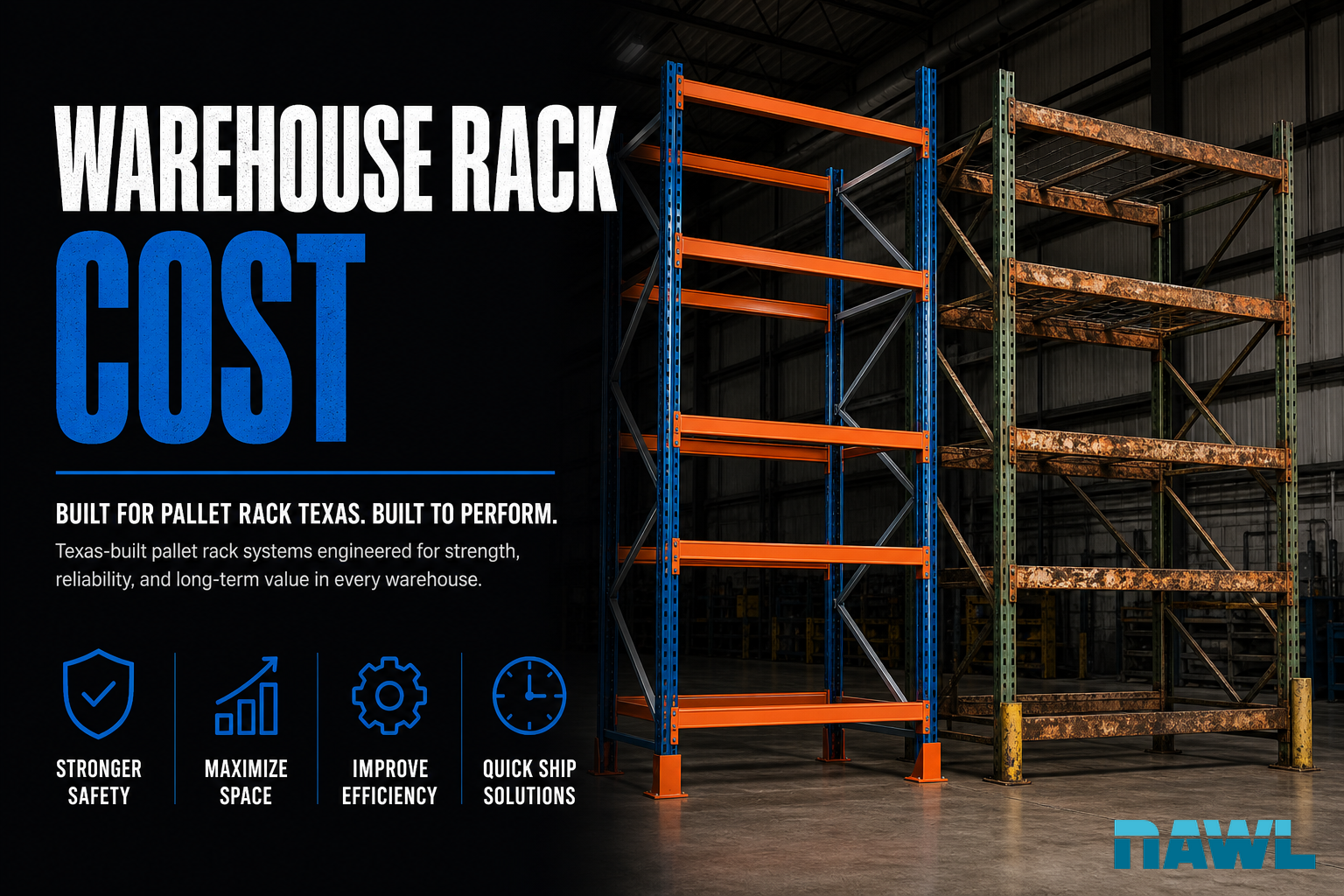
Selective pallet racking typically runs $50–$200 per pallet position (roughly $200–$450 per bay), while drive-in and push-back systems run $200–$500 per position — with steel gauge, upright height, beam capacity, and new-vs-used status doing most of the work to move you up or down that range. A 25,000-sq-ft facility with about 5,000 pallet positions typically lands between $375,000 and $1,000,000 for selective racking equipment alone, before installation.
Below is what actually drives the number for your project, and how NAWL's Quick Ship model changes the cost equation versus custom-ordered rack.
Typical Cost Ranges by System Type
| Rack Type | Typical Cost | Best Fit |
|---|---|---|
| Selective (teardrop) pallet rack | $50–$200 per position | Standard SKU mix, direct access to every pallet |
| Drive-in / push-back | $200–$500 per position | High-density storage, fewer SKUs, FIFO/LIFO tolerant |
| Pallet flow (gravity) | $200–$450 per position | High-turnover, FIFO-critical operations |
| Structural pallet rack | Higher than roll-formed, by project | Heavy pallets, high-impact aisles, forklift-heavy traffic |
| Cantilever rack | Priced by column/arm config, not "position" | Lumber, pipe, bar stock, oversized/long loads |
Selective (teardrop) pallet rack
- Typical Cost
- $50–$200 per position
- Best Fit
- Standard SKU mix, direct access to every pallet
Drive-in / push-back
- Typical Cost
- $200–$500 per position
- Best Fit
- High-density storage, fewer SKUs, FIFO/LIFO tolerant
Pallet flow (gravity)
- Typical Cost
- $200–$450 per position
- Best Fit
- High-turnover, FIFO-critical operations
Structural pallet rack
- Typical Cost
- Higher than roll-formed, by project
- Best Fit
- Heavy pallets, high-impact aisles, forklift-heavy traffic
Cantilever rack
- Typical Cost
- Priced by column/arm config, not "position"
- Best Fit
- Lumber, pipe, bar stock, oversized/long loads
Ranges reflect current industry benchmarks for equipment only, before installation. Installation typically adds 15–35% on top of equipment cost. NAWL sells wholesale rack components rather than published per-position retail pricing — request a quote for your exact configuration.
What Actually Drives Your Cost
- Steel gauge and beam capacity — Heavier gauge and higher-rated beams cost more per linear foot, but oversizing capacity you don't need is money left on the table. Match your rating to your actual pallet weight using NAWL's capacity charts rather than defaulting to the heaviest option.
- Upright height and frame depth — Taller frames and deeper bays use more steel. Going from a 96" upright to a 240" upright is a meaningfully different frame, not just a taller version of the same part.
- New vs. used — Used racking typically runs 30–50% below new pricing, but with tradeoffs on warranty, load placard documentation, and mixed-lot compatibility. New Quick Ship rack from NAWL avoids the compatibility guesswork of buying used frames and beams from different manufacturers.
- Freight and lead time — NAWL's Quick Ship inventory ships from Venus, TX (FOB) within 48–72 hours, which controls two real cost variables: freight distance and the carrying cost of downtime while you wait on custom-ordered steel.
- Installation — Typically adds 15–35% to the equipment cost depending on system complexity; drive-in and push-back systems take longer to install than selective rack because of rail alignment precision.
- Accessories — Wire decking, row spacers, post protectors, safety pins, and anchors are often quoted separately from frames and beams — confirm what's included before comparing quotes apples-to-apples.
New vs. Used: What You're Actually Trading Off
Used pallet rack can cut equipment cost by roughly a third to half, but it shifts risk onto you:
- Load placards — Used rack often arrives without documentation of its rated capacity, which means you either can't verify safe loading or need an engineer to re-certify it.
- Mixed compatibility — Beams and frames from different manufacturers frequently aren't interchangeable even when they look similar, which can mean re-buying components you thought you already had.
- Availability and lead time — Used inventory is whatever happens to be on the market; Quick Ship new inventory is a known SKU with a known ship date.
New Quick Ship rack costs more per unit but removes the re-certification and compatibility guesswork — worth weighing against the upfront savings, especially for racking that will carry rated loads day one.
How NAWL's Quick Ship Model Affects Total Cost
NAWL stocks teardrop uprights, step beams, wire decking, and accessories in Venus, TX, ready to ship in 48–72 hours. That matters for total project cost in two ways most buyers don't price in upfront:
- No custom-tooling premium. Quick Ship SKUs are standard sizes already in inventory, so you're not paying for a custom production run.
- Shorter downtime window. A warehouse waiting 8–10 weeks on custom-ordered structural steel is carrying that cost somewhere — idle space, delayed throughput, or temporary storage workarounds. A 48–72 hour ship window compresses that window significantly.
See the current Quick Ship inventory or the full Resource Center for capacity charts and installation drawings to spec your project before requesting a quote.
Frequently asked questions
How much does pallet racking cost per pallet position?
Selective pallet racking typically runs $50–$200 per position; drive-in and push-back systems run $200–$500 per position due to denser storage and more complex construction.
Is used pallet racking worth it?
It can save 30–50% on equipment cost, but often comes without load placard documentation and may mix frames and beams from incompatible manufacturers — factor in re-certification cost before comparing to new.
Does installation cost extra on top of the rack itself?
Yes — installation typically adds 15–35% to total project cost, varying by system complexity and whether it's selective rack (faster) or drive-in/push-back (more precision-dependent).
Why does NAWL's Quick Ship program matter for cost?
Quick Ship SKUs are already in stock in Venus, TX and ship in 48–72 hours, avoiding both the custom-tooling premium of a made-to-order run and the carrying cost of extended downtime while you wait.
Does cantilever rack get priced the same way as pallet rack?
No — cantilever is priced by column height, arm length, and capacity rather than per pallet position, since it's built for long or irregular loads rather than palletized storage.
Ready to spec your project? Get a quote from NAWL → or check the Quick Ship inventory →