Bryan/College Station Warehouse Racking Solutions
August 13, 2026
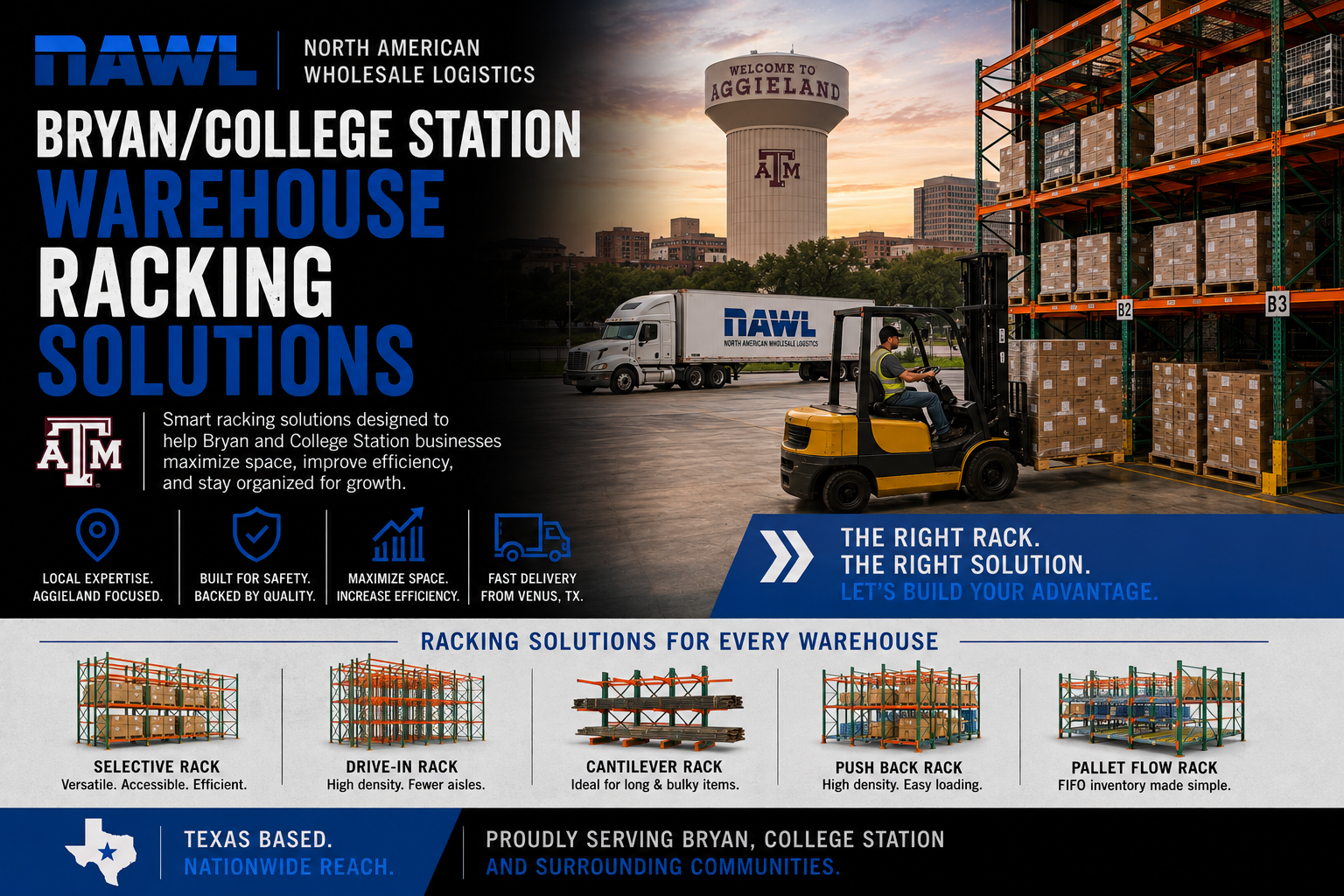
Bryan and College Station represent a dynamic hub of industrial activity, driven by Texas A&M University's research and the region's agricultural roots. As businesses in the Brazos Valley expand, the demand for efficient, reliable warehouse storage intensifies. Optimizing your storage footprint isn't just about saving space; it's about streamlining operations, enhancing safety, and boosting productivity. Selecting the right pallet rack system in Bryan, TX, is a critical investment for any growing enterprise.
For many local operations, storage problems show up gradually. Aisles get tight. Overflow pallets land on the floor. Receiving starts holding trailers longer than planned. Pick paths stretch farther than they should. The right warehouse racking College Station layout can correct those issues before they become daily labor costs, safety risks, or missed shipment windows.
The Brazos Valley's Unique Industrial Landscape
The Brazos Valley industrial sector is characterized by its diversity. From agricultural technology and food processing to distribution centers serving a wider Texas market, the need for robust storage infrastructure is paramount. Texas A&M's presence fuels innovation, leading to new businesses and expanded supply chains requiring sophisticated material handling solutions. Whether you're dealing with bulk agricultural products, specialized research equipment, or general consumer goods, your warehouse racking system in College Station must be adaptable, scalable, and built to last.
Traditional approaches to warehouse storage often fall short when facing rapid growth or evolving inventory profiles. Businesses need systems that can handle various product sizes, weights, and turnover rates while ensuring quick accessibility and worker safety. Investing in well-designed warehouse racking isn't a luxury; it's a strategic necessity for maintaining competitiveness in this expanding market.
Local facilities also have to account for practical constraints: dock locations, clear heights, slab condition, forklift fleet, fire protection layout, and future expansion. A building may have enough square footage on paper but still perform poorly if storage, travel, staging, and picking areas are not balanced. Brazos Valley industrial storage projects should start with the operation, not just the rack.
Common facility types in Bryan and College Station
Different operations need different storage strategies. A food or beverage distributor may need FIFO flow and clear sanitation aisles. An ag-tech manufacturer may need selective pallet rack for components, cantilever rack for long materials, and shelving for small parts. A 3PL or regional distributor may need flexible beam elevations because customer inventory changes from month to month.
The most effective industrial racking Texas projects usually combine several storage methods instead of forcing every SKU into one rack type. Fast movers, slow movers, hand-picked cartons, oversized materials, and reserve pallets should each have a planned location.
Key Considerations for Pallet Rack in Bryan, TX
When evaluating pallet rack options for your Bryan, TX, facility, several factors deserve close attention. The specific characteristics of your inventory, your current and projected throughput, and the physical dimensions of your warehouse all play a role in determining the most effective system.
- Inventory Profile: Understand the dimensions, weight, and fragility of your products. Do you store standard pallets, odd-sized items, or a mix? This dictates beam capacity and rack style.
- Throughput Needs: How quickly do products move in and out of your facility? High-volume operations benefit from systems like selective or push-back racking, while slower-moving items might suit drive-in or pallet flow.
- Space Utilization: Maximize vertical space. Taller racks require specialized material handling equipment but significantly increase storage density.
- Budget and Future Growth: Plan for scalability. A system that can expand with your business prevents costly overhauls down the line.
- Safety Regulations: Ensure your system complies with all local and national safety standards, including seismic considerations specific to Texas.
Those points are the starting line. A usable rack design also needs measurements that match the real-world load, pallet, equipment, and building.
Data to collect before requesting a rack layout
Before selecting storage solutions Bryan businesses should gather a few details. This helps avoid undersized beams, inefficient aisle widths, or rack that interferes with sprinklers and lighting.
| Item to confirm | Why it matters |
|---|---|
| Pallet width, depth, and load height | Determines bay width, beam spacing, and vertical clearance |
| Maximum pallet weight | Drives beam capacity and upright frame selection |
| Number of SKUs and pallets per SKU | Helps decide between selective pallet rack, drive-in racking, push-back, or flow |
| Forklift type and lift height | Sets aisle width and maximum top beam elevation |
| Clear building height | Determines how many pallet levels are practical |
| Slab condition and thickness | Affects anchoring, rack loading, and long-term performance |
| Dock, door, and staging locations | Impacts travel paths and shipping flow |
| Fire protection and lighting | Rack layout must maintain required clearance and access |
Pallet width, depth, and load height
- Why it matters
- Determines bay width, beam spacing, and vertical clearance
Maximum pallet weight
- Why it matters
- Drives beam capacity and upright frame selection
Number of SKUs and pallets per SKU
- Why it matters
- Helps decide between selective pallet rack, drive-in racking, push-back, or flow
Forklift type and lift height
- Why it matters
- Sets aisle width and maximum top beam elevation
Clear building height
- Why it matters
- Determines how many pallet levels are practical
Slab condition and thickness
- Why it matters
- Affects anchoring, rack loading, and long-term performance
Dock, door, and staging locations
- Why it matters
- Impacts travel paths and shipping flow
Fire protection and lighting
- Why it matters
- Rack layout must maintain required clearance and access
A common mistake is designing around average pallet weight instead of maximum pallet weight. Rack must be selected for the heaviest expected load in that location. Another mistake is forgetting pallet overhang. A standard pallet may sit on beams with front and rear overhang, so rack depth and flue space need to be considered together.
Worked example: increasing capacity without moving buildings
Assume a facility has 10,000 square feet available for storage, a 24-foot clear height, and a counterbalance forklift fleet. Floor stacking may appear economical at first, but it often limits access and creates buried inventory. Moving to selective pallet rack with three or four storage levels can multiply usable pallet positions while keeping access to every pallet.
If the facility later adds reach trucks or changes aisle strategy, the same footprint may support tighter aisles and more rack rows, provided the slab, clear height, and building layout can support the change. That is why planning for future equipment and expansion is part of warehouse optimization, not an afterthought.
Optimizing Warehouse Racking in College Station
For businesses in College Station, optimizing warehouse racking means more than just stacking pallets. It involves a strategic approach to design and layout that directly impacts operational efficiency. Here are proven strategies:
Maximize Vertical Space with Selective or Very Narrow Aisle (VNA) Racking
Selective racking is the most common and versatile, offering immediate access to every pallet. It's ideal for a wide range of products and high turnover. For even greater density, Very Narrow Aisle (VNA) systems utilize specialized forklifts to operate in aisles significantly narrower than standard, allowing for more rack rows within the same footprint. This is particularly effective in high-cost real estate areas or where maximizing storage per square foot is paramount.
Selective pallet rack works well when SKU variety is high and the operation needs direct pallet access. It is also easier to reconfigure than denser systems. Beam levels can often be adjusted as inventory changes, and damaged components are generally easier to identify and replace.
VNA can add capacity, but it is not just a rack decision. It requires the right lift equipment, floor conditions, operator training, and a layout that controls traffic. If the operation depends on frequent pallet moves and tight shipping schedules, the productivity gains can be strong. If the facility has heavy cross-traffic or inconsistent floor conditions, standard selective rack may be the better long-term fit.
Enhance Throughput with Flow and Push-Back Racks
If your operation relies on First-In, First-Out (FIFO) or Last-In, First-Out (LIFO) inventory management, consider pallet flow or push-back racking. Pallet flow systems use inclined rollers to move pallets to a picking face, ideal for FIFO. Push-back racks use nested carts on inclined rails, allowing storage multiple pallets deep from a single aisle, perfect for LIFO or high-volume SKUs.
Pallet flow can reduce travel because loading and picking happen from opposite aisles. It is often considered where expiration dates, lot rotation, or production sequence matter. Push-back racking offers higher density than selective rack while preserving more selectivity than drive-in. It can be a strong option for medium-SKU, high-volume inventory where several pallets of the same item are stored together.
Both systems require disciplined pallet quality. Broken bottom boards, inconsistent pallet sizes, or unstable loads can create hang-ups or unsafe handling conditions. If pallet condition varies, that needs to be addressed before choosing a dynamic rack system.
Consider Drive-In/Drive-Thru for High-Density, Low-SKU Storage
For large quantities of identical items, drive-in (LIFO) or drive-thru (FIFO) racking provides exceptional density. Forklifts drive directly into the rack structure, storing pallets several pallets deep. This is commonly used for cold storage, bulk storage of seasonal goods, or products with long shelf lives, making it a viable option for certain Brazos Valley industrial applications, especially in the ag-tech sector.
Drive-in racking is not the best fit for every warehouse. It trades selectivity for density. If the operation frequently needs one specific pallet from the back of a lane, labor time will rise. But when pallets are uniform and turns are predictable, drive-in can reduce the amount of square footage needed for reserve storage.
Match rack type to the job
| Rack type | Best fit | Main advantage | Watch-outs |
|---|---|---|---|
| Selective pallet rack | High SKU count, direct access | Flexibility and simple operation | Lower density than deep-lane systems |
| Push-back rack | Multiple pallets per SKU | Dense storage with single-aisle access | Usually LIFO by lane |
| Pallet flow | FIFO rotation, high throughput | Strong picking and replenishment flow | Requires good pallet quality and controls |
| Drive-in racking | Low SKU count, bulk storage | Very high density | Limited selectivity and careful forklift operation |
| Cantilever rack | Pipe, lumber, tubing, long loads | Open front storage for long materials | Load length and arm capacity must be specified |
Selective pallet rack
- Best fit
- High SKU count, direct access
- Main advantage
- Flexibility and simple operation
- Watch-outs
- Lower density than deep-lane systems
Push-back rack
- Best fit
- Multiple pallets per SKU
- Main advantage
- Dense storage with single-aisle access
- Watch-outs
- Usually LIFO by lane
Pallet flow
- Best fit
- FIFO rotation, high throughput
- Main advantage
- Strong picking and replenishment flow
- Watch-outs
- Requires good pallet quality and controls
Drive-in racking
- Best fit
- Low SKU count, bulk storage
- Main advantage
- Very high density
- Watch-outs
- Limited selectivity and careful forklift operation
Cantilever rack
- Best fit
- Pipe, lumber, tubing, long loads
- Main advantage
- Open front storage for long materials
- Watch-outs
- Load length and arm capacity must be specified
Layout, safety, and installation details that matter
A rack system is only as good as its layout and installation. Poor aisle planning can slow every forklift move. Insufficient staging space can create congestion around docks. Missing protection at high-traffic corners can lead to upright damage.
Key layout decisions include:
- Main travel aisles wide enough for two-way traffic where needed.
- Receiving and shipping staging sized for peak days, not only average days.
- Pick paths that separate pedestrians from forklift traffic wherever practical.
- Flue spaces maintained for fire protection performance.
- Upright protection at end-of-aisles, tunnels, and impact-prone locations.
- Beam elevations set to allow pallet clearance without wasting vertical space.
Installation should include proper anchoring, plumb and level checks, beam safety locks, and confirmation that installed elevations match the approved layout. Load capacity plaques should be posted where operators can see them. Operators should understand that beam capacities depend on proper beam placement and that field modifications should not be made without review.
Routine inspection is also part of the system. Bent uprights, twisted braces, missing anchors, dislodged beams, damaged safety clips, and overloaded bays should be documented and corrected. A simple monthly internal check, supported by a more formal review when conditions change, helps catch small damage before it becomes a larger problem.
Cost and lead-time context
Rack cost depends on steel size, frame height and depth, beam capacity, accessories, freight, installation scope, and whether the project uses standard quick-ship components or custom configurations. The least expensive rack on a quote is not always the lowest-cost system to operate. If it wastes vertical space, creates extra touches, or cannot expand, the savings disappear quickly.
Lead time matters for growing operations in Bryan and College Station. A distributor adding a new customer, a manufacturer launching a new product, or a processor entering a seasonal peak may not have months to wait. Stocked components and standard designs can shorten the path from layout approval to installation. Custom requirements may still be necessary for unique loads, but many storage projects can be built around available frames, beams, wire decking, row spacers, and protection components.
NAWL: Your Partner for Brazos Valley Industrial Storage
At NAWL, we understand the specific challenges and opportunities within the Bryan/College Station market. We provide comprehensive warehouse racking solutions, from initial design and layout consultation to installation and ongoing support. Our expert team ensures your pallet rack system in Bryan, TX, is not only robust and safe but also perfectly aligned with your operational goals. We focus on delivering practical, durable solutions that contribute directly to your bottom line, helping your Brazos Valley industrial business thrive.
Choosing the right partner for your warehouse racking needs in College Station is crucial. We offer tailored systems designed to maximize your storage capacity, improve workflow, and enhance safety across your facility. Our commitment to quality and service ensures that your investment in NAWL racking will serve your business effectively for years to come.
NAWL manufactures pallet rack in Venus, Texas and sells through dealers, with quick-ship options available from stock. That matters when a project needs practical support, clear specifications, and a faster path to usable storage. Whether the need is a few added bays, a full warehouse design, or a phased expansion, the goal is the same: rack that fits the load, the building, the equipment, and the way your team actually works.
Conclusion
The industrial landscape of Bryan/College Station demands efficient and reliable storage solutions. By carefully considering your operational needs and partnering with an experienced provider, you can implement a warehouse racking system that drives productivity and supports your growth. Investing in the right pallet rack setup in Bryan, TX, is a strategic decision that pays dividends in operational efficiency and long-term success.
Ready to optimize your warehouse storage? Contact NAWL today for a free consultation and let us help you design the ideal warehouse racking solution for your Brazos Valley industrial business. Request a quote to get started.
Related reading
- Austin & Round Rock 3PL Racking: Fast Delivery from Venus, TX
- Waco Pallet Rack Options: Optimizing I-35 Logistics
- Optimizing Killeen and Temple, TX, Warehouse Racking
- Warehouse Layout Guide: Optimize Space & Efficiency
Browse our selective pallet rack line, cantilever rack for long loads, and quick-ship inventory from Venus, TX. Ready to spec a system? Request a quote.
Frequently asked questions
What type of pallet rack is best for a Bryan or College Station warehouse?
Selective pallet rack is often the starting point because it gives direct access to every pallet and handles changing inventory well. Higher-density options like push-back, pallet flow, or drive-in racking make sense when SKU mix, pallet turns, and space constraints justify them.
How do I know what beam capacity I need?
Start with the heaviest pallet load expected in each bay, not the average load. Beam capacity depends on beam length, load weight, load distribution, and the number of pallet positions per level. Provide actual pallet weights and dimensions before finalizing a design.
Can an existing warehouse add more pallet positions without expanding?
Often, yes. Capacity may be improved by using vertical clear height, adjusting beam elevations, changing aisle strategy, or adding denser rack in the right areas. The building height, forklift type, slab, fire protection, and workflow all need to be reviewed first.
When is drive-in racking a good choice?
Drive-in racking is a good fit for high-density storage of large quantities of similar products. It is less suitable when you need frequent access to individual pallets across many SKUs.
What information should I provide for a warehouse design?
Provide a building layout, clear height, pallet sizes and weights, forklift types, SKU counts, inventory turns, dock locations, and any known sprinkler or code constraints. Photos of the space and current storage issues are also useful.
Does NAWL support quick-ship rack needs in Texas?
Yes. NAWL manufactures in Venus, Texas and offers quick-ship inventory from stock, which can help dealers and end users move faster on standard pallet rack projects.