Optimizing Killeen and Temple, TX, Warehouse Racking
July 28, 2026
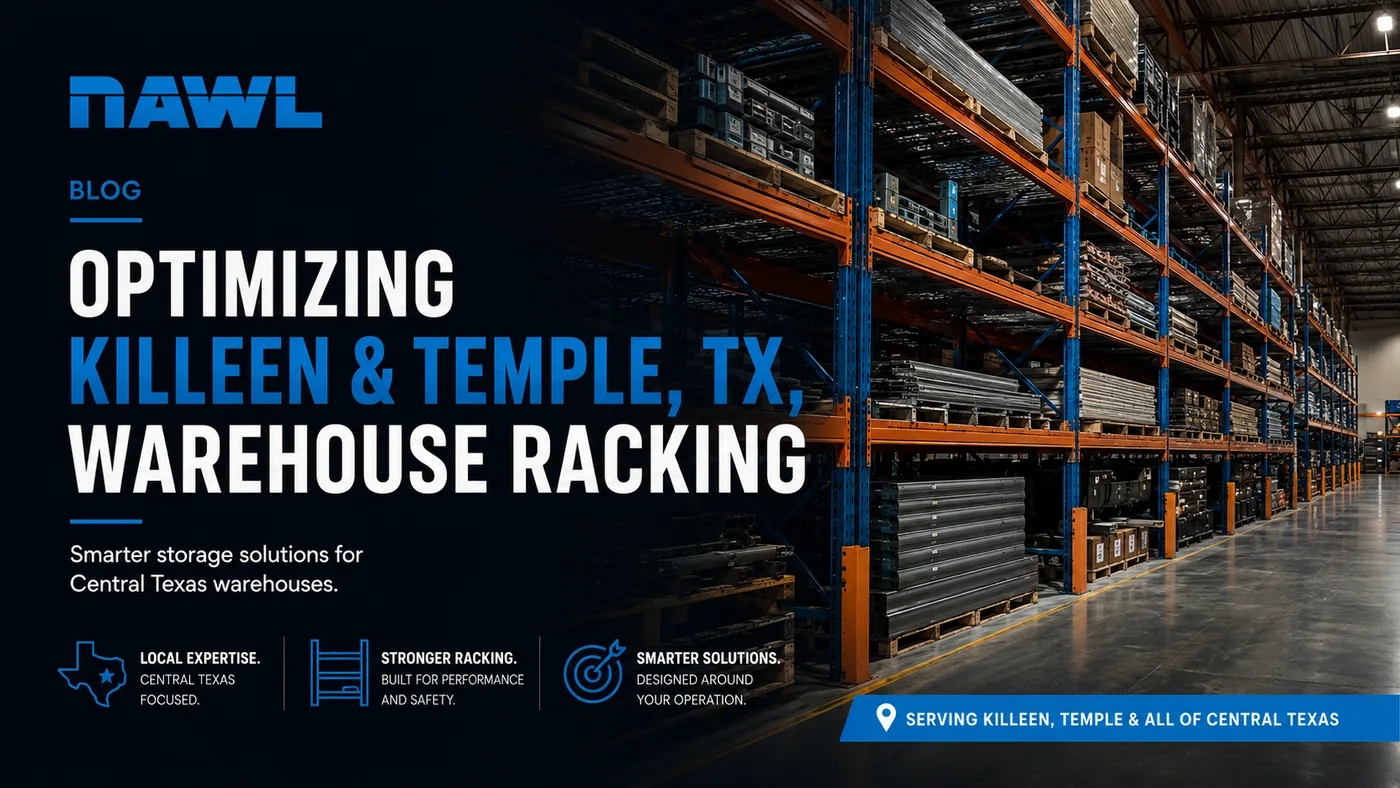
The rapid growth of Central Texas, particularly in Killeen and Temple, presents both opportunities and challenges for distribution centers. With its strategic location along the I-35 corridor and proximity to Fort Hood, this region has become a hotbed for logistics and 3PL operations. Optimizing your warehouse racking in Temple or Killeen, TX, is no longer a luxury; it's a necessity for efficient operations and continued expansion.
This guide will walk warehouse managers through key considerations for selecting and implementing robust pallet rack solutions tailored to the unique demands of this dynamic market.
Understanding the Central Texas Logistics Landscape
The I-35 corridor is a major artery for goods movement, making cities like Killeen and Temple prime locations for distribution centers. The presence of Fort Hood, one of the largest military installations in the world, drives significant demand for goods and services, further accelerating regional growth. This environment favors agile and scalable warehousing operations.
Moreover, the rise of third-party logistics (3PL) providers in Central Texas highlights a broader trend: businesses are increasingly outsourcing their warehousing and distribution. These 3PLs require highly efficient, adaptable storage systems to handle diverse product inventories for multiple clients. Your Killeen pallet rack systems must be designed to accommodate rapid throughput and potential changes in inventory profiles.
Central Texas operations also tend to serve a wide mix of freight: retail replenishment, military support goods, building products, food and beverage, e-commerce, parts distribution, and regional cross-dock activity. That mix creates a practical challenge. A rack layout that works for slow-moving full-pallet storage may not work for a 3PL that changes customers every quarter. Before buying pallet rack, define how the building will actually operate.
Key operating questions include:
- How many unique SKUs will be stored?
- What percentage of inventory moves by full pallet, case pick, or each pick?
- What is the heaviest pallet weight in the facility, including the pallet and packaging?
- What pallet sizes are used: standard 48 x 40, oversized, drums, crates, or mixed freight?
- What lift trucks are in use now, and what equipment may be added later?
- Is the building used for storage only, or will it include staging, kitting, returns, or light manufacturing?
The answers affect upright depth, beam length, beam capacity, aisle width, load clearances, and the total number of pallet positions. For many Killeen and Temple warehouses, the best system is not the densest possible rack. It is the system that balances storage capacity, selectivity, labor efficiency, and safe forklift movement.
Key Considerations for Pallet Rack in Killeen and Temple, TX
When planning or upgrading your warehouse racking in Temple or Killeen, TX, several factors must guide your decision-making. These aren't just about storing products; they're about optimizing every square foot for maximum return.
Maximize Vertical Space
Land costs are rising. Maximizing vertical storage is critical for a Central Texas distribution center. Selective pallet rack remains a popular choice for its direct access to every pallet, but evaluate high-density options like drive-in, push-back, or pallet flow systems if you handle large quantities of SKUs with fewer picks. Very-narrow-aisle (VNA) systems can also significantly increase storage density, though they require specialized equipment.
Start with clear height, not roof height. Clear height is the usable vertical space below joists, lights, sprinklers, HVAC, fans, and other obstructions. A building advertised with 28-foot height may not support 28 feet of rack if sprinkler clearances, fire code requirements, or equipment limitations reduce usable space.
A practical way to evaluate vertical use is to build a pallet profile. For example, a warehouse storing 48-inch-tall pallets may be able to fit more beam levels than a warehouse storing 72-inch-tall pallets, even in the same building. You also need lift-off clearance, typically several inches between the top of the load and the beam above, so operators can place and remove pallets without striking the rack.
Common pallet rack options for Central Texas warehouses include:
| Rack type | Best fit | Main advantage | Tradeoff |
|---|---|---|---|
| Selective pallet rack | Many SKUs, frequent access | Direct access to each pallet | Lower density than deep storage |
| Double-deep rack | Moderate SKU count, paired pallets | More positions in less floor space | Requires reach truck and reduced selectivity |
| Drive-in rack | High volume of the same SKU | Very dense storage | Last-in, first-out flow and more rack exposure to impacts |
| Push-back rack | Medium to high volume SKUs | Dense storage with aisle access | Higher equipment cost than selective rack |
| Pallet flow rack | FIFO inventory rotation | Strong for food, beverage, and date-sensitive goods | Requires careful design and maintenance |
| VNA selective rack | High SKU count with high storage density | More pallet positions without losing selectivity | Requires special trucks and flat floors |
Selective pallet rack
- Best fit
- Many SKUs, frequent access
- Main advantage
- Direct access to each pallet
- Tradeoff
- Lower density than deep storage
Double-deep rack
- Best fit
- Moderate SKU count, paired pallets
- Main advantage
- More positions in less floor space
- Tradeoff
- Requires reach truck and reduced selectivity
Drive-in rack
- Best fit
- High volume of the same SKU
- Main advantage
- Very dense storage
- Tradeoff
- Last-in, first-out flow and more rack exposure to impacts
Push-back rack
- Best fit
- Medium to high volume SKUs
- Main advantage
- Dense storage with aisle access
- Tradeoff
- Higher equipment cost than selective rack
Pallet flow rack
- Best fit
- FIFO inventory rotation
- Main advantage
- Strong for food, beverage, and date-sensitive goods
- Tradeoff
- Requires careful design and maintenance
VNA selective rack
- Best fit
- High SKU count with high storage density
- Main advantage
- More pallet positions without losing selectivity
- Tradeoff
- Requires special trucks and flat floors
A good layout will also protect dock and staging space. It is common to see warehouses over-racked on paper and then struggle because receiving, shipping, quality checks, and order staging were squeezed too tight. Pallet rack should support throughput, not just storage count.
Durability and Load Capacity
Given the high-throughput nature of many Central Texas DCs, durability is paramount. Heavy-duty Killeen pallet rack units made from robust steel are essential to withstand constant fork truck traffic and heavy loads. Understand your maximum pallet weight and ensure your racking system is appropriately rated. Consider options like column protectors, end-of-aisle guards, and heavy-duty footplates to prevent damage and extend the life of your investment.
Load capacity is not a guess. It depends on the upright frame, beam length, beam profile, steel gauge, connector type, anchoring, beam spacing, and the actual load pattern. A pair of beams rated for a certain capacity must be used with compatible uprights that can support the full bay load. Changing beam elevations later can affect upright capacity, especially if the first beam level is raised significantly.
A simple worked example shows why this matters. Suppose a bay uses 96-inch beams and stores two pallets per level. If each pallet weighs 2,500 pounds, each beam level must support 5,000 pounds, plus any allowance required by the rack design. If the bay has three storage levels above the floor, the upright frames may be carrying 15,000 pounds of product in that bay. If pallet weights later increase to 3,000 pounds, the same bay may now be carrying 18,000 pounds. That change should be reviewed before the heavier loads are placed into service.
Damage prevention is also part of capacity management. In a busy warehouse, the most common rack issues are bent front columns, damaged lower braces, twisted beams, missing beam locks, loose anchors, and impacts at row ends. These problems reduce the reliability of the system and should not be treated as cosmetic.
Recommended protection points include:
- Row ends near main aisles and dock traffic
- Tunnel bays and transfer aisles
- Uprights adjacent to staging lanes
- Pick modules or hand-stack areas with frequent pallet jack movement
- Any location where drivers turn with a load elevated
For Texas pallet rack projects, NAWL can support dealers and warehouse teams with durable rack components suited for demanding industrial use, including common selective rack configurations that can quick-ship from stock when schedules are tight.
Flexibility and Scalability
Growth in this region is constant. Your warehouse racking in Temple, TX, should be designed with future expansion in mind. Modular systems that can be easily reconfigured or expanded are ideal. Consider components that allow for adjustments in beam levels without major overhauls. This approach minimizes downtime and capital expenditure when your storage needs evolve.
Flexibility starts with consistent rack standards. If one phase uses one frame depth, beam length, and connection style, and the next phase uses a different standard, the warehouse may end up with islands of incompatible equipment. That makes expansion harder and increases the chance of improper field modifications.
For growing operations in Killeen and Temple, it is often smart to standardize around a small number of rack components:
- One or two upright depths, such as 42-inch frames for standard 48 x 40 pallets
- Common beam lengths, such as 96-inch or 108-inch beams, based on pallet width and load overhang
- Standard beam capacities that cover normal and heavy SKUs
- Consistent decking approach, such as wire decking where required for mixed storage
- Matching row spacers, anchors, guards, and safety accessories
Scalability also depends on the building plan. If the current phase only fills half the warehouse, plan the rack orientation, flue spaces, and main aisles so future rows can extend without blocking doors, electrical panels, fire exits, or sprinkler access. A low-cost first phase can become expensive if it must be torn out and reinstalled during the second phase.
Strategic Racking Solutions for Modern DCs
Beyond basic storage, modern distribution centers require intelligent racking that integrates with their overall operational strategy.
Integration with Automation
If you are considering or already utilizing automation (e.g., AS/RS, robotic forklifts), your Killeen pallet rack system must be compatible with it. This often means tighter tolerances, specific aisle widths, and reinforced structures. Plan this integration early to avoid costly retrofits.
Automation-ready racking requires more discipline than a conventional forklift layout. Robotic lift equipment and AS/RS systems depend on repeatable rack geometry. Uprights must be plumb, beams must be level, pallet locations must be consistent, and clearances must account for pallet quality. Damaged or inconsistent pallets can create problems even when the rack is correctly built.
For operations that may automate later, the design should consider:
- Aisle width and turning radius for future equipment
- Floor flatness requirements for narrow-aisle or automated vehicles
- Load overhang limits and pallet quality standards
- Rack tolerances and anchoring requirements
- Barcode, RFID, or location label placement
- Protection for sensors, chargers, conveyors, and controls
Not every warehouse needs automation on day one. Many Central Texas facilities benefit first from a clean selective rack layout, better slotting, clear labels, and properly sized staging areas. But if automation is likely within a few years, tell your rack supplier during the first design conversation.
Safety Compliance
Safety is not negotiable. Ensure your warehouse racking in Temple, TX, or anywhere, for that matter, complies with all OSHA regulations and RMI (Rack Manufacturers Institute) standards. This includes proper installation, regular inspections, and adherence to load capacity limits. A well-designed, compliant system protects your employees and prevents costly accidents and liabilities.
A safe rack program includes more than buying rated components. The system should be installed according to the design drawings, anchored correctly, and used within posted capacities. Load plaques should be visible and understandable to supervisors and operators. If beam levels are changed, or if heavier product is introduced, the capacity information should be reviewed.
Routine inspection should cover:
- Upright columns for dents, twists, or out-of-plumb conditions
- Horizontal and diagonal bracing for bends or broken welds
- Beam connectors, safety pins, and beam deflection
- Anchors, footplates, and concrete condition
- Row spacers and back-to-back row alignment
- Wire decks, pallet supports, and load placement
- Clearance from sprinklers, lights, doors, and building systems
Forklift operators should be trained to report rack impacts immediately. A hit that looks minor from the cab can create a serious issue at the base plate or connector. Damaged components should not be welded, heated, drilled, or modified in the field unless that repair is approved by qualified engineering guidance. In most cases, replacement with compatible components is the safer and cleaner path.
Expert Design and Installation
Partnering with an experienced supplier for your Central Texas distribution center is crucial. A reputable firm understands the local market dynamics, can design a system that maximizes your specific footprint, and ensures professional installation. They will conduct proper site surveys, perform engineering calculations, and provide post-installation support.
A strong pallet rack project starts with accurate information. Before requesting a quote, gather the building drawing if available, clear height, column grid, dock locations, door swings, fire exits, slab condition, lift truck models, pallet weights, pallet dimensions, and target pallet position count. Photos and a marked-up sketch are useful, but measurements still matter.
The design process should usually include these steps:
- Confirm storage goals, inventory type, and throughput requirements.
- Measure the building and identify obstructions.
- Select rack type and preliminary aisle widths based on lift equipment.
- Calculate pallet positions and review staging space.
- Confirm beam capacities, upright capacities, and accessories.
- Review code, fire, and sprinkler considerations with the proper local professionals.
- Schedule delivery and installation to reduce disruption.
- Inspect the finished system and post capacity information.
Installation quality has a direct effect on safety and performance. Frames should be set plumb, rows should be aligned, anchors should be installed correctly, and beams should be seated with locking devices in place. Installers also need to coordinate with warehouse operations so active facilities can keep shipping without creating unsafe traffic conflicts.
Lead time is another reason to plan early. Standard selective pallet rack is usually the fastest path because common frames, beams, wire decks, and accessories are often available from stock. Custom colors, unusual capacities, tall frames, engineered high-density systems, and large multi-phase projects may require longer planning and production time. NAWL manufactures pallet rack in Venus, Texas and supports dealer-supplied projects with stock programs that can help Central Texas warehouses move faster when timelines are tight.
Cost should be judged on total installed value, not rack price alone. A cheaper layout that creates longer travel paths, too many touches, or constant forklift damage may cost more over time. The right design improves storage density, protects product, reduces congestion, and gives operators room to work safely.
Common mistakes to avoid include:
- Designing around average pallet weight instead of maximum pallet weight
- Ignoring nonstandard pallets, overhang, drums, or unstable loads
- Reducing aisle width without confirming lift truck requirements
- Filling too much floor space with rack and leaving too little staging room
- Mixing incompatible used rack components without capacity documentation
- Moving beam levels without reviewing upright capacity
- Waiting until the week before move-in to order rack
The Central Texas market, with its strategic advantages and continuous growth, demands advanced and durable warehouse racking solutions. By focusing on maximizing space, ensuring durability, planning for flexibility, and integrating with future technologies, you can equip your Killeen or Temple, TX, distribution center for sustained success.
Ready to optimize your Central Texas distribution center? Contact us today for a quote on high-performance pallet rack solutions tailored to your Killeen or Temple, TX, operations.
Frequently asked questions
What type of pallet rack is best for a Killeen or Temple warehouse?
Selective pallet rack is the most common starting point because it gives direct access to every pallet and works for many SKU profiles. High-density systems like drive-in, push-back, or pallet flow may be better when you have larger quantities of the same SKU and need more storage per square foot.
How do I know what rack capacity I need?
Start with the heaviest loaded pallet you expect to store, not the average pallet. Multiply that by the number of pallets per beam level, then confirm the beams, uprights, anchors, and layout are rated for the full load condition.
Can I expand my rack system later?
Yes, if the first phase is designed with expansion in mind. Use compatible components, keep rack orientation consistent, and leave room for future aisles, fire access, staging, and building systems.
Should I use new or used pallet rack?
Used rack can work in some cases, but it must be compatible, undamaged, and supported by reliable capacity information. New rack is often the cleaner choice when capacity, consistency, lead time, and future expansion are important.
How often should warehouse racking be inspected?
Rack should be observed continuously by trained operators and inspected on a regular schedule by supervisors or qualified personnel. Any forklift impact, visible damage, missing safety lock, or overloaded bay should be addressed immediately.
Does NAWL serve Central Texas pallet rack projects?
Yes. NAWL manufactures pallet rack in Texas and supports dealer-led projects for Central Texas warehouses, including Killeen and Temple operations that need durable rack and practical lead-time options.