Austin & Round Rock 3PL Racking: Fast Delivery from Venus, TX
August 6, 2026
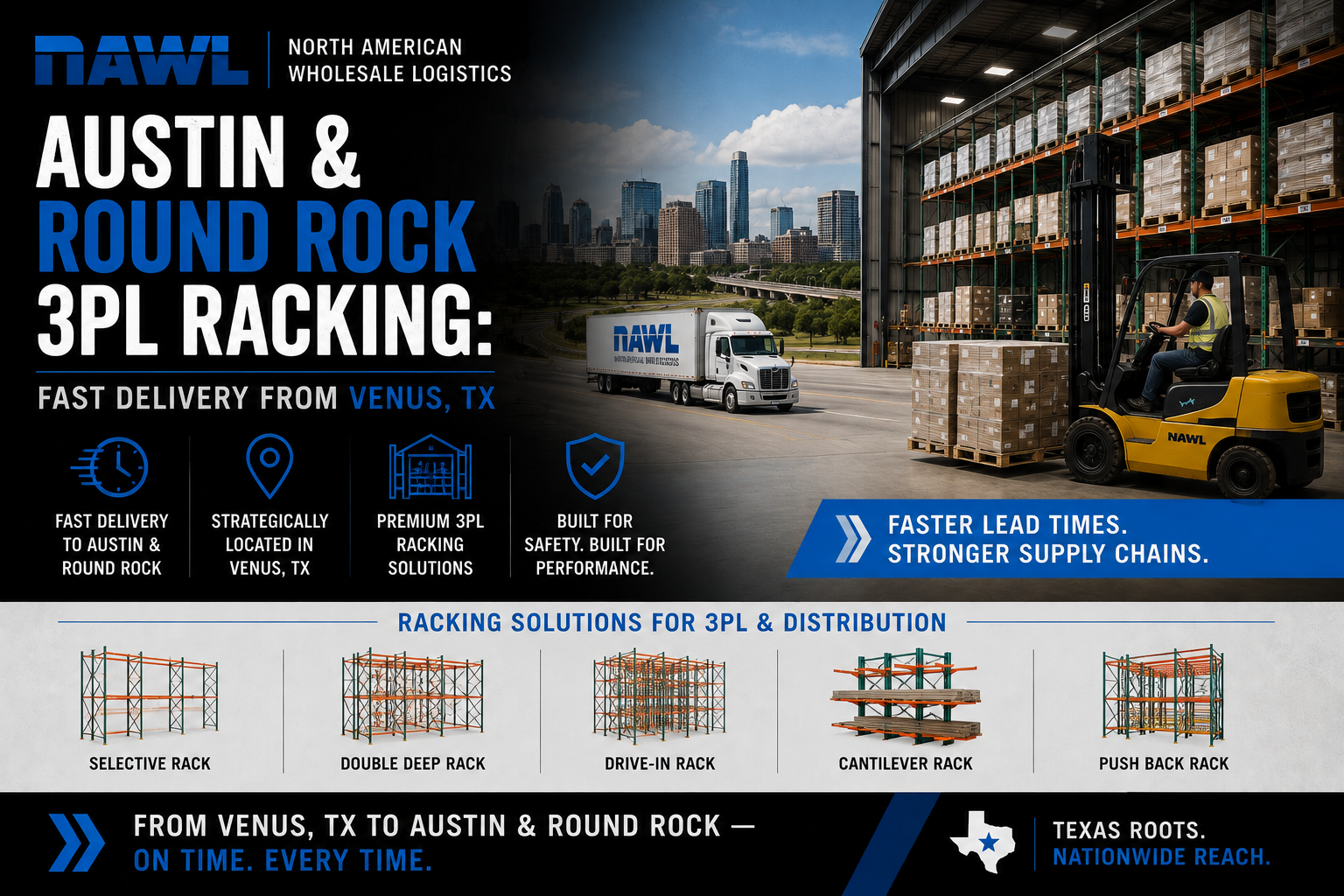
Strategic Pallet Racking for Central Texas 3PLs
The Austin and Round Rock markets are experiencing unprecedented growth, driven by expansion in semiconductor manufacturing and e-commerce fulfillment. That growth puts real pressure on third-party logistics (3PL) providers. New contracts often come with fixed start dates, fast inventory turns, and little tolerance for warehouse delays. For these businesses, having immediate access to high-quality pallet rack solutions is not a luxury; it is a necessity.
NAWL understands this urgency. While Austin and Round Rock sit at the edge of the typical 200-mile immediate delivery zone for some distributors, our strategic location in Venus, Texas, ensures that Central Texas warehouse operations, especially those needing 3PL racking in Round Rock and pallet rack in Austin, TX, receive their equipment when they need it most.
For a 3PL, rack is not just storage steel. It is the framework that determines receiving speed, putaway accuracy, pick travel, damage control, and how fast a new customer can be brought online. A missed rack delivery can hold up lift truck paths, sprinkler reviews, dock scheduling, striping, and labor planning. That is why availability, clear specifications, and practical delivery coordination matter as much as price per upright.
NAWL supports dealers and end users with quick-ship pallet rack from stock, manufactured and distributed from Venus, TX. For Central Texas projects, that combination of Texas-based inventory and experienced rack support helps reduce the friction that slows down warehouse expansions.
The Central Texas Growth Imperative
The economic landscape of Central Texas, particularly around Austin and Round Rock, is dynamic. Major technology companies are investing heavily, bringing with them a massive increase in demand for everything from raw material storage to finished goods distribution. This growth translates directly into a need for robust, flexible, and scalable warehousing infrastructure.
3PLs are on the front lines, tasked with managing complex supply chains for these expanding industries. Their ability to secure and deploy new pallet racking quickly is a key competitive differentiator. Delays in receiving racking mean delays in onboarding new clients, which translate to lost revenue and competitive disadvantage. Our focus is on mitigating those delays.
Central Texas 3PLs commonly serve a mix of product profiles. One customer may need dense storage for repeat pallets. Another may need selective access for a broad SKU base. A manufacturer may require staged storage for inbound components and outbound finished goods. E-commerce customers may shift between pallet storage, case pick, and replenishment zones as order volume changes.
Those realities create three practical rack requirements:
- Flexibility: Beam levels, bay layouts, and aisle plans need to adapt as customer profiles change.
- Availability: Common rack components should be accessible quickly, especially when a lease is signed or a new contract starts.
- Durability: 3PL environments see frequent forklift traffic, product changeovers, and higher handling intensity than many private warehouses.
A strong rack plan should also account for future expansion. Many operations start with selective rack because it gives immediate pallet access and is easy to re-slot. As volume grows, some areas can be converted to higher-density systems such as drive-in, pallet flow, or push back rack. Planning for that path early can reduce later disruption.
Why Venus, TX, Is Your Strategic Advantage
Our manufacturing and distribution facility in Venus, Texas, is not just another warehouse. It is a strategic hub positioned to serve the entire Texas market efficiently, with a particular focus on the critical Central Texas corridor. For businesses seeking pallet rack in Austin, TX, or 3PL racking in Round Rock, our Venus location offers several distinct advantages:
- Proximity: While not immediately adjacent, Venus provides a significantly shorter transit time to Austin and Round Rock compared to manufacturers located outside of Texas or even in more distant parts of the state. This proximity is critical when project timelines are tight.
- Dedicated Inventory: We maintain substantial inventories of common pallet rack components. This is not just a promise; it is a commitment to supporting the rapid growth experienced by our 3PL partners. We anticipate demand and stock accordingly.
- Efficient Logistics: Our internal logistics network is optimized for fast dispatch and delivery. We understand the specific routes and logistical challenges associated with serving the Austin and Round Rock areas, ensuring that your order moves from our facility to yours with maximum efficiency.
The delivery advantage is not only about distance. It is also about how quickly an order can be identified, pulled, staged, loaded, and dispatched. When rack is coming from out of state, a project can depend on production slots, long-haul carrier timing, and freight consolidation. With Texas-based stock, common selective rack orders can often move through the process with fewer handoffs.
For Austin and Round Rock warehouses, lead time also affects project sequencing. Rack often has to arrive after the slab is ready, but before electricians, conveyor installers, striping crews, or customer inventory move in. A supplier that understands Texas delivery lanes helps keep that sequence realistic.
Key delivery planning details include:
- Site access for flatbeds or dedicated trucks
- Forklift capacity to unload uprights, beams, and accessories
- Staging space near the installation area
- Delivery windows that do not conflict with live dock operations
- Clear labeling and packing to support fast installation
A rack order may be simple on paper, but the jobsite details decide whether the material is useful the same day it lands.
Tailored Solutions for 3PL Operations
3PL providers have unique requirements that differentiate them from traditional warehouse operations. They need systems that are adaptable, durable, and often reconfigurable to meet varying client needs. Our range of pallet racking solutions is designed with these demands in mind:
- Selective Pallet Rack: The workhorse of most warehouses, offering immediate access to every pallet. Ideal for high SKU counts and diverse product ranges common in 3PL environments.
- Drive-In/Drive-Thru Rack: Maximizes storage density for businesses handling fewer SKUs with large quantities of each, often seen in specific e-commerce or manufacturing support roles.
- Pallet Flow & Push Back Rack: Excellent for optimizing space and improving pick efficiency, suitable for first-in, first-out (FIFO) and last-in, first-out (LIFO) applications, respectively. These systems can dramatically reduce labor costs in high-volume operations.
We do not just sell rack; we consult with you to understand your specific operational flows, inventory characteristics, and future growth projections to recommend the optimal solution for your Central Texas warehouse.
A good 3PL rack design starts with product movement, not just pallet count. Before selecting a system, define how inventory will enter, sit, replenish, and leave the building. The answers will point toward the correct rack type, bay depth, beam spacing, aisle width, and safety accessories.
| Rack type | Best fit | Strengths | Planning considerations |
|---|---|---|---|
| Selective pallet rack | High SKU counts, mixed clients, frequent access | Direct access to every pallet, easy to expand or reconfigure | Lower storage density than deep-lane systems |
| Drive-in/drive-thru rack | Large quantities of similar products | High density and efficient cube use | Requires disciplined traffic flow and product rotation planning |
| Push back rack | Medium SKU counts with multiple pallets per SKU | Dense storage with front-facing access | Typically used for LIFO inventory rotation |
| Pallet flow rack | High-volume FIFO lanes | Strong rotation control and reduced travel | Requires careful pallet quality, flow lane design, and braking components |
Selective pallet rack
- Best fit
- High SKU counts, mixed clients, frequent access
- Strengths
- Direct access to every pallet, easy to expand or reconfigure
- Planning considerations
- Lower storage density than deep-lane systems
Drive-in/drive-thru rack
- Best fit
- Large quantities of similar products
- Strengths
- High density and efficient cube use
- Planning considerations
- Requires disciplined traffic flow and product rotation planning
Push back rack
- Best fit
- Medium SKU counts with multiple pallets per SKU
- Strengths
- Dense storage with front-facing access
- Planning considerations
- Typically used for LIFO inventory rotation
Pallet flow rack
- Best fit
- High-volume FIFO lanes
- Strengths
- Strong rotation control and reduced travel
- Planning considerations
- Requires careful pallet quality, flow lane design, and braking components
Specification details that affect performance
Small specification choices can have a large effect on day-to-day operation. Common items to confirm include:
| Specification | Why it matters |
|---|---|
| Pallet size and condition | Standard 48-inch by 40-inch pallets are common, but many 3PLs handle oversize, import, or irregular pallets. |
| Maximum pallet load | Rack capacities must be based on the heaviest expected pallet, not the average pallet. |
| Beam length | Beam length should match pallet count per level, pallet width, and required clearances. |
| Upright depth | Rack depth should properly support the pallet while maintaining safe overhang and flue space requirements. |
| Clear height | Building clear height, sprinkler layout, lighting, and fire code considerations all affect the top storage level. |
| Forklift type | Sit-down counterbalance trucks, reach trucks, and turret trucks all require different aisle assumptions. |
| Seismic and slab conditions | Rack anchoring and capacity depend on the slab, building conditions, and applicable design requirements. |
Pallet size and condition
- Why it matters
- Standard 48-inch by 40-inch pallets are common, but many 3PLs handle oversize, import, or irregular pallets.
Maximum pallet load
- Why it matters
- Rack capacities must be based on the heaviest expected pallet, not the average pallet.
Beam length
- Why it matters
- Beam length should match pallet count per level, pallet width, and required clearances.
Upright depth
- Why it matters
- Rack depth should properly support the pallet while maintaining safe overhang and flue space requirements.
Clear height
- Why it matters
- Building clear height, sprinkler layout, lighting, and fire code considerations all affect the top storage level.
Forklift type
- Why it matters
- Sit-down counterbalance trucks, reach trucks, and turret trucks all require different aisle assumptions.
Seismic and slab conditions
- Why it matters
- Rack anchoring and capacity depend on the slab, building conditions, and applicable design requirements.
For many 3PL projects, selective rack remains the safest starting point because it can accommodate changing customer profiles. Dense systems can then be placed where inventory behavior supports them. For example, a Round Rock 3PL serving a semiconductor supplier might use selective rack for varied components and push back rack for repeat packaging materials. An Austin fulfillment support warehouse might use selective rack for inbound holding and pallet flow for fast-moving replenishment.
Worked example: adding capacity without overbuilding
Consider a 3PL taking on a new account that needs space for 600 pallet positions. If the operation stores two pallets per beam level and uses three storage levels above the floor position, each bay can hold eight pallet positions, depending on layout and clearances. That means roughly 75 bays may be needed before accounting for aisle intersections, end-of-row conditions, staging areas, and nonstandard pallet sizes.
The mistake is assuming the bay count alone defines the project. The better approach is to verify:
- How many pallets need immediate access
- How many pallets can sit in reserve
- Whether pallets rotate FIFO or LIFO
- Whether inventory will be picked by pallet, case, or each
- How much growth is expected within the lease term
With those details, the rack plan may shift. The final layout could use selective rack for 400 positions and a denser system for 200 reserve positions. That kind of decision can protect operating flexibility while using the building cube more effectively.
Ensuring Rapid Deployment and Installation
Securing the right pallet rack is only half the battle. Getting it installed quickly and correctly is equally vital. NAWL partners with experienced, certified installation teams who are familiar with the demands of the Central Texas market. We coordinate closely with these teams to ensure that once your materials arrive from Venus, TX, the installation process begins promptly, adhering to all safety standards and project specifications. Our goal is to minimize disruption to your operations and get your new capacity online as fast as possible.
Rapid deployment depends on preparation. Before material ships, the project team should confirm drawings, aisle dimensions, building columns, dock doors, fire exits, slab condition, and any obstructions such as electrical panels or floor drains. If the warehouse is occupied, installation phasing should be planned so rack crews and warehouse labor are not competing for the same aisles.
A practical installation checklist includes:
- Confirm final layout drawings and rack elevations
- Mark row locations and verify aisle widths in the field
- Check column locations, wall clearances, and emergency egress paths
- Confirm sprinkler and flue space requirements with the appropriate project parties
- Stage uprights, beams, wire decking, anchors, and accessories by install sequence
- Use proper anchoring and verify plumb and level during installation
- Inspect beam engagement and safety locks before loading product
Accessories should not be treated as afterthoughts. Column protectors, end-of-row guards, pallet supports, wire decking, row spacers, and load plaques all contribute to safe operation. In busy 3PL buildings, end-of-row protection is especially important because turn zones and intersections see more lift truck contact.
After installation, the rack should be inspected before loading. Operators should be trained to report damaged uprights, missing beam locks, dislodged decking, bent braces, or overloaded bays. A rack system is designed to carry specific loads in a specific configuration. Moving beams without review, adding heavier pallets, or changing lift equipment can affect safety and capacity.
Partner with Experience for Your Central Texas Warehouse Needs
The growth in Austin and Round Rock is not slowing down. As a 3PL provider in this competitive market, your ability to respond to client demands with agile, reliable warehouse infrastructure is paramount. NAWL provides the high-quality pallet rack solutions in Austin, TX, and 3PL racking solutions in Round Rock that you need, backed by the strategic advantage of our Venus, TX, manufacturing and distribution hub. We are committed to supporting your growth with fast delivery, expert consultation, and durable products designed to perform.
Ready to equip your Central Texas warehouse for accelerated growth? Contact us today for a quote, and let's discuss how our strategic advantage can become yours.
Also serving nearby markets: Bryan/College Station warehouse racking.
When requesting a quote, the more complete the project information, the faster the process usually moves. Useful details include building address, target install date, pallet dimensions, pallet weights, desired storage positions, clear height, forklift type, slab notes if available, and whether the warehouse is new construction or an active operation. Photos, drawings, and existing rack information can also help identify the right components.
Common purchasing mistakes include buying rack before confirming pallet loads, assuming all used rack components will match, overlooking freight and unloading requirements, and waiting until the move-in date to address installation. For 3PLs, another common mistake is designing only around the first customer in the building. A better layout leaves room for change, because customer mix rarely stays fixed.
NAWL's role is to help dealers and warehouse operators move from need to installed capacity with fewer delays. For Austin, Round Rock, and the broader Central Texas corridor, Venus, TX, gives us a strong position to support urgent projects while still focusing on the fundamentals: correct specifications, dependable material, and practical logistics.
Frequently asked questions
How fast can pallet rack ship to Austin or Round Rock?
Timing depends on the components, order size, staging requirements, and delivery schedule. NAWL quick-ships common pallet rack components from stock in Venus, TX, which helps shorten lead times for many Central Texas projects.
What information is needed for a 3PL rack quote?
Provide pallet size, maximum pallet weight, desired pallet positions, clear height, forklift type, building layout, delivery address, and target timeline. If available, include drawings, photos, and notes about sprinkler, column, or dock constraints.
Is selective rack the best choice for a new 3PL operation?
Selective pallet rack is often the best starting point because it provides direct access to every pallet and adapts well to changing customers. Higher-density systems may be added where SKU velocity and inventory rotation support them.
Can rack be installed in an active warehouse?
Yes, but it requires phasing, clear staging areas, and coordination between installers and warehouse operations. Traffic control, dock scheduling, and safety planning are important when rack is installed around live activity.
What accessories should be considered for a busy 3PL facility?
Common accessories include wire decking, pallet supports, row spacers, column protectors, end-of-row guards, anchors, and load plaques. The right mix depends on pallet type, lift truck traffic, rack layout, and product handling requirements.
Why does a Texas-based rack source matter?
A Texas-based source can reduce transit complexity, improve scheduling, and support faster response on common components. For Austin and Round Rock operations, NAWL's Venus, TX, facility provides a practical supply point for urgent warehouse growth.
Ready to spec a system? Request a quote and our team will size it with you.