Waco Pallet Rack Options: Optimizing I-35 Logistics
July 23, 2026
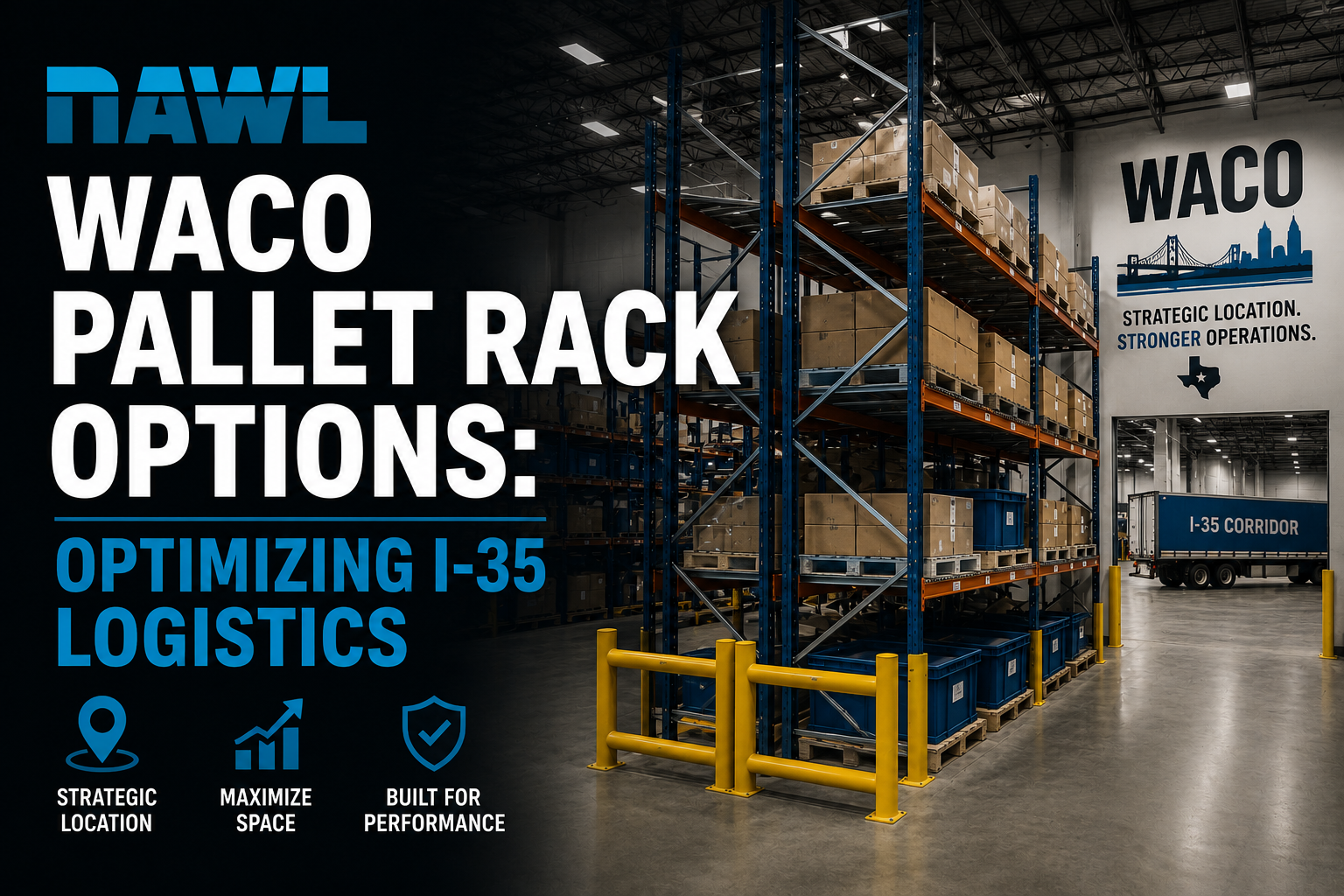
Waco, Texas, has rapidly solidified its position as a critical logistics hub between the DFW Metroplex and Austin. Its prime location on the I-35 corridor makes it an ideal spot for distribution centers aiming for efficient product movement across the state. For warehouses in this growing region, optimizing storage capacity and operational efficiency is paramount. This means selecting the right pallet rack Waco system.
Choosing the appropriate pallet racking directly impacts throughput, safety, and overall profitability. As the demand for rapid delivery increases, particularly for facilities operating along I-35, the need for robust and intelligently designed I-35 distribution racking solutions becomes more pronounced. A rack layout is not just a storage purchase. It affects receiving, putaway, replenishment, picking, staging, trailer loading, forklift travel, damage rates, and the number of pallet positions you can operate safely inside the same building.
For a Central Texas warehouse, the right answer depends on inventory profile and operating method. A beverage distributor, building products supplier, e-commerce fulfillment operation, cold storage facility, and regional parts warehouse may all need warehouse racking, but they should not all use the same design. The best system starts with accurate pallet dimensions, load weights, clear height, slab condition, forklift type, aisle requirements, fire code constraints, and the way product actually moves through the building.
The Strategic Advantage of Waco Warehouse Storage
Waco's central location on I-35 offers unparalleled access to major Texas markets. This geographic advantage translates into significant opportunities for businesses focused on distribution. However, to fully capitalize on this, warehouses need storage systems that can handle high volumes, diverse product types, and rapid inventory turns. Standard shelving isn't enough; sophisticated warehouse storage Waco TX solutions are required to maintain a competitive edge.
Effective pallet rack systems in Waco allow businesses to:
- Maximize Vertical Space: Utilize the full height of your warehouse, increasing storage density without expanding the physical footprint.
- Improve Inventory Accessibility: Design systems for quick retrieval, reducing picking times and enhancing order fulfillment rates.
- Enhance Safety: Proper racking ensures product stability, minimizing accidents and protecting both inventory and personnel.
- Adapt to Growth: Modular and scalable systems can evolve with your business needs, accommodating future expansion.
That vertical space matters in Waco because many logistics warehouse projects are working with fixed buildings and tight operating deadlines. Adding positions by using height is often faster and less expensive than moving to a larger facility. Still, height has to be engineered. Upright frame capacity, beam capacity, beam spacing, pallet overhang, sprinkler clearance, and forklift lift height all need to match.
A good warehouse optimization review should answer a few practical questions before steel is ordered:
- What is the heaviest pallet load, including the pallet itself?
- What are the standard pallet width, depth, and height?
- How many SKUs require immediate access?
- How many pallets per SKU are stored at peak inventory?
- Does the operation run FIFO, LIFO, batch picking, or full-pallet shipping?
- What forklifts are used now, and will they change after the rack is installed?
- What clear height is available below lights, joists, ductwork, fans, and sprinkler lines?
- Where are dock doors, charging areas, pedestrian routes, and emergency exits?
These details separate a practical industrial storage system from a drawing that looks good on paper but slows down the floor.
Common Pallet Rack Options for Waco Warehouses
Not all pallet racking is created equal. The best system for your Waco operation depends on factors like product characteristics, inventory turnover, and available space. Here are some of the most common and effective options:
| Rack type | Best fit | Inventory access | Density | Common tradeoff |
|---|---|---|---|---|
| Selective pallet rack | Many SKUs, fast access | Every pallet position | Medium | More aisles required |
| Drive-in rack | Few SKUs, many pallets per SKU | Lane-based | High | Limited selectivity |
| Push back rack | Several pallets per SKU | Front pallet per lane | High | LIFO rotation |
| Pallet flow rack | FIFO rotation, high volume | Pick face access | Very high | Higher upfront complexity |
Selective pallet rack
- Best fit
- Many SKUs, fast access
- Inventory access
- Every pallet position
- Density
- Medium
- Common tradeoff
- More aisles required
Drive-in rack
- Best fit
- Few SKUs, many pallets per SKU
- Inventory access
- Lane-based
- Density
- High
- Common tradeoff
- Limited selectivity
Push back rack
- Best fit
- Several pallets per SKU
- Inventory access
- Front pallet per lane
- Density
- High
- Common tradeoff
- LIFO rotation
Pallet flow rack
- Best fit
- FIFO rotation, high volume
- Inventory access
- Pick face access
- Density
- Very high
- Common tradeoff
- Higher upfront complexity
The right warehouse equipment mix may include more than one system. Many distribution center storage layouts use selective pallet rack for active SKUs, push back rack for medium-depth reserve storage, and warehouse shelving or carton flow near pick modules for smaller parts. The goal is not to choose the densest system every time. The goal is to reduce total cost per handled order while keeping storage safe and accessible.
Selective Pallet Racking
Selective racking is the most common and versatile pallet storage system. It offers immediate access to every pallet, making it ideal for warehouses with a wide variety of SKUs and high turnover. It's relatively inexpensive to install and can be configured in various heights and depths. For a typical warehouse storage Waco TX facility needing flexibility, selective racking is a strong baseline choice.
Selective pallet rack is usually built from upright frames, horizontal load beams, wire decking, pallet supports, row spacers for back-to-back rows, anchors, and safety accessories. Beam levels can be adjusted as pallet heights change, which is why selective rack works well for 3PLs and distributors that serve changing customer profiles.
Key selective rack decisions include:
- Frame depth: Common pallet depths often use rack depths that allow the pallet to overhang the front and rear beams. Overhang should be consistent and accounted for in the design.
- Beam length: Beam length is selected based on pallet width, desired pallets per level, and clearance between loads and uprights.
- Beam capacity: Capacity must cover the total load per beam pair, not just one pallet.
- Aisle width: Sit-down counterbalance lifts generally need wider aisles than reach trucks or turret trucks.
- Decking: Wire decking helps support nonstandard pallets, improves visibility, and reduces the chance of a pallet falling through the beam level.
As a simple worked example, consider a Waco warehouse storing standard pallets at 2,000 lb each, two pallets per beam level. That beam pair needs to be rated for at least 4,000 lb, and the upright frame must be rated for the cumulative loads from all beam levels based on actual vertical spacing. If there are four beam levels plus floor storage, the rack is not evaluated one beam at a time. The whole bay configuration matters.
Selective rack is also a good starting point when future requirements are uncertain. It can support full-pallet storage today and be reconfigured later for pick tunnels, over-dock storage, mixed-height product, or additional beam levels if clear height allows.
Drive-In/Drive-Through Racking
When space utilization is the primary concern and inventory is high-volume and low-SKU, drive-in (or drive-through) racking excels. This system allows forklifts to drive directly into the rack structure, storing pallets in deep lanes. It's excellent for cold storage or bulk storage applications where last-in, first-out (LIFO) or first-in, first-out (FIFO) access is managed effectively. For I-35 distribution racking dealing with identical products in large quantities, this can drastically increase density.
Drive in rack is strongest when pallet loads are uniform and operators can dedicate lanes to a single SKU, lot, or product family. Since pallets sit on rails instead of front beams, load quality matters. Broken pallets, inconsistent pallet widths, and excessive product overhang can create handling problems inside the lane.
Drive-through rack uses loading access from both ends, which can support FIFO if the operation is disciplined. Drive-in rack is accessed from one side and typically supports LIFO. In either case, forklift guidance, rack protection, and operator training are important because the lift travels inside the rack structure. Impacts at uprights, rail supports, or entry points can affect capacity and must be addressed quickly.
Common mistakes with drive-in systems include making lanes too deep for the actual SKU count, mixing too many products in the same bay, and underestimating the time needed to retrieve a pallet stored deep in a lane. High density only pays off when the product profile supports it.
Push Back Pallet Racking
Push-back racking offers higher density than selective racking while still providing excellent selectivity (though not 100% individual pallet access). Pallets are stored on nested carts that ride on inclined rails. When a pallet is loaded, it pushes the previous pallet back. When unloaded, gravity brings the remaining pallets forward. This system provides last-in, first-out (LIFO) retrieval and is well-suited for medium-turnover products with several pallets per SKU.
Push back rack is often a strong middle ground for a Central Texas warehouse that wants more density than selective rack but cannot operate efficiently with deep drive-in lanes. It keeps every lane accessible from the aisle, which reduces forklift travel into the rack and can improve productivity.
Typical applications include food and beverage, packaged goods, manufacturing components, and regional distribution where each SKU has two to six pallets on hand. Each lane should generally hold the same SKU or a planned SKU group because the rear pallets cannot be picked until the front pallets are removed. Pallet quality is important here as well. The carts and rails must be designed for the pallet footprint and weight.
Push back rack also requires careful attention to slope, cart condition, and load control. Operators should place pallets squarely on carts and avoid forcing loads. During inspections, look for damaged carts, loose stops, bent rails, missing safety components, and evidence that pallets are rubbing or hanging up.
Pallet Flow Racking
Designed for high-density, first-in, first-out (FIFO) applications, pallet flow racking uses inclined roller lanes. Pallets are loaded from one aisle and flow by gravity to a picking aisle. This system is excellent for freezer applications, food and beverage distribution, or any operation requiring strict FIFO inventory rotation. It significantly reduces labor costs by separating loading and picking aisles.
Pallet flow rack is a strong fit when product rotation is not optional. It supports clean separation between replenishment and picking, which helps reduce congestion. Loaders work from the rear aisle, while pickers or outbound operators work from the front aisle. For high-volume distribution center storage, that separation can make the building easier to manage during peak shipping windows.
Design details matter. Pallet flow lanes may need full-width rollers, skate wheels, speed controllers, entry guides, and lane separators depending on load type. A light, stable pallet behaves differently from a heavy pallet with a flexible bottom board. Before selecting flow rack, verify pallet construction, load weight range, temperature conditions, lane depth, and forklift placement accuracy.
The main tradeoff is upfront cost and engineering complexity. Pallet flow rack should be specified when the labor savings, FIFO control, and density benefits justify the investment. It is not the right choice for low-volume SKUs that change constantly.
Rapid Delivery for Waco and I-35 Operations
Beyond selecting the right system, timely delivery and installation are crucial. Downtime costs money, especially for operations reliant on the fast pace of I-35 logistics. We understand the urgency required by businesses in the Waco corridor. Our facility in Venus, TX, strategically located just north of Waco, allows us to offer rapid delivery and installation services. This means your new pallet rack Waco system can be up and running precisely when you need it, minimizing disruption and maximizing productivity.
When choosing I-35 distribution racking providers, consider their proximity and ability to deliver swiftly without compromising quality or safety standards. Our Venus location significantly reduces lead times for Central Texas projects.
Quick-ship availability is especially useful when a lease starts, a customer contract launches, or seasonal inventory arrives before a full buildout was planned. Stocked pallet rack components can shorten the schedule compared with waiting on a fully custom order. That does not mean layout should be rushed. The best approach is to confirm core dimensions and capacities first, then use stocked uprights, beams, decking, and accessories where they fit the requirement.
A practical pallet rack installation plan for Waco should include:
- Field measurement of the building, including obstructions and slab conditions
- Final layout approval before material ships
- Verification of rack elevations, beam capacities, and aisle widths
- Coordination with fire protection requirements and local code needs
- Staging plan so material does not block docks or production areas
- Anchor installation using the correct pattern and embedment for the system
- Post-installation walk-through to confirm plumb, level, beam engagement, and protection needs
Safety accessories should be considered during the layout phase, not after damage occurs. End-of-aisle guards, column protectors, guard rail, rack backing, pallet stops, flue space keepers, and load plaques all play a role in a safer warehouse. In busy I-35 corridor operations, where temporary labor and peak shipping periods can increase traffic, visible protection and clear aisle discipline are worth planning up front.
Rack inspection should also become part of normal warehouse operations. Supervisors should watch for bent uprights, twisted braces, damaged beams, missing beam safety clips, loose anchors, overloaded bays, damaged decking, and pallets stored incorrectly. Any damaged rack should be unloaded and evaluated before being placed back into service. Pallet rack installation is not a one-time concern. Safe operation depends on daily use, training, and maintenance.
Conclusion
Waco's growth as a logistics hub is undeniable, driven by its strategic position along I-35. To truly thrive, businesses require robust, efficient, and well-designed warehouse storage Waco TX solutions. Whether you need the versatility of selective racking, the density of drive-in, or the efficiency of flow racking, selecting the right system is a critical investment in your operational success. Partner with a provider who understands the unique demands of the Central Texas market and can deliver solutions quickly.
The best warehouse racking decision is based on product movement, not just floor space. Selective pallet rack supports broad SKU access. Drive in rack increases density for bulk storage. Push back rack balances density and accessibility. Pallet flow rack supports high-volume FIFO movement. Add the right warehouse shelving, safety equipment, installation plan, and inspection routine, and the result is a more productive logistics warehouse built for Central Texas demand.
Ready to optimize your Waco warehouse? Contact us today for a detailed quote on the best pallet rack system for your business needs.
Frequently asked questions
What pallet rack is best for a Waco distribution center?
Selective pallet rack is usually the best starting point when a Waco distribution center handles many SKUs and needs direct access to each pallet. Push back, drive-in, and pallet flow systems become stronger options when the operation has deeper inventory per SKU or strict rotation requirements.
How do I know if my warehouse needs pallet rack or warehouse shelving?
Use pallet rack for palletized loads handled by forklifts. Use warehouse shelving for hand-loaded cartons, parts, tools, and small inventory. Many warehouse storage Waco TX layouts use both, with pallet rack for reserve storage and shelving near packing or maintenance areas.
What information is needed for a pallet rack quote?
A useful quote starts with pallet size, pallet weight, clear height, building dimensions, forklift type, desired aisle width, SKU count, and inventory rotation method. Photos, dock layout, and any existing rack details also help speed up the design process.
Can pallet rack be installed in an active warehouse?
Yes, pallet rack installation can often be phased in an active warehouse, but it requires careful coordination. The plan should separate installers from forklift traffic, stage materials safely, and protect docks, exits, electrical panels, and pedestrian paths.
Why does I-35 corridor location affect racking decisions?
I-35 operations often face fast turns, tight delivery schedules, and fluctuating inventory. That makes layout efficiency, quick access, and lead time important. A Central Texas warehouse may benefit from quick-ship rack components and a design that can expand as volume grows.
Also serving nearby markets: Corsicana, Ennis & Waxahachie pallet rack.