Pallet Rack in Texarkana: Choosing the Right Warehouse System
August 10, 2026
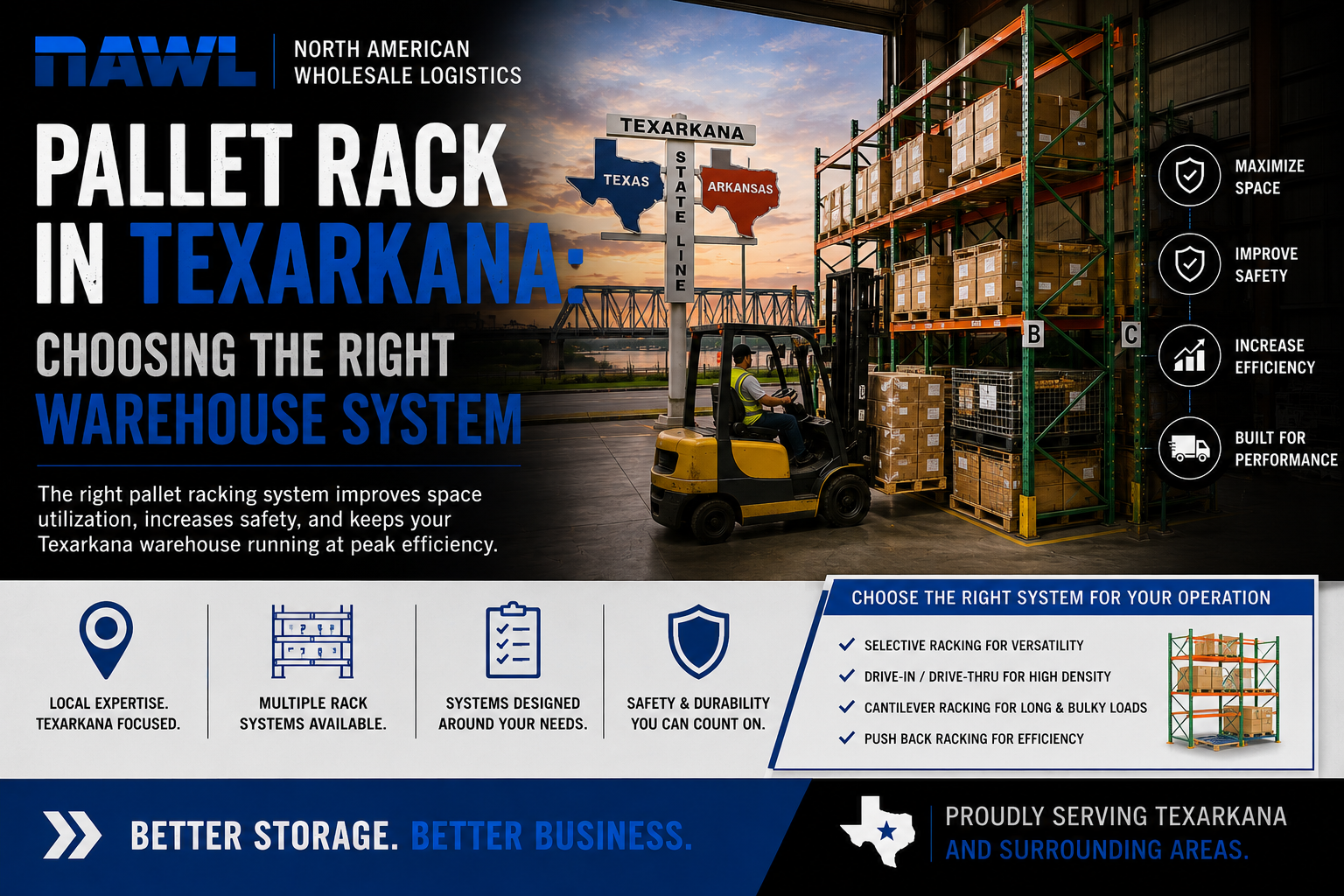
Texarkana, positioned strategically on the I-30 corridor between Dallas-Fort Worth and Little Rock, is a critical hub for regional distribution. Its role as a federal courthouse district and a growing distribution center market means warehouses here manage diverse inventories, from high-volume, fast-moving items to specialized goods. Choosing the right pallet rack system is not merely about storage; it's about optimizing flow, maximizing space, and ensuring the long-term efficiency of your Texarkana warehouse operations.
This guide will break down the essential considerations for selecting warehouse racking in Arkansas and Texas, helping you make an informed decision for your facility.
Assess Your Inventory Characteristics and Throughput
The fundamental starting point for any pallet rack decision is a thorough understanding of what you store and how quickly it moves. Your inventory's size, weight, perishability, and turnover rate will dictate the most suitable racking solution. Before discussing beam sizes, upright depths, or aisle layouts, document your pallet profile in writing. A good rack design starts with the real loads that will sit in the system every day, not with a generic warehouse sketch.
At minimum, collect the following information:
| Planning item | Why it matters |
|---|---|
| Pallet width, depth, and loaded height | Determines beam length, upright depth, vertical spacing, and clearances |
| Maximum pallet weight | Drives beam capacity, upright capacity, and floor anchoring requirements |
| Number of SKUs | Helps determine whether direct pallet access or high-density storage is the priority |
| Pallets per SKU | Indicates whether selective, push back, drive-in, or pallet flow may fit |
| Turns per month | Helps match rack type to picking speed and replenishment frequency |
| Forklift type and lift height | Sets aisle width, rack height, and load placement limits |
| Fire protection and building constraints | Can affect flue space, rack height, and storage configuration |
Pallet width, depth, and loaded height
- Why it matters
- Determines beam length, upright depth, vertical spacing, and clearances
Maximum pallet weight
- Why it matters
- Drives beam capacity, upright capacity, and floor anchoring requirements
Number of SKUs
- Why it matters
- Helps determine whether direct pallet access or high-density storage is the priority
Pallets per SKU
- Why it matters
- Indicates whether selective, push back, drive-in, or pallet flow may fit
Turns per month
- Why it matters
- Helps match rack type to picking speed and replenishment frequency
Forklift type and lift height
- Why it matters
- Sets aisle width, rack height, and load placement limits
Fire protection and building constraints
- Why it matters
- Can affect flue space, rack height, and storage configuration
Product Variety and SKU Count
Warehouses with a high number of different SKUs but lower quantities per SKU often benefit from selective pallet rack systems. This allows direct access to every pallet, which is ideal for diverse product lines and order picking. For Texarkana operations managing a broad range of products for varied regional customers, selective racking provides the necessary flexibility.
Selective rack is also the easiest system to re-slot as your customer mix changes. If a product moves from slow-moving storage to a fast pick location, beam levels can often be adjusted without replacing the entire system. That flexibility matters for third-party logistics operations, building material distributors, foodservice suppliers, and industrial parts warehouses serving both sides of the Texas-Arkansas line.
Higher SKU counts usually favor access over density. If a warehouse has 1,000 SKUs and only one to three pallets per SKU, burying pallets in deep lanes can create extra handling. The labor cost of moving pallets to reach the correct load may exceed the floor space savings. On the other hand, if you store 20, 40, or 100 pallets of the same product, a denser rack system may reduce travel time and improve storage economics.
Pallet Dimensions and Weight
Standard pallet sizes are common, but nonstandard or oversized items require custom design considerations. Crucially, pallet weight determines the capacities needed for beams and uprights. Overlooking this can lead to serious safety hazards and structural failure. Engineers must always confirm load specifications.
For a typical selective pallet rack bay, two 48-inch-wide pallets may be stored on one pair of beams. The beam length must provide enough clearance between pallets and between each pallet and the upright frame. If loads overhang, lean, or vary in width, the bay may need longer beams, deeper frames, pallet supports, or wire decking. Do not assume that a 96-inch beam works for every two-pallet application.
A simple planning example:
- Two pallet positions per beam level
- Each loaded pallet weighs 2,000 pounds
- Required beam pair capacity is at least 4,000 pounds, plus any design margin required by the engineer or applicable code
- If the rack has four loaded beam levels, the upright frame must support the combined vertical load from all levels, not just one shelf
The floor also matters. Rack columns concentrate load at base plates. A warehouse slab that performs well for forklift traffic may still need review before supporting tall, heavily loaded rack. For used buildings in Texarkana, especially facilities converted from light manufacturing or older storage use, slab condition, flatness, cracks, joints, and anchor capacity should be reviewed before final rack layout.
Inventory Turnover (FIFO vs. LIFO)
- First-In, First-Out (FIFO): Essential for perishable goods, items with expiration dates, or those that depreciate over time. Drive-In Rack and Pallet Flow Rack are strong FIFO contenders.
- Last-In, First-Out (LIFO): Suitable for nonperishable, high-volume, uniform products where direct accessibility to every SKU isn't paramount. Push Back Rack Systems excel in LIFO applications.
FIFO and LIFO are not accounting labels in this context; they are physical flow rules. If the oldest pallet must ship first, the rack system and operating procedure must support that. Pallet flow rack uses gravity lanes so pallets load from one side and discharge from the other. That is a natural FIFO pattern when the system is maintained and loaded correctly. Drive-in rack can also support the right rotation plan when configured and operated for the product flow required by the warehouse.
Push back rack stores pallets on nested carts or rails. A forklift loads from the aisle, pushing existing pallets back into the lane. The next pallet removed is typically the last one loaded. That is useful for uniform products with no strict expiration concern, but it is a poor fit when lot control or date rotation requires older inventory to be selected first.
Space Utilization and Density Requirements
Real estate costs are a factor, even in Texarkana. Maximizing your vertical and horizontal space is paramount. Different racking systems offer varying degrees of storage density versus immediate accessibility.
The basic tradeoff is simple: the more aisles you remove, the more storage positions you can gain, but the less direct access you may have. A good layout balances storage density, labor efficiency, forklift travel, safety clearances, and future expansion. The lowest-cost rack on paper can become expensive if it slows picking, creates congestion, or forces daily pallet reshuffling.
High-Density Solutions
When floor space is limited, high-density systems like Drive-In, Push Back, and Pallet Flow racking dramatically increase storage capacity within the same footprint. These systems reduce the need for multiple aisles, dedicating more floor area to storage bays. For new facilities or expansions along the I-30 distribution corridor where space is at a premium, these systems offer a compelling return on investment by delaying or eliminating the need for additional physical expansion.
Use the storage profile to narrow the options:
| Rack system | Best fit | Access pattern | Typical caution |
|---|---|---|---|
| Selective pallet rack | Many SKUs, mixed order picking, frequent changes | Direct access to each pallet | Lower storage density than deep-lane systems |
| Push back rack | Multiple pallets of the same SKU, medium to high density | LIFO | Not ideal for strict date rotation |
| Drive-in rack | Large quantities of similar product | Dense lane storage | Requires disciplined forklift operation inside rack lanes |
| Pallet flow rack | High-volume products needing rotation | FIFO | Higher upfront complexity and lane maintenance |
| VNA selective rack | Direct access with narrower aisles | Direct access | Requires compatible lift trucks and floor conditions |
Selective pallet rack
- Best fit
- Many SKUs, mixed order picking, frequent changes
- Access pattern
- Direct access to each pallet
- Typical caution
- Lower storage density than deep-lane systems
Push back rack
- Best fit
- Multiple pallets of the same SKU, medium to high density
- Access pattern
- LIFO
- Typical caution
- Not ideal for strict date rotation
Drive-in rack
- Best fit
- Large quantities of similar product
- Access pattern
- Dense lane storage
- Typical caution
- Requires disciplined forklift operation inside rack lanes
Pallet flow rack
- Best fit
- High-volume products needing rotation
- Access pattern
- FIFO
- Typical caution
- Higher upfront complexity and lane maintenance
VNA selective rack
- Best fit
- Direct access with narrower aisles
- Access pattern
- Direct access
- Typical caution
- Requires compatible lift trucks and floor conditions
A worked layout example shows the decision point. Suppose a Texarkana warehouse has 10,000 square feet available for storage after docks, staging, and offices are excluded. A selective rack layout may provide excellent access but dedicate a large percentage of that footprint to lift truck aisles. If the inventory includes 30 SKUs with 25 pallets each, push back or drive-in may increase pallet positions significantly because fewer aisles are required. If the same building stores 750 SKUs with one pallet each, selective rack may be the better system because every pallet can be reached without digging through lanes.
Aisles and Forklift Access
Standard selective racking requires wider aisles for forklift maneuverability, offering 100% immediate access. High-density systems reduce aisles but often require specialized lift trucks or carefully planned stock rotation. Very Narrow Aisle (VNA) systems, paired with specialized equipment, can also boost density within a selective rack setup by shrinking aisle width.
Aisle width must be based on the actual forklift, attachment, load length, and operating clearance. A sit-down counterbalance truck often needs wider aisles than a reach truck. VNA layouts may require turret trucks or order selectors, plus tighter floor tolerances. Door locations, dock staging, battery charging, emergency exits, building columns, sprinklers, and fire lanes can all limit what looks possible on a drawing.
Do not forget vertical clearances. Beam elevation must allow the forklift to place and remove pallets without striking the level above. The rack height must also respect sprinkler requirements, roof structure, lighting, HVAC, and local fire code interpretations. In many projects, the best design is not the tallest rack possible; it is the tallest rack that can be operated safely and approved for the building.
Operational Efficiency and Future Growth
Your racking system should enhance, not hinder, your daily operations and adapt to future business needs.
Speed of Access and Picking Efficiency
If rapid order fulfillment is critical, systems that offer immediate access to individual pallets or easily replenished pick faces are essential. While high-density systems increase storage, they can sometimes decrease picking efficiency for diverse, high-volume orders if not properly integrated with material handling equipment.
Map the movement of a pallet from receiving to storage to picking to shipping. In a busy Texarkana distribution warehouse, congestion often forms at dock doors, staging zones, and main travel aisles. A rack plan that maximizes pallet positions but leaves too little staging space can slow the whole facility. Leave room for inbound inspection, damaged goods, returns, outbound staging, stretch-wrapping, and traffic separation where possible.
For case picking, consider whether pallet rack will support full-pallet storage only or also pick modules and ground-level pick faces. Many warehouses use upper beam levels for reserve storage and the floor level for active picking. That approach can work well with selective Texas pallet rack because replenishment is straightforward and SKUs can be rebalanced as demand changes.
System Durability and Maintenance
Opt for robust, high-quality materials from reputable manufacturers. Warehouse racking in Arkansas and Texas endures daily wear and tear. Consider protective accessories like column protectors and end-of-aisle guards to prolong the life of your investment and minimize repair costs.
Impact is the most common rack damage risk. Forklift contact with upright columns, braces, beam connectors, and end frames can reduce capacity even when the rack still appears usable. Good protection includes:
- Column protectors at high-traffic upright locations
- End-of-aisle guards at row ends and intersections
- Guard rail near building walls, equipment, and pedestrian routes
- Pallet supports or wire decking where pallets vary in quality
- Load plaques that identify rated capacities
Routine inspection should be part of warehouse operations. Supervisors should look for bent uprights, twisted braces, damaged beam connectors, missing safety pins, loose anchors, overloaded beams, improper pallet placement, and out-of-plumb frames. Any damaged rack should be unloaded and evaluated before being returned to service. Field welding, drilling, or mixing incompatible components without engineering review can create more risk than it solves.
Scalability and Adaptability
Your Texarkana distribution needs may evolve. Will your chosen pallet rack system be able to accommodate new product lines, increased inventory levels, or changes in material handling processes? Modular designs and systems that can be reconfigured or expanded are key for long-term viability.
Scalability is partly a product decision and partly a purchasing decision. If you expect to add rows later, standardize upright heights, depths, beam profiles, and connector styles where practical. Keep drawings and load documentation. Plan for future cross aisles, sprinkler changes, dock growth, and equipment upgrades. A low first cost can be costly if the next phase requires custom matching components or extensive rework.
Lead time should also be considered. Stock rack components can move faster than fully custom systems, especially when a project needs common upright and beam sizes. NAWL manufactures pallet rack in Venus, Texas and sells through dealers, with quick-ship options from stock for many standard needs. For a Texarkana facility, that regional supply can help reduce delays compared with sourcing every component from distant inventories. Custom engineered systems, large pallet flow projects, or unusual finish requirements may require more planning time.
Partnering with the Right Expert
Choosing the optimal pallet rack solution in Texarkana is a significant investment. It requires detailed analysis of your operational specifics, safety regulations, and budget. Partner with a trusted provider who understands the nuances of warehouse racking in Arkansas and Texas. They can offer expert design, engineering, installation, and ongoing support tailored to your unique I-30 distribution needs. Their experienced team will ensure your system is compliant, safe, and maximizes your operational efficiency.
A qualified rack partner should ask detailed questions before quoting. Be cautious if the only discussion is price per beam or price per upright. The right conversation includes pallet weights, beam elevations, seismic and local code considerations where applicable, fire protection, lift truck specs, slab conditions, permitting needs, installation schedule, and how operations will continue during the work.
For installation, confirm the layout before material arrives. Mark row locations, verify building dimensions, check column conflicts, and coordinate dock access. During installation, rack should be set plumb, anchored according to the approved plan, and assembled with the proper safety hardware. After installation, capacity signs and final drawings help operators use the system correctly. If the warehouse later changes beam elevations or load weights, capacities should be reviewed again.
Common mistakes to avoid include:
- Buying rack before confirming actual pallet weights
- Designing around ideal pallets instead of damaged, overhanging, or mixed pallets
- Ignoring staging space in favor of maximum storage positions
- Using high-density rack for SKUs that need constant direct access
- Mixing rack brands or connector types without review
- Moving beams without updating load capacity documentation
- Treating rack inspection as a one-time event instead of an ongoing process
Maximize your Texarkana warehouse's potential. Contact us today for a comprehensive consultation and a personalized quote for your pallet rack system needs.
Frequently asked questions
What type of pallet rack is best for a Texarkana warehouse?
It depends on SKU count, pallet weight, turnover, and picking method. Selective pallet rack is often best for many SKUs and direct access. Push back, drive-in, and pallet flow can be better when you store larger quantities of fewer products.
How do I know what capacity my rack system needs?
Start with the heaviest loaded pallet you will store, then calculate the load per beam level and total load on each upright frame. Final capacities should be confirmed by qualified design or engineering review, especially for tall systems or heavy pallets.
Is used pallet rack a good option?
Used rack can work when it is compatible, undamaged, properly rated, and suitable for the load. The risk is missing capacity data, hidden damage, or mixed components. For critical warehouse racking, documentation and condition matter as much as price.
How much aisle space should I plan for?
Aisle width depends on the forklift type, load size, rack height, and turning requirements. Do not use a generic aisle dimension without checking the lift truck manufacturer’s guidance and the actual operating conditions in the warehouse.
How often should pallet rack be inspected?
Operators should watch for damage daily, and supervisors should perform routine documented inspections. Any rack that is hit, bent, overloaded, or missing components should be unloaded and evaluated before continued use.
Can NAWL help with Texas pallet rack for Texarkana projects?
NAWL manufactures pallet rack in Texas and supplies dealers with stock and standard components for many warehouse racking needs. For Texarkana projects, the right dealer can help match the rack system to your layout, loads, and schedule.