OSHA Rack Safety: Essential Guidelines for Your Warehouse
August 14, 2026
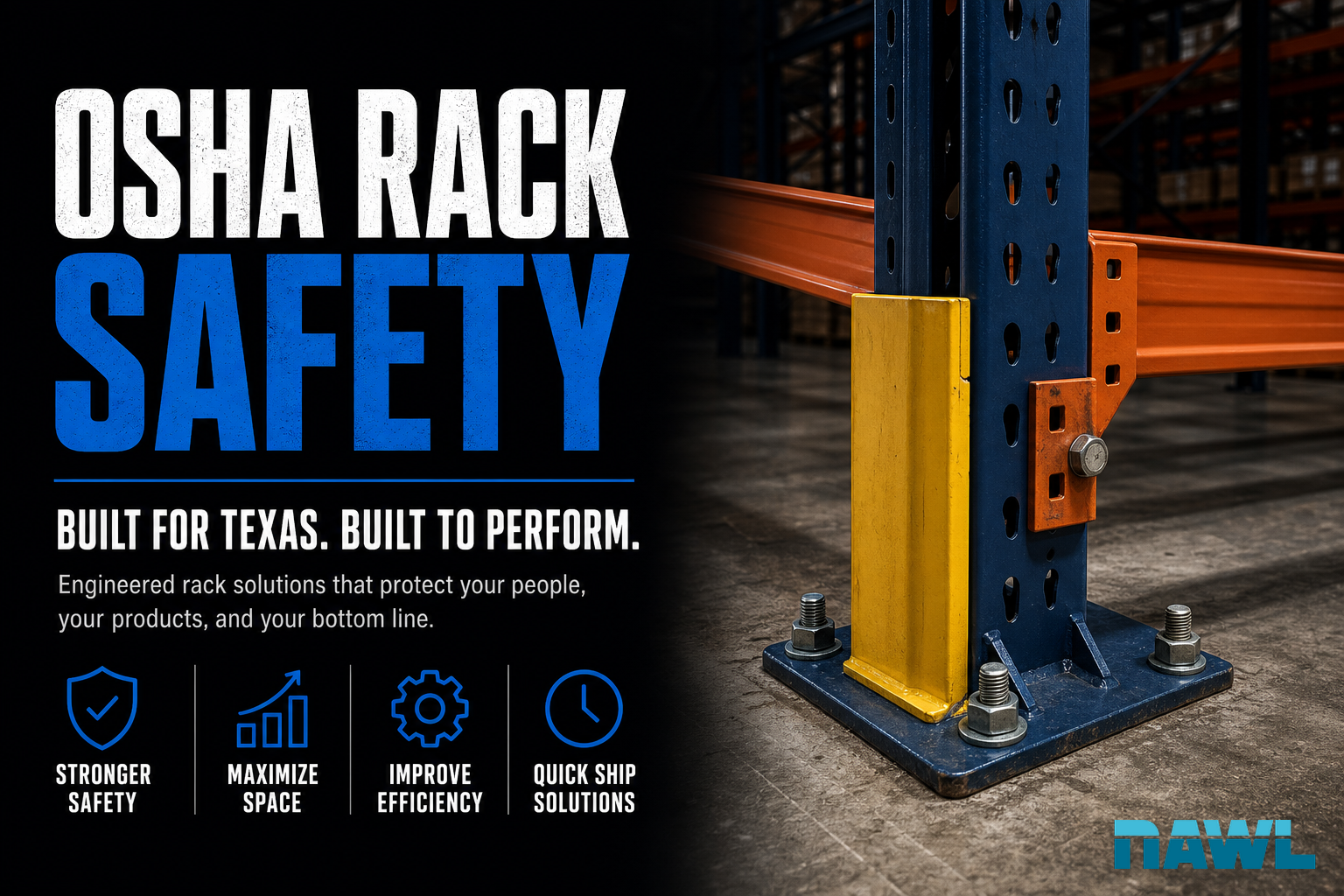
Maintaining a safe warehouse environment is paramount, and pallet rack systems are a critical component of that safety. OSHA (Occupational Safety and Health Administration) sets the standards for workplace safety, including specific guidelines for storage racks. Compliance is not just about avoiding penalties; it's about protecting your people and your assets.
This guide outlines the fundamental aspects of OSHA rack safety, drawing on widely accepted industry practices like ANSI MH16.1. Understanding these principles is essential for warehouse managers, installers, and distributors responsible for safe and efficient storage solutions.
Proper rack setup, regular inspection, and prompt repair are non-negotiable. NAWL is committed to providing the knowledge and products that support a secure and compliant warehouse operation.
Understanding OSHA's Stance on Pallet Rack Safety
While OSHA does not have a single, dedicated standard specifically for pallet racks, its General Duty Clause (Section 5(a)(1) of the OSH Act) requires employers to provide a workplace free from recognized hazards that are causing or are likely to cause death or serious physical harm. This clause is the basis for enforcing safe rack practices.
OSHA often references industry consensus standards like ANSI MH16.1, "Specification for the Design, Testing and Utilization of Industrial Steel Storage Racks," as recognized best practices. Adhering to these standards helps satisfy the General Duty Clause requirements and provides a robust framework for rack safety.
In practical terms, warehouse OSHA standards for rack systems come down to three questions: was the rack engineered and installed correctly, is it being used within its rated capacity, and is damage being controlled before it becomes a collapse hazard? If the answer to any of those questions is unclear, the operation has exposure.
ANSI MH16.1 is important because it gives owners, engineers, manufacturers, installers, and inspectors a common language. It covers design assumptions, load application, out-of-plumb conditions, connections, anchorage, and proper utilization. OSHA may not hand an employer a pallet rack checklist, but after an incident it will look for evidence that recognized pallet rack safety guidelines were followed.
A strong warehouse safety compliance file should include:
| Document | Why it matters |
|---|---|
| Rack drawings or layout | Confirms bay dimensions, beam elevations, aisle widths, and configuration |
| Load capacity information | Shows permissible unit loads and total bay loading |
| Installation records | Supports that anchoring, shimming, and assembly were completed correctly |
| Inspection logs | Creates a dated record of pallet rack inspection activity |
| Repair records | Shows that damaged pallet rack was isolated and corrected properly |
| Operator training records | Confirms forklift operators were trained on safe loading and traffic practices |
Rack drawings or layout
- Why it matters
- Confirms bay dimensions, beam elevations, aisle widths, and configuration
Load capacity information
- Why it matters
- Shows permissible unit loads and total bay loading
Installation records
- Why it matters
- Supports that anchoring, shimming, and assembly were completed correctly
Inspection logs
- Why it matters
- Creates a dated record of pallet rack inspection activity
Repair records
- Why it matters
- Shows that damaged pallet rack was isolated and corrected properly
Operator training records
- Why it matters
- Confirms forklift operators were trained on safe loading and traffic practices
These records do not replace safe behavior on the floor, but they help prove that the employer has a rack safety program rather than an informal response after damage is discovered.
The Importance of Regular Rack Inspections
Proactive and consistent rack inspections are the cornerstone of an effective safety program. Daily visual checks by warehouse personnel should be supplemented by formal, documented inspections conducted quarterly or semiannually by a trained individual. This includes checking for damaged uprights, beams, connectors, and footplates.
Any visible damage, no matter how minor it may seem, must be reported immediately. Impact damage from forklifts is a common culprit, but you should also look for corrosion, loose components, and plumbness issues. Documenting these inspections creates a historical record and demonstrates due diligence.
Daily checks should be simple enough that supervisors and operators will actually complete them. A formal pallet rack inspection should be more detailed and should include measurements, photographs, location identification, and a disposition for each issue. Use rack row, bay, level, and aisle identifiers so repairs can be found quickly.
Common inspection points include:
| Rack area | What to check | Why it matters |
|---|---|---|
| Upright columns | Dents, bends, tears, twist, missing bracing | Uprights carry the vertical load and resist forklift impact |
| Horizontal and diagonal braces | Bent or detached members | Bracing stabilizes the frame and transfers forces |
| Baseplates and anchors | Missing anchors, loose nuts, cracked concrete | Anchors help prevent movement and overturning |
| Beams | Deflection, dents, missing safety clips, connector damage | Beams support pallet loads and depend on secure engagement |
| Wire decking or supports | Broken welds, sagging, improper seating | Decking helps support pallets but is not a substitute for capacity control |
| Row spacers and ties | Loose bolts, missing members | Ties keep back-to-back rows aligned and stable |
| Plumb and level | Leaning frames, uneven shims, floor settlement | Out-of-plumb rack can reduce usable capacity |
Upright columns
- What to check
- Dents, bends, tears, twist, missing bracing
- Why it matters
- Uprights carry the vertical load and resist forklift impact
Horizontal and diagonal braces
- What to check
- Bent or detached members
- Why it matters
- Bracing stabilizes the frame and transfers forces
Baseplates and anchors
- What to check
- Missing anchors, loose nuts, cracked concrete
- Why it matters
- Anchors help prevent movement and overturning
Beams
- What to check
- Deflection, dents, missing safety clips, connector damage
- Why it matters
- Beams support pallet loads and depend on secure engagement
Wire decking or supports
- What to check
- Broken welds, sagging, improper seating
- Why it matters
- Decking helps support pallets but is not a substitute for capacity control
Row spacers and ties
- What to check
- Loose bolts, missing members
- Why it matters
- Ties keep back-to-back rows aligned and stable
Plumb and level
- What to check
- Leaning frames, uneven shims, floor settlement
- Why it matters
- Out-of-plumb rack can reduce usable capacity
A useful field rule is to treat damage differently from normal wear. Scratches in paint should be watched. Bent steel, torn steel, broken welds, missing connectors, missing anchors, or visibly leaning rack should trigger action. If there is any doubt about severity, unload the affected area and have it reviewed by a qualified person.
Inspection frequency should reflect operating conditions. A low-traffic reserve storage area may be fine with quarterly or semiannual formal reviews. A busy staging area with narrow aisles, deep reach trucks, or frequent product rotation may need more frequent documented checks. The higher the impact risk, the shorter the inspection interval should be.
Safe Repair and Maintenance Protocols
Damaged rack components must be addressed swiftly. Under no circumstances should a damaged rack be loaded or repaired with unauthorized parts. Rack repairs must be carried out by qualified personnel, often using manufacturer-approved components or certified repair kits that restore the rack to its original load-bearing capacity.
Temporary fixes are not acceptable and can lead to catastrophic failure. If a component is compromised, the affected bays should be immediately offloaded and isolated until proper repairs are completed. This might involve replacing uprights, beams, or reinforcement pieces.
A practical damaged pallet rack response should be consistent every time:
- Stop using the affected bay or aisle section.
- Remove pallets from the impacted levels and adjacent areas if stability is in question.
- Block or tag the bay so it cannot be reloaded by another shift.
- Photograph the damage and record the exact location.
- Contact the rack manufacturer, dealer, installer, or qualified engineer for direction.
- Replace or repair using approved components.
- Reinspect and document the completed repair before returning the bay to service.
Rack repair OSHA discussions often focus on whether a facility can weld, reinforce, or patch damaged components in place. The safer approach is to assume engineered approval is required. Pallet rack is not general-purpose steel shelving. Column shape, hole pattern, beam connector style, steel thickness, bracing pattern, and anchorage all affect capacity. A field modification can change the load path even if it looks strong.
Common mistakes include sistering a damaged upright with random channel, welding over a tear without addressing the lost section properties, replacing one beam with a different connector style, or moving beam elevations without checking frame capacity. Beam elevation changes matter because rack capacity is tied to the vertical spacing between beam levels. Raising a level can increase the unsupported column length and reduce allowable frame capacity.
Maintenance should also include prevention. Replace missing safety clips immediately. Tighten loose hardware. Keep pallets in good condition so broken boards do not drop product or point-load decking. Keep aisles clear so operators are not forced into tight turns. Good housekeeping is part of rack protection.
Rack Capacity Signage: A Critical Safety Tool
Every pallet rack system must display clear, visible load capacity signage. This signage specifies the maximum permissible unit load (weight per pallet) and the maximum permissible total load for each shelf level and for the entire bay. This information is vital for preventing overloading, which is a major cause of rack failure.
The signage should be prominently displayed at the end of each aisle and on individual rack sections, easily readable by forklift operators and warehouse staff. Failure to post capacity signs is a direct violation of best practices and compromises safety.
Good load capacity signage is specific. A sign that only says "heavy duty rack" does not help an operator or supervisor make a safe decision. At minimum, signage should communicate the rack configuration and limits in plain language.
| Sign item | Example information to include |
|---|---|
| Maximum pallet weight | 2,500 lb per pallet, if applicable to the engineered design |
| Maximum beam level load | Total allowable load per pair of beams |
| Maximum bay load | Total allowable load in one upright bay |
| Beam spacing assumption | Capacity based on listed beam elevations |
| Pallet type or load condition | Uniformly distributed pallet loads, if that is the design basis |
| Warning language | Do not exceed posted capacity; report rack damage immediately |
Maximum pallet weight
- Example information to include
- 2,500 lb per pallet, if applicable to the engineered design
Maximum beam level load
- Example information to include
- Total allowable load per pair of beams
Maximum bay load
- Example information to include
- Total allowable load in one upright bay
Beam spacing assumption
- Example information to include
- Capacity based on listed beam elevations
Pallet type or load condition
- Example information to include
- Uniformly distributed pallet loads, if that is the design basis
Warning language
- Example information to include
- Do not exceed posted capacity; report rack damage immediately
Worked example: suppose a bay has two beam levels, each designed to hold two pallet positions. If the posted maximum unit load is 2,500 lb per pallet, each level may be limited to 5,000 lb total, and the bay may have an overall capacity limit based on the upright frame and beam elevations. Operators should not assume an empty upper level allows extra weight on a lower level unless the posted bay capacity allows it.
Signage should be updated when the rack changes. If beams are moved, frames are extended, rows are reconfigured, or pallet weights increase, the old sign may no longer apply. This is a common warehouse safety compliance gap: the rack was originally rated, but the operation changed over time.
Loading and Unloading Best Practices
Safe rack operation extends beyond the physical structure to the practices of those using it. Forklift operators must be trained and certified, operate within speed limits, and respect designated aisles. Loads should always be placed squarely and gently onto beams, never dropped or pushed forcibly.
Maintain adequate clearance between loads and rack components to prevent accidental impacts. Overhanging loads or unstable pallet configurations also pose significant risks and should be avoided. Properly trained operators are your first line of defense against rack damage.
Operators should approach square to the bay whenever possible, keep forks level, and set pallets down instead of using the rack as a backstop. Side-loading, dragging pallets across beams, and nudging pallets with fork tips can damage beam faces, connectors, and upright columns. If a pallet does not seat correctly, it should be removed and repositioned.
Load quality matters. A rated rack system can still be unsafe if pallets are broken, undersized, poorly wrapped, or loaded off-center. Pallets should fully engage the front and rear beams or be supported by properly specified accessories. Wire decking improves product support and fall protection for certain loads, but it does not automatically increase beam or frame capacity.
Aisle discipline is another part of OSHA rack safety. Marked travel paths, adequate lighting, clear visibility at intersections, and controlled pedestrian access reduce rack strikes. Operators should be encouraged to report impacts immediately without fear of punishment. Hidden damage is more dangerous than reported damage.
Rack Protection and Damage Prevention
Rack protection is not a replacement for operator training, but it is a practical way to reduce recurring damage in high-risk areas. The most common impact zones are aisle ends, tunnel bays, transfer aisles, dock-adjacent storage, and lower upright columns near pick faces.
Protection options include column protectors, end-of-row guards, guardrail, bollards, rub rails, and reinforced starter bays. The right choice depends on equipment type, traffic pattern, impact exposure, and available aisle width. A guard that narrows the aisle too much can create a new hazard, so protection should be laid out with lift truck turning requirements in mind.
Use protection where impacts are likely, not just where it is easiest to install. If the same upright is hit repeatedly, the root cause may be aisle width, pallet overhang, poor visibility, or a congested staging process. Fixing the layout may be more effective than replacing the same damaged component over and over.
Why Dealers Choose NAWL Quick Ship
NAWL understands the urgency of maintaining safe and operational warehouses. When damage occurs or expansion is needed, having immediate access to quality components is critical. Our quick-ship program from Venus, TX, ensures that our dealer network can promptly address its customers' OSHA rack safety and storage needs.
We provide reliable, American-made pallet rack solutions that meet stringent industry standards, enabling our dealers to deliver rapid, dependable service. This commitment to speed and quality minimizes downtime and supports continuous compliance for end users, solidifying NAWL as a trusted, compliance-focused supplier.
For dealers, lead time can be the difference between a closed aisle and a repaired system. Stock availability helps when a customer needs replacement frames, beams, or compatible components to restore a damaged area quickly. It also supports phased projects where a customer is adding storage capacity but cannot afford a long interruption.
When requesting rack components, the details matter. Dealers should gather upright height and depth, column profile, beam length, beam face height, connector style, capacity requirements, color requirements, and current beam elevations. Photos of the existing rack and damaged area help reduce quoting errors. If the system has posted capacities or drawings, include them with the request.
Ready to spec a system? Request a quote and our team will size it with you.
FAQ
Does OSHA have a specific standard for pallet racks?
No, OSHA does not have a standalone standard for pallet racks, but it enforces safety through its General Duty Clause and by referencing industry consensus standards like ANSI MH16.1.
How often should pallet racks be inspected?
Daily visual checks by staff are recommended, supplemented by formal, documented inspections performed quarterly or semiannually by a trained individual. Higher-traffic areas, narrow aisles, and locations with frequent impacts may justify more frequent formal checks.
What should I do if a rack component is damaged?
Immediately offload and isolate the affected rack section. Do not load it until qualified personnel have performed proper repairs using manufacturer-approved parts. Document the damage, repair action, and return-to-service date.
Is rack capacity signage legally required?
While not always explicitly mandated by law, visible capacity signage is a critical best practice endorsed by OSHA and ANSI MH16.1, and its absence can lead to citations under the General Duty Clause.
Can I weld a damaged rack component for repair?
Welding a damaged rack component is generally not recommended and can compromise its engineered capacity. Always consult the manufacturer or a qualified engineer for approved repair methods.
What is ANSI MH16.1 and why is it important for rack safety?
ANSI MH16.1 is an industry consensus standard (Specification for the Design, Testing and Utilization of Industrial Steel Storage Racks) that OSHA often references as a recognized best practice for safe rack design, installation, and usage.
Do rack capacity signs need to be updated after moving beams?
Yes. Beam elevation changes can affect upright frame capacity and overall bay loading. If beam levels or load weights change, review the rack design and update signage before returning the system to normal use.