Optimizing East Texas Warehouses with Pallet Rack
August 5, 2026
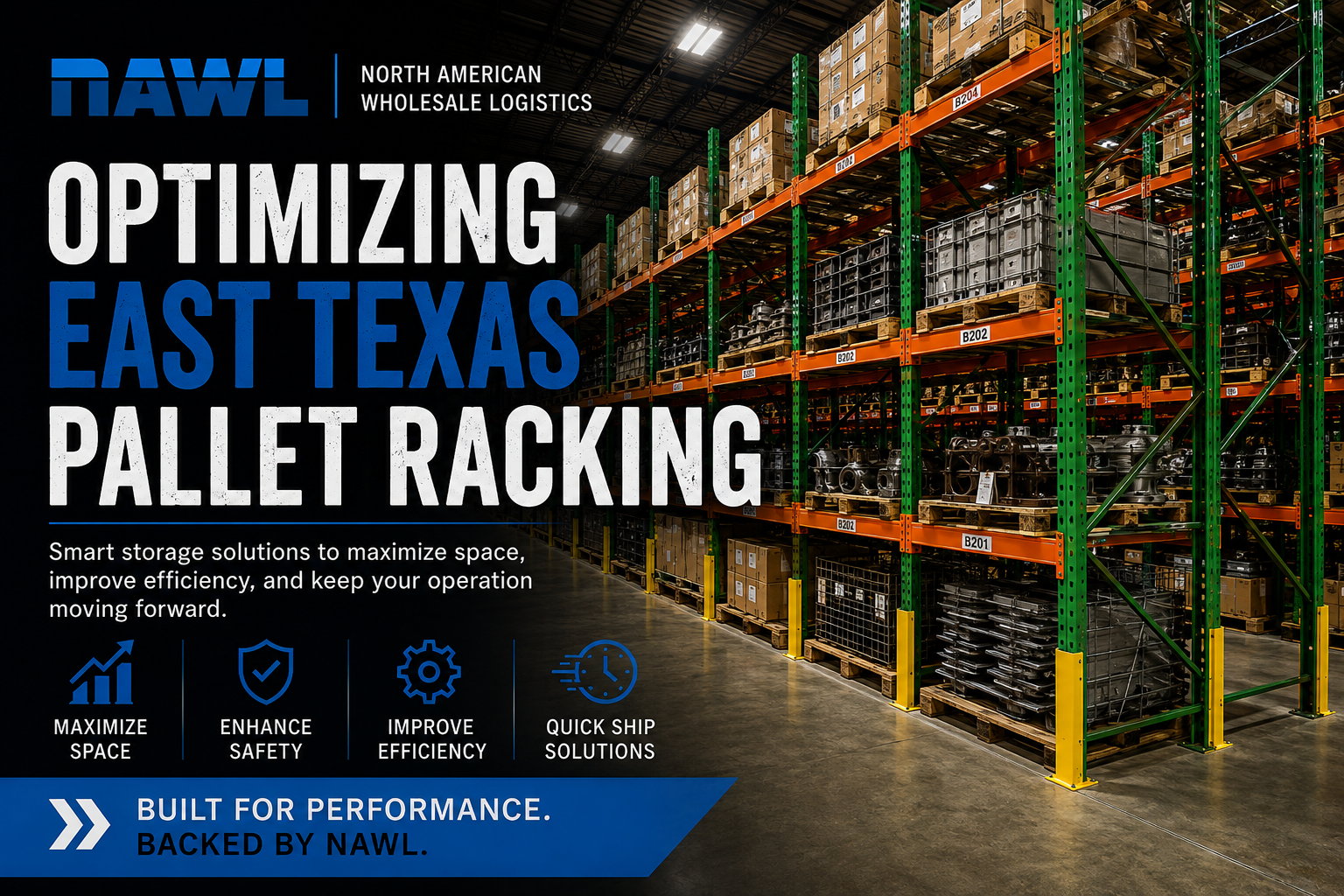
East Texas—home to a thriving industrial belt encompassing Tyler, Longview, and the surrounding Piney Woods—represents a significant hub for diverse industries. From the demands of the oil and gas sector to the specialized needs of timber processing and general manufacturing, efficient warehouse operations are critical. At NAWL, we understand these distinct requirements. Choosing the right pallet rack system for your East Texas facility isn't just about storing goods; it's about optimizing space, ensuring safety, and boosting your bottom line.
For many facilities, the rack decision starts when floor space gets tight, staging areas become crowded, or lift truck travel time starts cutting into production. The right pallet rack systems can reduce wasted space, improve inventory control, and create a cleaner path from receiving to storage, picking, production, and shipping. The wrong system can lock a warehouse into poor traffic flow, damage-prone aisles, and expensive rework.
The East Texas Industrial Landscape: Storage Challenges and Opportunities
Companies operating in the East Texas industrial region face unique storage challenges. The sheer volume and variety of goods, often heavy and sometimes oddly shaped, necessitate robust and adaptable warehouse racking solutions. Oil and gas equipment, large timber products, and diverse manufacturing components all require systems that can handle significant weight and varied dimensions while allowing for efficient retrieval. The right warehouse racking in Longview or pallet rack in Tyler, TX can transform a cluttered space into a lean, high-performing operation.
East Texas warehouses also tend to deal with mixed realities. A single operation may store palletized finished goods, raw materials, maintenance parts, pipe, crated equipment, drums, and long loads. Some products move daily. Others sit for months but need to remain protected and accessible. Humidity, outdoor yard storage, dust, and forklift traffic can all affect how a storage system performs over time.
Common storage problems in the region include:
- Pallets staged on the floor because there are not enough beam levels or properly sized rack openings
- Wide, underused aisles that consume cube without improving throughput
- Rack damage at aisle ends, tunnel bays, and high-traffic intersections
- Mixed pallet sizes stored in rack that was designed for only one load type
- Poor product rotation for materials that need FIFO handling
- Overstocked production areas because bulk storage is too far from the line
The opportunity is just as clear. A properly designed industrial racking solution can use vertical building height, separate fast movers from reserve inventory, reduce forklift touches, and make inventory easier to count. In a region where industrial buildings vary widely in age, ceiling height, slab condition, and dock configuration, the design process matters as much as the rack type.
Pallet Rack Systems for East Texas Industries
Selecting the appropriate pallet rack system depends heavily on your specific inventory, operational flow, and facility layout. Here are common systems that prove effective for East Texas companies:
| Rack system | Best fit | Inventory flow | Key advantage | Watch for |
|---|---|---|---|---|
| Selective pallet rack | Many SKUs, mixed pallet sizes, frequent access | FIFO or LIFO depending on operation | Direct access to every pallet | Lower storage density than deep-lane systems |
| Drive-in rack | Large quantities of the same SKU | LIFO | Very high density | Requires disciplined loading by lane |
| Drive-thru rack | Bulk goods needing rotation | FIFO | Dense storage with two-sided access | Requires aisles on both ends |
| Push back rack | Multiple SKUs with medium to high pallet counts | LIFO | Density with better selectivity than drive-in | Cart depth and pallet quality matter |
| Pallet flow rack | High-volume goods needing rotation | FIFO | Fast throughput and lane rotation | Higher upfront planning and component cost |
Selective pallet rack
- Best fit
- Many SKUs, mixed pallet sizes, frequent access
- Inventory flow
- FIFO or LIFO depending on operation
- Key advantage
- Direct access to every pallet
- Watch for
- Lower storage density than deep-lane systems
Drive-in rack
- Best fit
- Large quantities of the same SKU
- Inventory flow
- LIFO
- Key advantage
- Very high density
- Watch for
- Requires disciplined loading by lane
Drive-thru rack
- Best fit
- Bulk goods needing rotation
- Inventory flow
- FIFO
- Key advantage
- Dense storage with two-sided access
- Watch for
- Requires aisles on both ends
Push back rack
- Best fit
- Multiple SKUs with medium to high pallet counts
- Inventory flow
- LIFO
- Key advantage
- Density with better selectivity than drive-in
- Watch for
- Cart depth and pallet quality matter
Pallet flow rack
- Best fit
- High-volume goods needing rotation
- Inventory flow
- FIFO
- Key advantage
- Fast throughput and lane rotation
- Watch for
- Higher upfront planning and component cost
Selective Pallet Rack: Versatility for Varied Inventories
Selective pallet rack is the most common and versatile system, offering direct access to every pallet. This is ideal for operations with a wide variety of SKUs, or those requiring high throughput and easy accessibility. For manufacturing plants in Tyler or distribution centers in Longview dealing with diverse product lines, selective racking provides the flexibility needed to manage changing inventory demands. Its simplicity also makes it cost-effective and relatively quick to install.
Selective rack typically uses upright frames, horizontal load beams, pallet supports or wire decking, row spacers for back-to-back rows, anchors, and column protection where needed. Beam levels can be adjusted as inventory changes, which is valuable for manufacturers that add new packaging, change pallet heights, or shift between raw materials and finished goods.
A practical selective rack layout starts with the pallet, not the building. Confirm pallet width, depth, height, maximum load weight, overhang, and whether loads are stable enough for standard beam storage. For example, a facility storing 48-inch-deep pallets may use 42-inch-deep frames when loads have proper front and rear overhang. Heavier or unusual loads may require deeper frames, heavier beams, pallet supports, or other engineered details.
Selective rack is often the right starting point when:
- Operators need immediate access to many SKUs
- Inventory counts and cycle counts are frequent
- Pallet sizes vary by customer, supplier, or product line
- Lift truck operators need simple, familiar storage locations
- Future layout changes are likely
For pallet rack Tyler TX projects, selective rack is often used to organize maintenance inventories, packaged goods, components, and finished product waiting on shipment. It may not deliver the highest pallet positions per square foot, but it often delivers the best balance of access, cost, and flexibility.
Drive-In/Drive-Thru Rack: Maximizing Density for Homogeneous Goods
When storing large quantities of homogeneous products, such as specific timber grades or bulk manufactured goods, drive-in or drive-thru pallet rack systems offer excellent space utilization. These systems allow forklifts to drive directly into the bay, effectively creating deep storage lanes. Drive-in is ideal for Last-In, First-Out (LIFO) inventory management, while drive-thru supports First-In, First-Out (FIFO) for perishable or time-sensitive goods. This high-density storage is a significant advantage for facilities looking to maximize their footprint in the East Texas industrial corridor.
Drive-in rack reduces aisle count by storing pallets multiple positions deep. Instead of every pallet facing an aisle, pallets are supported on rails running down the lane. This can dramatically increase storage density when the inventory profile supports it. The tradeoff is selectivity. If a lane is five pallets deep and four levels high, it should generally be assigned to one SKU or one very tightly controlled product group.
Drive-in and drive-thru systems require careful attention to forklift type, pallet condition, and operator training. Lift trucks enter the rack structure, so impact risk is higher than in standard selective rack. Upright protection, rail design, lane guides, clearances, and a good traffic plan are important. Pallets should be consistent and strong enough to sit on rails without excessive deflection or broken bottom boards.
Use drive-in or drive-thru rack when you can answer yes to most of these questions:
- Do you store many pallets of the same SKU or product family?
- Can you dedicate full lanes to a single item or batch?
- Is storage density more important than immediate access to every pallet?
- Are your pallets consistent and in good condition?
- Can your operators follow lane loading rules without frequent exceptions?
For timber-related products, packaged commodities, and bulk manufacturing output, drive-in rack can turn a warehouse with too much floor stacking into an organized, high-density storage area.
Push-Back Rack: High-Density with Greater SKU Accessibility
Push-back rack systems combine the high-density benefits of drive-in with improved SKU accessibility. Pallets are loaded onto deep lanes via carts or nested cradles, which are pushed back by the next pallet loaded from the same aisle. This creates a LIFO inventory system with better selectivity than traditional drive-in. For operations needing high-density storage for multiple SKUs without dedicating an entire lane to a single product, push-back rack is a strong contender. It's particularly useful where floor space is at a premium but direct access to more product lines is still desired.
Push-back rack commonly stores two to six pallets deep, depending on the application. Since each lane is accessed from the aisle face, operators do not drive into the rack. That can reduce some impact exposure compared with drive-in systems and speed up loading and unloading. It also allows multiple SKUs across a bay face, since each lane can be assigned separately.
The details matter. Push-back systems rely on gravity, carts, rails, and controlled movement. Pallets must be loaded squarely, and damaged pallets can create hang-ups or unsafe conditions. The system should be matched to the actual pallet style and load weight, not just a generic pallet size. If your operation handles a mix of pallets, including recycled or partial pallets, that needs to be reviewed before choosing push-back rack.
A worked example: suppose a Longview warehouse has 300 pallets each of eight fast-moving SKUs, but the product does not require strict FIFO. Standard selective rack provides excellent access but uses many aisles. Drive-in rack may be dense, but dedicating deep lanes to each SKU could become inefficient if order patterns vary. A four-deep push-back system may provide the better middle ground: fewer aisles, faster access from the face, and enough lane separation to keep SKUs organized.
Pallet Flow Rack: Efficient FIFO Throughput
For products requiring First-In, First-Out (FIFO) rotation, such as processed timber products or high-volume manufactured goods with expiration dates, pallet flow rack is an excellent solution. Pallets are loaded from one aisle and flow by gravity down an inclined rail system to the opposite picking aisle. This separation of loading and picking aisles significantly improves efficiency and material handling. It's a high-throughput system that can greatly benefit fast-moving distribution centers in the East Texas region.
Pallet flow rack is built around controlled gravity movement. Pallets enter from the load side and move forward on rollers or wheels toward the discharge side. Speed controllers, brakes, lane separators, and end stops help manage pallet movement. Because loading and unloading occur in separate aisles, traffic can be cleaner and safer when compared with operators working both functions in the same aisle.
Pallet flow is often used when inventory rotation is critical or when a small number of SKUs move in high volume. It can reduce travel time because the pick face stays stocked as pallets flow forward. In production environments, it can also support line-side replenishment, with bulk loads fed from the back and consumed from the front.
Before choosing pallet flow rack, confirm:
- Pallet quality and consistency
- Load stability and stretch-wrap integrity
- Required lane depth and pallet weights
- Forklift access on both load and discharge aisles
- Sprinkler, fire code, and flue space requirements
- Maintenance access for rollers, brakes, and lane components
Pallet flow typically requires more upfront design than selective rack, but in the right application it can reduce handling touches and improve throughput.
Designing Your East Texas Warehouse Layout
Effective pallet rack implementation goes beyond choosing a system; it involves strategic layout and professional installation. Our team works closely with East Texas businesses to analyze their unique operational demands, inventory characteristics, and future growth projections. Factors like clear aisle widths, forklift turning radii, overhead sprinkler systems, and building column locations all influence the final design. A well-designed warehouse ensures not only efficient storage but also safe operation and compliance with local building codes. Investing in a professional design minimizes future headaches and maximizes the long-term return on your storage investment.
A good layout answers three basic questions: what are you storing, how does it move, and what limits does the building impose? The process should include field measurements, slab review, dock and door locations, forklift specifications, clear height, lighting, obstructions, fire protection, and emergency egress paths. Even a strong rack design can fail operationally if it creates blind corners, blocks access panels, or puts slow-moving inventory in the best pick locations.
Key layout inputs to confirm before ordering rack
| Input | Why it matters |
|---|---|
| Pallet size and weight | Determines beam length, beam capacity, frame depth, and decking needs |
| Load height | Determines vertical beam spacing and total pallet positions |
| Forklift type | Drives aisle width, lift height, and turning clearance |
| Clear building height | Limits top beam elevation and usable storage cube |
| Slab condition | Affects anchoring, column loads, and installation planning |
| Sprinkler system | May require flue spaces, in-rack sprinklers, or layout adjustments |
| Inventory rotation | Determines whether selective, LIFO, or FIFO systems make sense |
| Growth plans | Helps avoid buying a layout that is full on day one |
Pallet size and weight
- Why it matters
- Determines beam length, beam capacity, frame depth, and decking needs
Load height
- Why it matters
- Determines vertical beam spacing and total pallet positions
Forklift type
- Why it matters
- Drives aisle width, lift height, and turning clearance
Clear building height
- Why it matters
- Limits top beam elevation and usable storage cube
Slab condition
- Why it matters
- Affects anchoring, column loads, and installation planning
Sprinkler system
- Why it matters
- May require flue spaces, in-rack sprinklers, or layout adjustments
Inventory rotation
- Why it matters
- Determines whether selective, LIFO, or FIFO systems make sense
Growth plans
- Why it matters
- Helps avoid buying a layout that is full on day one
A simple capacity example
Consider a warehouse area that can fit three back-to-back selective rack rows with aisles between them. If each row has ten bays, each bay stores two pallets per beam level, and the design uses four storage levels, the area provides 240 pallet positions:
3 rows x 10 bays x 2 pallets x 4 levels = 240 pallet positions
If the same area is redesigned with a high-density system for bulk inventory, the pallet position count may increase, but access may decrease. That is the central tradeoff in warehouse optimization. The best layout is not always the one with the most pallet positions. It is the one that supports the way your warehouse actually receives, stores, picks, replenishes, and ships product.
Common mistakes to avoid
Many rack problems come from underestimating the operating details. Common mistakes include using average pallet weight instead of maximum pallet weight, ignoring damaged or non-standard pallets, designing aisle widths without checking the actual forklift data plate, and placing rack too close to building columns or dock traffic. Another frequent issue is buying used or mismatched components without confirming capacity. Rack systems depend on compatible uprights, beams, connectors, anchors, and bracing. A single weak component can limit the entire bay.
Protection is also part of the design. End-of-aisle guards, post protectors, rack guards, and clear traffic lanes can reduce damage in busy East Texas industrial storage environments. Damaged rack should be unloaded and evaluated before it is returned to service. Bent columns, twisted bracing, missing beam safety clips, loose anchors, and overloaded beams are not cosmetic issues; they are operating risks.
Installation and inspection details
Professional installation helps ensure frames are plumb, beams are properly seated, anchors are installed correctly, and rows are aligned. Installers should verify floor conditions, maintain specified clearances, and install accessories such as wire decking, pallet supports, row spacers, column guards, and safety clips according to the layout. After installation, the rack should be labeled or documented so operators know the rated load limits.
Routine inspection should be part of normal warehouse operations. Supervisors should look for impact damage, missing hardware, beam deflection, improper pallet placement, overloaded bays, and blocked aisles. Forklift operators should be trained to report impacts immediately. In high-traffic areas, inspection frequency should increase. A rack system is a working structure, and it needs the same practical attention as forklifts, docks, conveyors, and other material handling equipment.
Cost and lead-time considerations
Rack cost depends on steel requirements, capacity, frame height, beam length, accessories, protection, freight, installation, and whether the project requires permitting or engineering review. Selective rack is generally the simplest and fastest to source and install. Drive-in, push-back, and pallet flow systems typically require more design coordination because rails, carts, rollers, lane depths, and load behavior must be matched to the application.
Lead time is also affected by whether standard components can be used or whether the job requires custom sizes or heavier capacities. For East Texas facilities, quick-shipping from stock can help reduce downtime when the project uses common selective rack components or standard accessories. Larger high-density projects should allow time for layout review, field verification, installation scheduling, and any local approval requirements.
For businesses in Tyler, Longview, and across the East Texas industrial belt, optimizing warehouse space with the right pallet rack is a critical strategic decision. Whether you need versatile selective racking, high-density drive-in, efficient push-back, or rapid-throughput pallet flow, NAWL has the expertise and products to deliver a tailor-made solution.
Ready to enhance your East Texas warehouse efficiency? Request a quote today and let our experts design the ideal pallet rack system for your operation.
Frequently asked questions
What is the best pallet rack system for a Tyler or Longview warehouse?
It depends on SKU count, pallet weight, inventory rotation, and forklift flow. Selective pallet rack is best for broad SKU access, while drive-in, push-back, and pallet flow are better when density or FIFO rotation is the priority.
When should I choose selective pallet rack instead of high-density rack?
Choose selective rack when you need access to every pallet, store many SKUs, or expect frequent inventory changes. High-density rack makes more sense when you store larger pallet quantities of fewer items.
How much aisle space does pallet rack need?
Aisle width depends on the forklift type, load size, and required turning radius. Standard sit-down forklifts usually need wider aisles than reach trucks, so the forklift specification should be confirmed before finalizing the layout.
Can pallet rack handle heavy industrial products?
Yes, but the system must be designed for the maximum load, not an estimate. Beam capacity, frame capacity, slab condition, pallet support, and load dimensions all affect whether a rack system is suitable for heavy industrial storage.
What should be inspected after rack installation?
Check that frames are plumb, anchors are secure, beams are seated with safety clips, decking or supports are installed correctly, and load capacity information is available. Ongoing inspections should look for impact damage and overloaded bays.
How do I start a warehouse racking project in East Texas?
Start by gathering pallet sizes, load weights, SKU counts, forklift information, building dimensions, and storage goals. With those details, NAWL can help compare rack options and build a layout that fits your operation.