Cantilever Rack Texas: Optimized Storage for Lumber & Steel
August 5, 2026
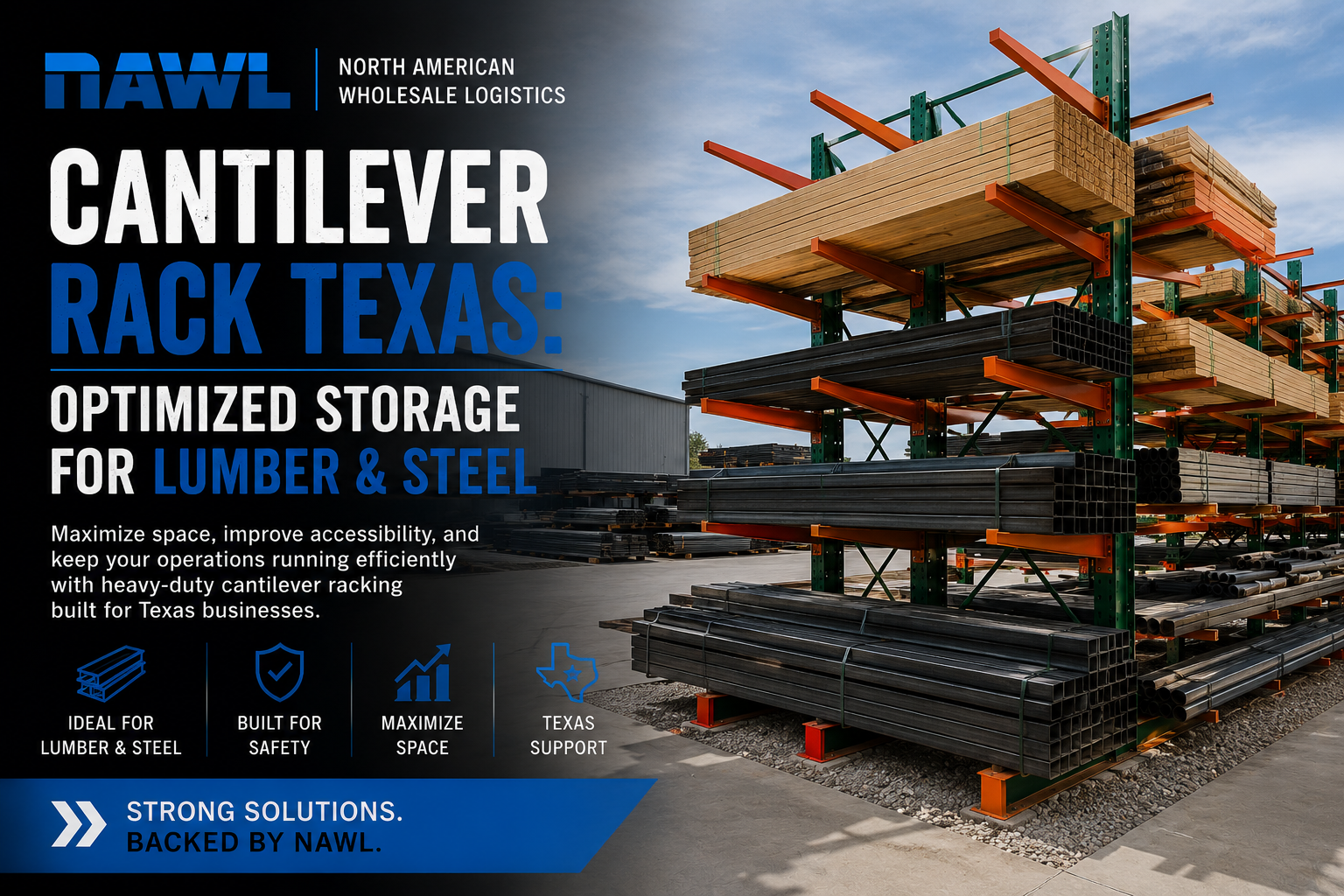
For lumber yards and steel distributors across North Texas, efficient and safe storage of long, bulky materials is not just a convenience—it's a necessity. From Waxahachie to Weatherford, Ennis to Cleburne, businesses dealing with pipe, lumber, bar stock, or structural steel face unique challenges that traditional pallet racking cannot address. This is where cantilever rack systems become indispensable, offering a specialized solution engineered for these exact demands.
A good cantilever layout does more than get material off the floor. It sets up your yard or warehouse so crews can identify stock faster, pick with fewer touches, reduce product damage, and keep lift truck traffic predictable. For long loads, the storage system becomes part of the handling process. If the rack does not match the product length, bundle weight, forklift type, and aisle plan, the operation will fight the rack every day.
Why Cantilever Racks are Essential for Long Products
Traditional selective pallet racking is designed for palletized goods. When you attempt to store long, unwieldy items on standard rack, you encounter limitations: materials overhang, creating safety hazards; bay widths become inefficient; and loading/unloading operations are slow and cumbersome. Cantilever racks eliminate these issues because they are designed without front columns, allowing for clear, unobstructed access to materials from end to end. This design is critical for improving operational flow and safety in any facility handling structural components or long-dimension lumber.
The difference is simple: pallet rack supports a load between two front columns and two rear columns. Cantilever rack supports the load on projecting arms tied back to a vertical column and base. That open face lets a forklift handle long product squarely, instead of threading it between frames. It also makes it easier to store mixed lengths because the load can run across multiple arms without being trapped by bay openings.
For Texas pallet rack users who are expanding into lumber, steel, pipe, conduit, or trim storage, cantilever is often the safer and cleaner choice. Standard warehouse racking can still be the right answer for pallets, cartons, and skids. But when the product is long, bundled, flexible, or loaded by side approach, cantilever rack is usually the purpose-built tool.
Open Access for Efficient Material Handling
The primary advantage of cantilever rack is its open design. Imagine a lumber storage rack DFW area, where 20-foot beams need to be accessed quickly. With cantilever, forklifts can approach the rack directly, place or retrieve items without maneuvering around uprights, and utilize the full length of the bay. This significantly reduces handling time, preventing bottlenecks and improving overall throughput. For distributors with high inventory turnover, this efficiency translates directly to reduced labor costs and faster customer service.
Open access also helps with accuracy. Operators can see the face of the load, verify the product, and pull the right bundle without digging through stacked material. This matters in yards where similar items sit close together: 2x material by length, pipe by diameter and wall, angle by leg size, or bar stock by grade. The less time operators spend sorting and shifting loads, the less damage occurs.
A well-planned cantilever system should match the forklift and the load. Side loaders, multidirectional forklifts, and standard counterbalance trucks all influence aisle width and arm elevation. In indoor warehouses, clear height, column spacing, fire protection, lighting, and dock flow must be considered. In outdoor yards, truck paths, drainage, wind exposure, and surface conditions matter just as much.
Custom Solutions for North Texas Operations
NAWL understands that an off-the-shelf solution rarely fits the precise needs of every operation. Whether you're a steel distributor in Dallas handling heavy I-beams or a lumberyard in Waxahachie storing varied lengths of treated lumber, your cantilever rack Texas system must be tailored. Our approach involves assessing your specific material dimensions (length, weight, height), workflow, and available floor space to design a system that optimizes every square foot.
As a pallet rack manufacturer in Venus, Texas, NAWL works with dealers and quick-ships from stock where available, which helps North Texas projects move without unnecessary delays. Local manufacturing knowledge is useful when a project needs practical answers: how much capacity is needed, what arm length makes sense, how high to build, whether outdoor protection is required, and how the rack will be installed on the existing slab or yard surface.
The starting point is a material schedule. List the longest product, shortest product, heaviest bundle, typical bundle depth, and how often each SKU turns. From there, the rack can be sized around real operating conditions rather than a rough guess. For example, a rack storing 20-foot lumber packs may use different arm spacing than a rack storing 12-foot steel tube bundles. The goal is to support the load evenly, prevent sagging, and keep pick faces organized.
Heavy-Duty Cantilever for Steel Distribution
For steel storage rack Dallas facilities, the primary concern is load capacity. Steel products—bar stock, tubing, sheet bundles, or rebar—are inherently heavy. Cantilever systems designed for steel distribution feature robust uprights and arms, often fabricated from structural steel, capable of supporting thousands of pounds per arm. These systems ensure that your valuable inventory is stored securely, preventing damage and ensuring worker safety. For operations near Ennis or Cleburne, where heavy loads are common, investing in a properly spec'd heavy-duty cantilever system is non-negotiable.
Steel storage also requires attention to load shape. Round pipe can roll if it is not contained. Bar stock can deflect if arms are spaced too far apart. Bundles may not distribute weight evenly, especially when banding is loose or product is picked down over time. Arm lips, removable pipe stops, dividers, and decking options can help control product movement, but they must be matched to the way the material is handled.
When sizing heavy-duty cantilever for steel, focus on these details:
| Design factor | Why it matters | Practical question |
|---|---|---|
| Arm capacity | Each arm carries a share of the bundle weight | What is the heaviest bundle and how many arms support it? |
| Upright capacity | The column must carry all loaded arms on one or both sides | How many levels will be loaded at the same time? |
| Base length | The base resists overturning and supports the lower load | Is the rack single-sided or double-sided? |
| Arm spacing | Spacing controls sag and load distribution | Does the material need support every 4, 5, or 6 feet? |
| Forklift access | Aisle width affects speed and safety | What truck type, load length, and turning radius are used? |
Arm capacity
- Why it matters
- Each arm carries a share of the bundle weight
- Practical question
- What is the heaviest bundle and how many arms support it?
Upright capacity
- Why it matters
- The column must carry all loaded arms on one or both sides
- Practical question
- How many levels will be loaded at the same time?
Base length
- Why it matters
- The base resists overturning and supports the lower load
- Practical question
- Is the rack single-sided or double-sided?
Arm spacing
- Why it matters
- Spacing controls sag and load distribution
- Practical question
- Does the material need support every 4, 5, or 6 feet?
Forklift access
- Why it matters
- Aisle width affects speed and safety
- Practical question
- What truck type, load length, and turning radius are used?
As a worked example, consider a 4,000-pound bundle of steel tube stored across four arms. If the bundle sits evenly, each arm carries about 1,000 pounds. That does not mean a 1,000-pound arm is automatically enough. The design still needs to account for arm length, load position on the arm, impact risk, rack configuration, and the total load on the upright. A bundle placed near the arm tip creates more force than one centered close to the column, so accurate layout and operator training matter.
Optimized Cantilever for Lumber Yards
Lumber yards in the DFW metroplex, including those in high-growth areas like Celina or Anna, benefit from cantilever's flexibility. Lumber storage rack DFW systems can be configured with varying arm lengths and capacities to accommodate everything from dimensional lumber to engineered wood products (EWP). The ability to store different lengths on the same level, or to adjust arm spacing, offers unparalleled versatility. Furthermore, outdoor cantilever options, often galvanized or coated, protect materials from the elements—a crucial consideration for North Texas weather patterns that can shift from intense sun to heavy rain.
Lumber is lighter than steel in many applications, but it brings its own storage problems. Boards can bow if support points are too far apart. Treated lumber, wet lumber, and engineered products may have different bundle weights. Product labeling must stay visible for fast picking. Outdoor racks may need enough clearance for banding, wrapping, and dunnage. If the rack is used for retail or contractor pickup, traffic patterns need to separate customers, loaders, and delivery trucks where possible.
A lumber yard layout often benefits from grouping products by movement. High-turn dimensional lumber belongs where forklifts can reach it quickly and trucks can be loaded with minimal travel. Slower-moving specialty items can use upper levels or less central rack runs. Cantilever makes that zoning easier because the face is open and levels can be assigned by length, species, treatment, or product family.
Key Considerations for Your Cantilever Rack Investment
Before implementing a cantilever rack system, several factors should be carefully evaluated to ensure longevity, safety, and operational effectiveness.
| Consideration | What to confirm before ordering |
|---|---|
| Product length | Longest stock length, common lengths, and allowed overhang |
| Bundle weight | Maximum actual weight, not just average weight |
| Arm length | Depth needed to support the load without excessive overhang |
| Arm spacing | Number of arms under each load and spacing between columns |
| Upright height | Clear height, lift height, sprinklers, lights, and building obstructions |
| Rack type | Single-sided against a wall or double-sided for aisle access on both sides |
| Environment | Indoor, outdoor, coated, galvanized, or other finish requirements |
| Concrete or surface | Slab thickness, condition, levelness, and anchor requirements |
Product length
- What to confirm before ordering
- Longest stock length, common lengths, and allowed overhang
Bundle weight
- What to confirm before ordering
- Maximum actual weight, not just average weight
Arm length
- What to confirm before ordering
- Depth needed to support the load without excessive overhang
Arm spacing
- What to confirm before ordering
- Number of arms under each load and spacing between columns
Upright height
- What to confirm before ordering
- Clear height, lift height, sprinklers, lights, and building obstructions
Rack type
- What to confirm before ordering
- Single-sided against a wall or double-sided for aisle access on both sides
Environment
- What to confirm before ordering
- Indoor, outdoor, coated, galvanized, or other finish requirements
Concrete or surface
- What to confirm before ordering
- Slab thickness, condition, levelness, and anchor requirements
Material Type and Weight
Accurately categorize the materials you intend to store. The weight per linear foot of steel differs significantly from that of lumber. This data directly influences the required capacity of the cantilever arms and uprights. Overestimating risks structural failure; underestimating leads to wasted investment and potential hazards.
In practice, the safest way to start is to identify the worst-case load for each level. Use purchase records, supplier bundle weights, mill tags, or scale weights where available. Do not size the system only around the product stored today if purchasing patterns are likely to change. Many operations add heavier material after rack is installed because the new storage space makes it possible. That is where a little planning can prevent an expensive retrofit later.
Also consider how loads change during picking. A full lumber pack may sit flat, while a partial pack may become uneven. A bundle of pipe may shift after several pieces are removed. Operators should be trained to re-band, re-stack, or reposition partial loads when needed. Rack capacity is only useful when the load is placed as intended.
System Configuration and Footprint
Will your system be single-sided, against a wall, or double-sided, allowing access from both aisles? The available clear height in your facility is also critical for determining upright height. Maximize vertical space to get the most out of your footprint, especially in expensive industrial real estate markets around cities like Fort Worth or Denton. A well-designed cantilever rack Texas solution will minimize aisles while maintaining safe operational clearance.
Single-sided rack works well along walls, fence lines, or yard perimeters. Double-sided rack improves density because one upright line serves both sides, but it requires traffic access on both faces and proper base design. For heavy steel, aisle width should be based on the actual load length and truck geometry, not a generic warehouse aisle number. Long loads swing wider, and operators need room to align the bundle before placing it on the arms.
Common mistakes include placing rack too close to building columns, ignoring door clearances, failing to account for fire lanes, and setting the first arm level too low for safe fork entry. Another mistake is designing for maximum density without leaving staging space. Lumber and steel orders often need to be picked, checked, banded, and loaded. If there is no staging area, aisles become temporary storage, which slows every lift truck in the building.
Installation Best Practices
Proper installation is paramount for any racking system, especially cantilever. Anchoring to the concrete slab must meet engineering specifications to prevent tipping. Foundations must be level and capable of bearing the total load. NAWL provides professional installation services, ensuring your system is set up correctly and safely from day one, meeting all local codes and industry standards.
Installation should begin with a layout check against the approved plan. Verify aisle dimensions, row starts, building obstructions, slab condition, and elevation changes before drilling anchors. Uprights should be plumb, bases aligned, braces installed correctly, and arms pinned or secured according to the rack design. Capacity labels or load information should be visible so operators know the allowable limits.
After installation, inspection should become routine. Look for bent arms, damaged bases, loose anchors, missing stops, scraped columns, cracked concrete around anchors, and loads stored beyond the intended arm length. Any rack that has been struck by equipment should be evaluated before it is reloaded. Small damage on a cantilever arm can become a larger issue because long loads place leverage on the system.
The NAWL Advantage
As a US-based manufacturer, NAWL delivers high-quality, durable cantilever rack systems designed to withstand the demands of industrial use. Our local expertise means we understand the specific needs of businesses in North Texas, offering solutions that stand the test of time and support your operational goals. Investing in a NAWL cantilever system is an investment in safety, efficiency, and long-term material handling effectiveness.
NAWL brings practical rack knowledge to projects that need straight answers. For a dealer, contractor, lumber yard, steel house, or warehouse manager, that means help with component selection, capacity questions, layout constraints, and lead-time planning. Because NAWL is based in Venus, Texas and sells through dealers, North Texas customers can work with a manufacturer that understands the regional industrial market while still supporting the dealer channel.
For businesses across North Texas, from the bustling industrial zones of Dallas to the growing distribution hubs around Weatherford and Cleburne, optimizing your storage for lumber and steel is a critical component of success. NAWL provides robust, engineered cantilever rack solutions that meet these challenges head-on.
Ready to transform your lumber or steel storage? Contact NAWL today for a custom cantilever rack quote and discover the difference a purpose-built system can make for your North Texas operations.
Ready to spec a system? Request a quote and our team will size it with you.
Related reading
Frequently asked questions
What is cantilever rack best used for?
Cantilever rack is best for long, bulky, or irregular products such as lumber, pipe, tubing, bar stock, rebar, structural steel, and engineered wood products. The open-front design allows forklifts to load and unload from the side without front columns blocking access.
How do I know what arm capacity I need?
Start with the heaviest bundle weight and divide it by the number of arms supporting that load, then review the result with the arm length, load position, and upright capacity. The final specification should be based on the full rack design, not just a simple weight division.
Is cantilever rack suitable for outdoor Texas yards?
Yes, cantilever rack can be used outdoors when the system, finish, anchoring, and layout are selected for the environment. North Texas sun, rain, wind, and yard surface conditions should all be considered before installation.
Should I choose single-sided or double-sided cantilever rack?
Single-sided rack is common against walls or perimeters. Double-sided rack can improve storage density and access from two aisles, but it requires enough operating clearance on both sides and a base designed for that configuration.
Can cantilever rack store both lumber and steel?
It can, but the rack must be sized for the heaviest and most demanding material stored on it. Steel loads usually drive capacity requirements, while lumber may drive length, product separation, and outdoor handling needs.
How often should cantilever rack be inspected?
Operators should watch for obvious damage during daily use, and management should schedule routine formal inspections. Any rack hit by a forklift or showing bent arms, loose anchors, damaged bases, or cracked concrete should be evaluated before continued use.