Bill of Materials for a Three-Column Cantilever Run
November 12, 2026
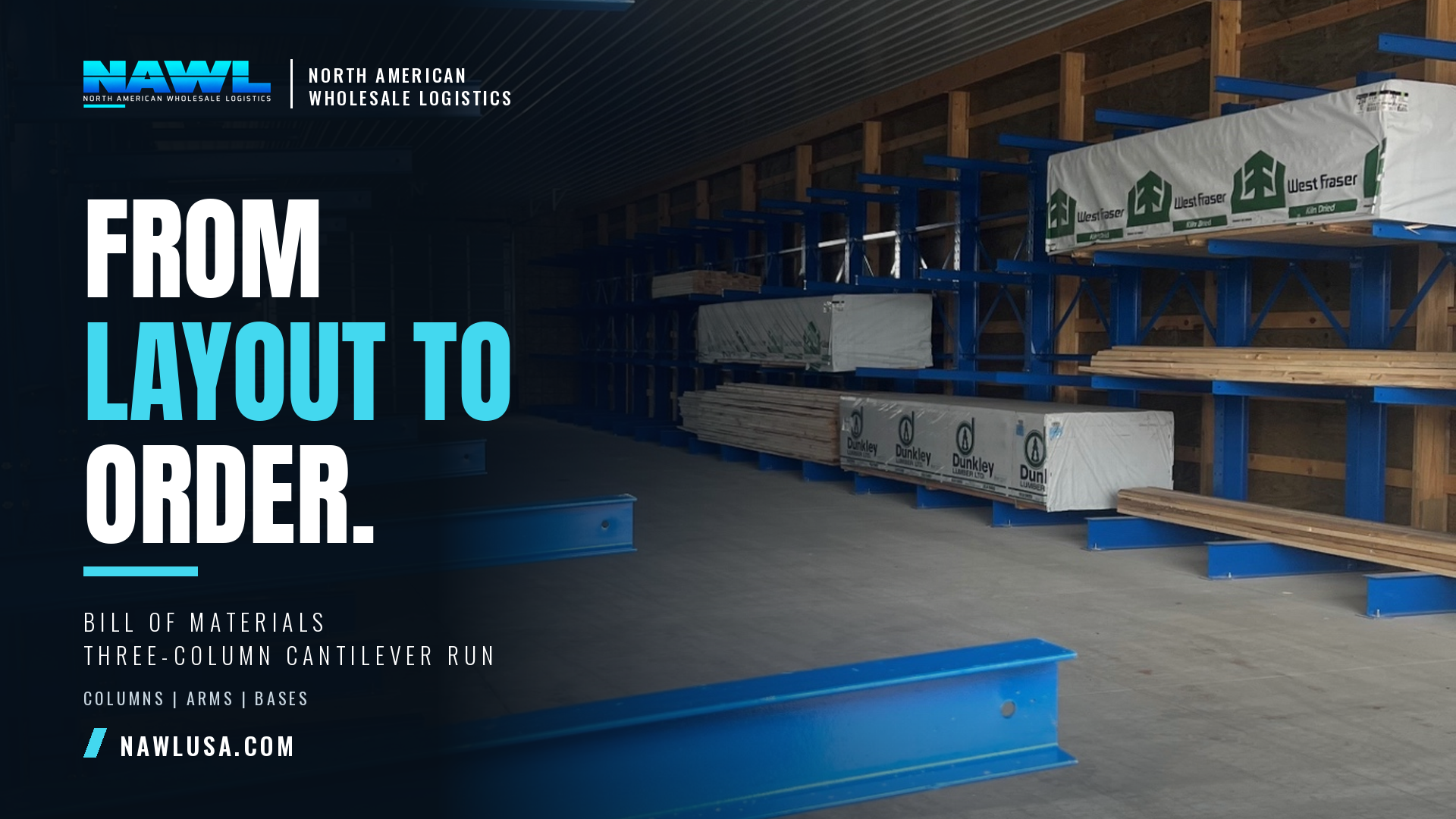
A three-column cantilever run with four arm levels needs 3 columns, 3 bases, 12 arms, and anchors for each base. With 12-foot columns and 60-inch arms, four arms per side add up to 13,040 lbs, which is above the 12,980 lbs per side column rating, so the column is the limit. Build the list, then check capacity before you order.
A bill of materials, or BOM, is the bridge between a sketch and a purchase order. Getting the counts right saves a second freight bill.
What does the layout look like?
Three columns in a row form two bays. Long stock rests across all three columns, so each bundle gets support at three points. Each level has one arm per column. With four levels, you have four arms on each column.
What goes on the list?
| Item | Quantity | Notes |
|---|---|---|
| 12 ft columns | 3 | Rated 12,980 lbs per side |
| 60 in bases | 3 | Each base matches the deepest arm |
| 60 in arms | 12 | Four levels times three columns; 3,260 lbs each |
| Anchors | Per base | Confirm anchor type for your slab or pad |
| Shims | As needed | For leveling on uneven floors |
| Arm end stops | As needed | Ask what options exist |
| Capacity sign | One per bay | Post the governing rating |
12 ft columns
- Quantity
- 3
- Notes
- Rated 12,980 lbs per side
60 in bases
- Quantity
- 3
- Notes
- Each base matches the deepest arm
60 in arms
- Quantity
- 12
- Notes
- Four levels times three columns; 3,260 lbs each
Anchors
- Quantity
- Per base
- Notes
- Confirm anchor type for your slab or pad
Shims
- Quantity
- As needed
- Notes
- For leveling on uneven floors
Arm end stops
- Quantity
- As needed
- Notes
- Ask what options exist
Capacity sign
- Quantity
- One per bay
- Notes
- Post the governing rating
Counts change with the layout. Single-sided runs need arms on one side only. A double-sided run doubles the arm count for the same columns.
How do you check capacity?
For one side of one column:
- Four 60-inch arms at 3,260 lbs each add up to 13,040 lbs
- The 12-foot column rating is 12,980 lbs per side
- The column limit governs, so treat 12,980 lbs as the ceiling, not 13,040
The whole run, if every level were loaded to the limit, would carry at most three columns at 12,980 lbs per side, which is 38,940 lbs on one face. Real loads are usually lower, and the arms themselves must hold each bundle's share. The capacity per side worked example covers the logic.
What about arm levels?
Set levels in 4-inch steps based on your tallest bundle per level. See setting arm levels in 4-inch increments. Put heavy stock low.
What else do people forget?
- Anchors that suit the surface. Slab, pad or something else. See anchoring cantilever bases to an indoor slab
- Pad or footing work for outdoor runs. See outdoor cantilever concrete pads and frost depth
- Galvanized finish if the run is outside. See galvanized vs. powder-coated cantilever
- Capacity signs. See what to post
- A spare arm or two.
- Freight and receiving. Columns are long. See how stock cantilever ships to Minnesota
How do you size the run for your stock?
Bundle length decides column spacing. Pick spacing so the bundle rests on at least two supports and ideally three, with a modest overhang at each end. Confirm the arm and spacing for flexible stock. See choosing arm length for your longest stock.
Can I expand the run later?
Yes. Standard sizes make it easy to add a column and a set of arms. See expanding a cantilever system later.
What should I send for a quote?
Send your stock lengths and weights, column height, single- or double-sided, finish, and site type. Use the RFQ checklist. Stock items typically dispatch within 48 to 72 hours of ordering. NAWL supplies cantilever rack and components and does not install.
Frequently asked questions
Do I need one base per column? Yes, each column sits on a base.
Can I use 48-inch arms on a 60-inch base? Yes. The base follows the deepest arm.
Is the example a design? No. It is an illustration. Confirm your layout with your supplier and engineer.
Ready to turn your sketch into an order?
Send your layout and stock details, and we will build the parts list from stock.