Cantilever Racking in Minneapolis
September 27, 2026
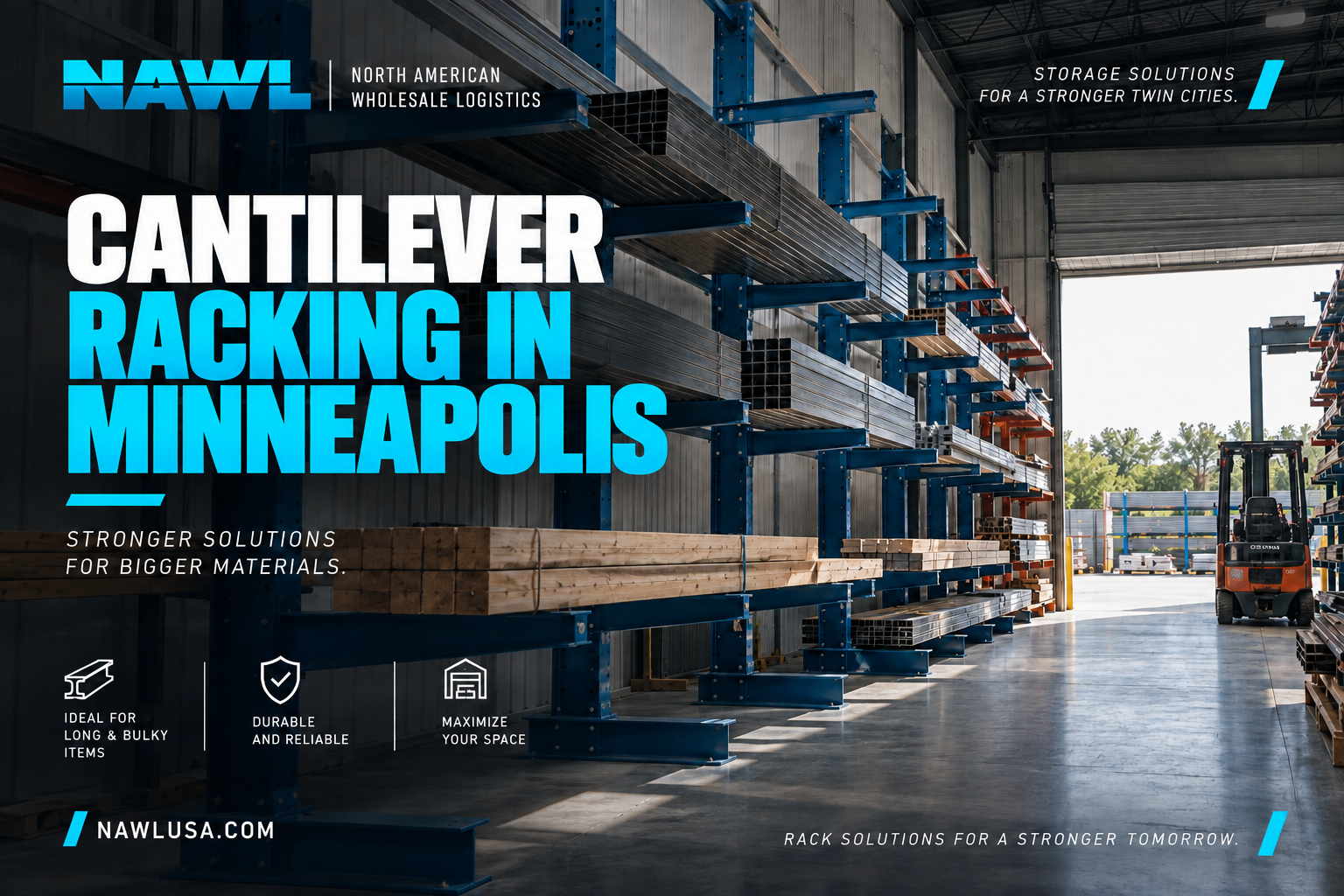
Cantilever racking in the Twin Cities typically runs $200–$550 per arm/column assembly, sized for lumber, steel, pipe, and agricultural equipment storage. Outdoor yard systems in Minnesota require additional bracing for snow and frost-heave loads not found in warmer climates. NAWL USA's Midwest division stocks cold-climate-rated cantilever for quick-ship delivery across the 200-mile Minneapolis service area.
If you're storing lumber, pipe, steel stock, or ag implement components, standard pallet racking usually isn't the right fit — cantilever racking is built specifically for loads that don't fit on a pallet. Here's what it costs, how to configure it for Minnesota's climate, and how fast you can get it installed.
How much does cantilever racking cost in Minneapolis?
Pricing depends on arm length, capacity, and whether you need a single-sided or double-sided base:
- Single-sided cantilever (wall-backed or one-way access): roughly $200–$350 per arm/column assembly
- Double-sided cantilever (pick from both sides): roughly $350–$550 per assembly, since you're getting two arm sets per column run
- Outdoor/covered yard systems run slightly higher due to cold-climate coating and footing requirements
Arm length and load capacity are the biggest cost drivers — a 4-foot arm rated for 1,500 lbs costs meaningfully less than an 8-foot arm rated for 4,000+ lbs. We'll walk through your actual load list before quoting rather than pricing off a generic per-foot number.
Single-sided vs. double-sided cantilever racking — which do I need?
This comes down to how your aisle is laid out:
- Single-sided makes sense against a wall, fence line, or building perimeter where you only need to load/unload from one side.
- Double-sided puts two rows of arms on shared columns, letting you pick from both sides of the same run — this usually means fewer total columns and more storage density per square foot of floor or yard space.
Most indoor manufacturing floors and covered yards do better with double-sided configurations. Perimeter or fence-line outdoor storage is more often single-sided.
What loads is cantilever racking best suited for?
Cantilever racking earns its keep with long, bulky, or awkwardly shaped inventory:
| Arm Length | Capacity per Arm (lbs) | Base Type | Typical Use Case |
|---|---|---|---|
| 4 ft | 1,500–2,500 | Single or double | Pipe, conduit, smaller lumber |
| 6 ft | 2,000–3,500 | Single or double | Standard dimensional lumber, tubing |
| 8 ft | 2,500–4,500 | Single or double | Long steel stock, oversized lumber |
| 10+ ft | 3,000–6,000+ | Double (typical) | Structural steel, long pipe, ag implement components |
4 ft
- Capacity per Arm (lbs)
- 1,500–2,500
- Base Type
- Single or double
- Typical Use Case
- Pipe, conduit, smaller lumber
6 ft
- Capacity per Arm (lbs)
- 2,000–3,500
- Base Type
- Single or double
- Typical Use Case
- Standard dimensional lumber, tubing
8 ft
- Capacity per Arm (lbs)
- 2,500–4,500
- Base Type
- Single or double
- Typical Use Case
- Long steel stock, oversized lumber
10+ ft
- Capacity per Arm (lbs)
- 3,000–6,000+
- Base Type
- Double (typical)
- Typical Use Case
- Structural steel, long pipe, ag implement components
In the Twin Cities, we see this most often with lumber yards and building materials dealers, steel and pipe distributors, and agricultural equipment dealers storing implement attachments, axles, and hydraulic tubing that would otherwise sit on the ground taking up floor space and getting damaged.
Does cantilever racking need special bracing for snow and frost loads?
Yes — and this is the biggest difference between cantilever racking specified for Minnesota versus a supplier working off a generic national spec sheet. Two things matter:
- Snow load on covered/canopy structures. If your cantilever system has a roof or canopy, it needs bracing rated for local ground snow load values, which vary by county. Open, uncovered arm structures don't carry this requirement, but anything with a roof does.
- Frost heave on outdoor footings. Footings for outdoor cantilever bases need to be set below the local frost line — otherwise repeated freeze-thaw cycles can gradually shift the base out of plumb over a few winters, even if the rack itself is rated for the load.
We cover both of these in detail in our cantilever snow load and bracing requirements guide, including footing depth by region.
Twin Cities service area
NAWL USA's Midwest Division installs cantilever racking throughout Minneapolis and within a 200-mile radius, including St. Paul, St. Cloud, Rochester, Mankato, Duluth, and Eau Claire, WI. Quick-ship inventory ships within 72 hours for standard configurations across the Twin Cities metro.
Frequently asked questions
Can cantilever racking be quick-shipped year-round? Indoor and covered-yard installs, yes. Open outdoor yard installs during frozen-ground months may need extended scheduling for footing work — see our quick-ship cantilever program for the seasonal breakdown.
Can I mix cantilever with standard pallet racking in the same building? Yes — many Minneapolis facilities use cantilever for long stock and selective pallet racking for palletized goods in the same warehouse. See our cantilever vs. pallet racking guide.
Do I need an engineered drawing for an outdoor system? We strongly recommend it. A generic published capacity chart doesn't account for Minnesota-specific snow and frost loads — see our cantilever capacity chart for what a general reference chart does and doesn't cover.
Ready to get a quote?
Get pricing on cantilever racking sized and braced for Minnesota's climate — standard configurations ship and install within 72 hours across the Twin Cities.
Request a Minneapolis Cantilever Quote →