Reading Cantilever Capacity Per Side: A Worked Example
October 30, 2026
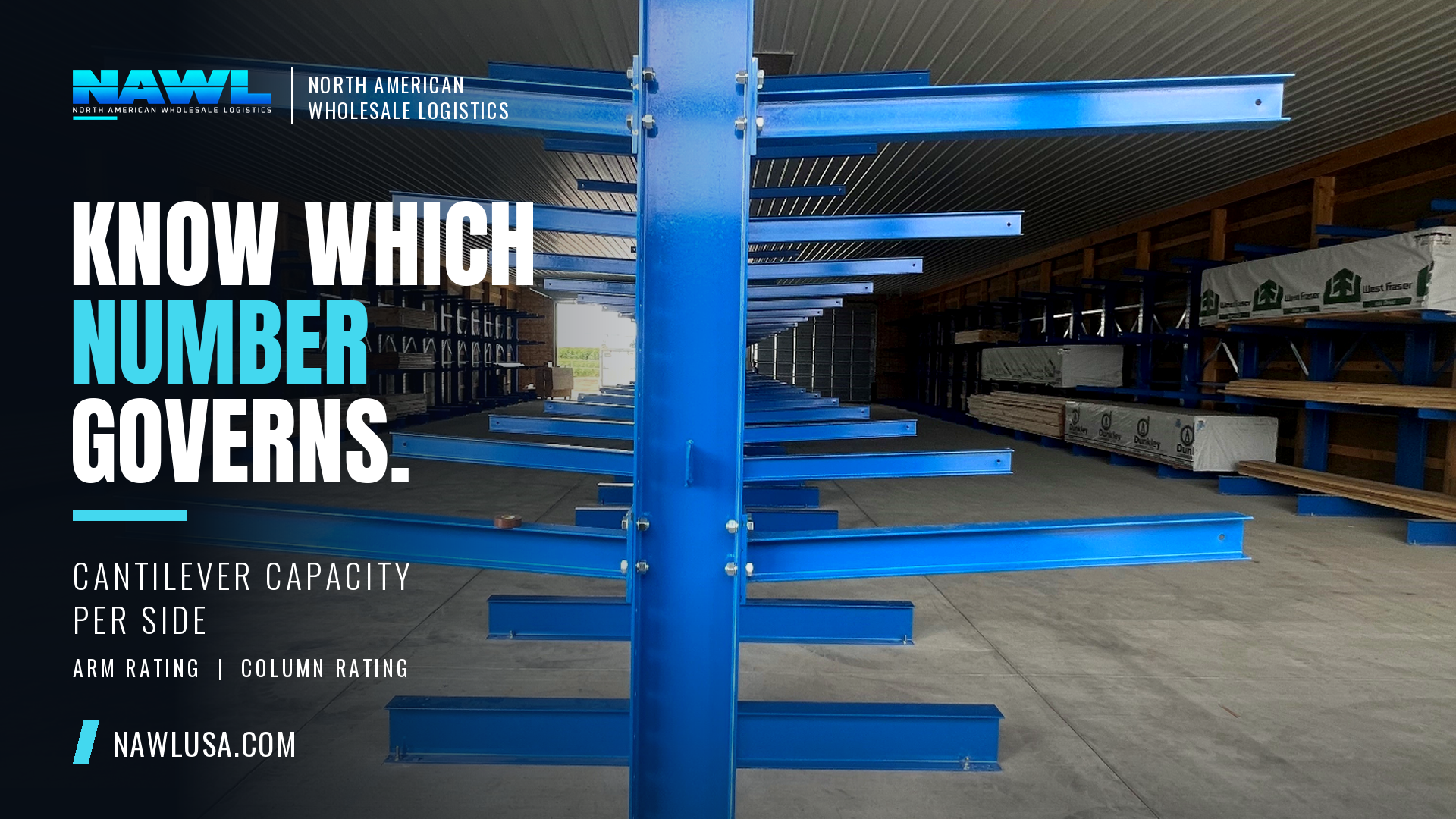
A cantilever system has two limits: what each arm can carry and what each column can carry per side. The lower of the two governs. With 60-inch arms at 3,260 lbs each on a 12-foot column rated 12,980 lbs per side, four arms add up to 13,040 lbs, so the column limit controls, not the arms.
Most overload mistakes come from checking one number and ignoring the other. Here is how to check both.
What are the stock ratings?
| Component | Rating |
|---|---|
| 12 ft column | 12,980 lbs per side |
| 16 ft column | 11,660 lbs per side |
| 48 in arm | 2,640 lbs each |
| 60 in arm | 3,260 lbs each |
12 ft column
- Rating
- 12,980 lbs per side
16 ft column
- Rating
- 11,660 lbs per side
48 in arm
- Rating
- 2,640 lbs each
60 in arm
- Rating
- 3,260 lbs each
These are catalog ratings for stock components. Confirm how they apply to your exact configuration on your quote, and do not treat them as a substitute for site engineering.
How do you run the check?
For each side of a column:
- Count the arms on that side
- Multiply by the arm rating
- Compare the total with the column's per-side rating
- The smaller number is your ceiling for that side
- Check each arm's own load, too
What does the math look like?
If arms were loaded to their full rated limits:
| Column | Arms on one side | Arm total | Column limit | What governs |
|---|---|---|---|---|
| 12 ft | Three 60 in | 9,780 lbs | 12,980 | Arms |
| 12 ft | Four 60 in | 13,040 lbs | 12,980 | Column |
| 12 ft | Four 48 in | 10,560 lbs | 12,980 | Arms |
| 12 ft | Five 48 in | 13,200 lbs | 12,980 | Column |
| 16 ft | Three 60 in | 9,780 lbs | 11,660 | Arms |
| 16 ft | Four 60 in | 13,040 lbs | 11,660 | Column |
12 ft
- Arms on one side
- Three 60 in
- Arm total
- 9,780 lbs
- Column limit
- 12,980
- What governs
- Arms
12 ft
- Arms on one side
- Four 60 in
- Arm total
- 13,040 lbs
- Column limit
- 12,980
- What governs
- Column
12 ft
- Arms on one side
- Four 48 in
- Arm total
- 10,560 lbs
- Column limit
- 12,980
- What governs
- Arms
12 ft
- Arms on one side
- Five 48 in
- Arm total
- 13,200 lbs
- Column limit
- 12,980
- What governs
- Column
16 ft
- Arms on one side
- Three 60 in
- Arm total
- 9,780 lbs
- Column limit
- 11,660
- What governs
- Arms
16 ft
- Arms on one side
- Four 60 in
- Arm total
- 13,040 lbs
- Column limit
- 11,660
- What governs
- Column
The takeaway: adding more arm levels does not add capacity once the column is the limit. A fourth level on a 16-foot column can sit on arms that could carry more than the column will allow.
Does real stock weigh as much as the rating?
Usually not, and that is the point. Your actual load per arm is your bundle weight divided by the number of arms supporting it. A bundle that weighs 4,000 lbs across two 60-inch arms puts 2,000 lbs on each arm, well under 3,260. Run the numbers with real bundle weights, not guesses. Weigh a sample. See choosing arm length for your longest stock.
What about uneven loads?
Heavy bundles on the top arm raise the center of gravity and add leverage. Put the heaviest loads low. Keep loads centered on the arms, with the bundle resting over most of the arm depth. See load placement on cantilever rack and arm end stops and load centering.
What about double-sided columns?
Ratings are listed per side. When both sides carry loads, keep them reasonably balanced and ask how the rating applies to your configuration. See single-sided vs. double-sided cantilever.
What about snow and outdoor loads?
Outdoor arms can pick up snow and ice, which adds weight that is not on your inventory sheet. Leave a margin and clear arms safely. See snow and ice on outdoor cantilever arms and the snow load and bracing requirements guide.
What if I need more than stock ratings?
Heavier columns are available on a 7 to 10 day lead time. See when to order heavier cantilever columns.
Frequently asked questions
Which rating do I post on the rack? Post the lowest governing rating for each bay. See capacity signs: what to post.
Can I exceed the column rating if the arms can take more? No. The column limit still applies.
Does the example apply to other brands? No. Use each manufacturer's own ratings.
Want a capacity check on your layout?
Send your bundle weights, arm counts and column height, and we will review them against stock ratings.