Abilene Pallet Rack for Wind Energy, Ag, & Distribution
August 3, 2026
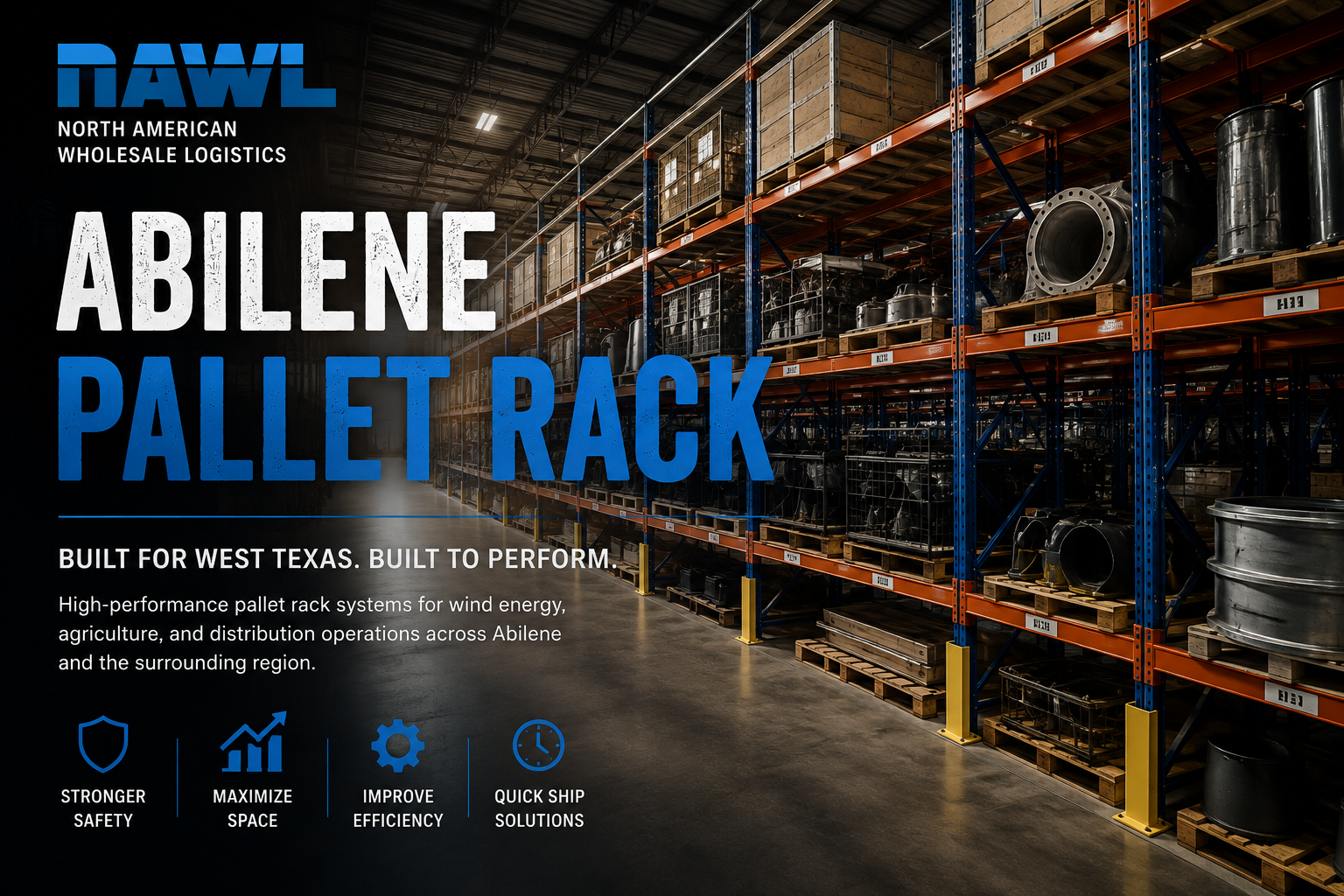
Abilene, Texas, serves as a pivotal logistical center in West Texas. Its strategic location makes it essential for industries ranging from the booming wind energy sector to established agricultural operations and general distribution networks. Operating a warehouse in Abilene, TX, particularly one supporting these diverse industries, requires robust and adaptable storage solutions. Effective warehouse storage in West Texas is not just about holding inventory; it’s about optimizing space, improving throughput, and ensuring the safety of specialized and often oversized goods. This demands a thoughtful approach to pallet rack selection and design.
For many Abilene facilities, the rack system has to support more than standard 48 x 40 pallet loads. A single building may handle replacement wind components, palletized seed, boxed industrial supplies, and bulky service parts. That mix affects beam length, upright depth, capacity, aisle layout, forklift selection, guard protection, and the way inventory is slotted. The right Texas pallet rack plan starts with the load and works backward to the building, equipment, and workflow.
Understanding Abilene’s Unique Storage Needs
The economic landscape of Abilene presents specific challenges and opportunities for warehouse management. Each primary industry—wind energy, agriculture, and general distribution—has distinct requirements that influence the type of pallet rack system best suited for its operations.
A common mistake is treating all pallet rack as interchangeable. Upright frames, beams, wire decking, anchors, row spacers, column protectors, and rack accessories all need to match the actual application. A rack bay used for lightweight cartons is not the same as a bay used for gearboxes, chemical totes, large agricultural parts, or slow-moving wind service inventory.
Wind Energy Components: Specialized Wind Energy Storage Rack
The Permian Basin and surrounding West Texas region are at the forefront of wind energy production. This translates into a significant need for warehousing large, often irregularly shaped components such as turbine blades, nacelles, tower sections, and gearboxes. Standard pallet rack installations in Abilene may not suffice.
- Turbine Blades: Require very long, cantilevered racking or specialized A-frame racks to prevent warping and damage.
- Nacelles & Hubs: Heavy, bulky items necessitate heavy-duty selective rack or structural rack, often designed with extra-wide bays.
- Tower Sections: Can be stored horizontally on cantilever racking or custom-designed cradles.
- Spare Parts & Tools: Smaller, high-value components benefit from shelving, parts bins, or multi-level picking systems within a selective pallet rack framework.
Implementing a purpose-built wind energy storage rack system is crucial for minimizing damage, maximizing vertical space, and streamlining access for maintenance and deployment.
Wind energy storage often needs a split approach. Oversized components may belong in cantilever rack, floor-mounted cradles, or custom fixtures, while the replacement parts and consumables that keep field crews moving belong in standard selective pallet rack or carton flow. Mixing those categories without a plan creates congestion and raises the risk of damage.
| Wind inventory type | Storage concern | Practical rack approach |
|---|---|---|
| Long blades or blade sections | Length, deflection, surface damage | Cantilever rack, A-frame support, custom cradles |
| Gearboxes and hubs | Concentrated weight, lift clearance | Heavy-duty selective rack, structural rack, reinforced beam levels |
| Fasteners and service kits | SKU control, picking accuracy | Shelving, bins, pallet rack with lower pick levels |
| Maintenance tools | Security, frequent access | Caged areas, shelving, selective rack near dock or service zone |
Long blades or blade sections
- Storage concern
- Length, deflection, surface damage
- Practical rack approach
- Cantilever rack, A-frame support, custom cradles
Gearboxes and hubs
- Storage concern
- Concentrated weight, lift clearance
- Practical rack approach
- Heavy-duty selective rack, structural rack, reinforced beam levels
Fasteners and service kits
- Storage concern
- SKU control, picking accuracy
- Practical rack approach
- Shelving, bins, pallet rack with lower pick levels
Maintenance tools
- Storage concern
- Security, frequent access
- Practical rack approach
- Caged areas, shelving, selective rack near dock or service zone
For heavy components, capacity must be reviewed at the beam level and frame level. A rack beam pair rated for a certain load assumes the load is evenly distributed. If a gearbox sits on a small skid with point loads, decking, pallet supports, or custom supports may be required. Wind-related parts can also have odd center-of-gravity issues, so operators need defined pick points and clear storage procedures.
Agricultural Equipment & Supplies: Robust Warehouse Storage in West Texas
Agriculture remains a cornerstone of the West Texas economy. Warehouses in Abilene often store everything from large farm implements and spare parts to bulk agricultural chemicals, feed, and seed. The challenges here include varying sizes and weights, the potential for corrosive materials, and the need for quick turnaround during planting and harvest seasons.
- Heavy Equipment Parts: Engine blocks, transmissions, and large implements demand high-capacity selective rack or push-back systems.
- Bulk Goods: Drive-in or drive-through racks are effective for high-density storage of palletized bags of feed, fertilizer, or seed.
- Chemicals: May require specialized corrosion-resistant finishes on racking and proper ventilation and may need to be isolated in dedicated areas with appropriate containment.
- Seasonal Inventory: Rack systems must be flexible enough to handle significant fluctuations in inventory levels throughout the year.
Durability and load-bearing capacity are paramount for agricultural warehouse storage in West Texas.
Agricultural operations also need flexibility. During one part of the year, the building may be packed with seed and fertilizer. Later, the same footprint may be used for replacement parts, seasonal returns, or packaged supplies. Adjustable pallet rack is useful because beam levels can be reset as pallet heights change, but changes should be controlled. Moving beams without checking clearances and load plaques can create unsafe conditions.
Chemical storage deserves special attention. Rack steel, decking, and anchors can be affected by spills, humidity, and corrosive materials. Warehouses handling agricultural chemicals should review segregation, ventilation, spill containment, and local requirements before laying out the rack. In some cases, it is better to isolate chemical storage from general parts storage so lift traffic, picking labor, and spill response are easier to manage.
General Distribution: Maximizing Efficiency with Abilene Pallet Rack
Abilene's position as a distribution hub means warehouses handle a vast array of consumer goods, industrial supplies, and e-commerce inventory. These operations often require highly efficient picking processes and adaptable storage for diverse product lines.
- Selective Pallet Rack: The most common and versatile option, offering direct access to every pallet. Ideal for high SKU counts and diverse inventory.
- Push-Back Rack & Pallet Flow Rack: Excellent for high-density storage of products with multiple pallets per SKU, increasing storage capacity and improving pick face presentation.
- Very Narrow Aisle (VNA) Rack: Maximizes floor space utilization by reducing aisle widths, requiring specialized VNA forklifts.
- Mezzanines & Multi-Level Picking Systems: Can double or triple usable floor space, especially beneficial for e-commerce fulfillment centers handling smaller items.
For general distribution, the goals are often speed, accuracy, and maximum throughput while keeping operational costs down.
The best rack style depends on SKU count, pallet positions per SKU, rotation rules, and forklift fleet. Selective rack is simple and gives immediate access, but it may not provide enough density for a fast-growing operation. Push-back rack can increase pallet positions while keeping multiple pick faces available. Pallet flow can support first-in, first-out rotation where product dating matters. Drive-in rack can work for bulk storage, but it reduces selectivity and requires disciplined operation.
| Operation profile | Typical priority | Rack system to evaluate |
|---|---|---|
| High SKU count, mixed pallets | Access to every pallet | Selective pallet rack |
| Several pallets per SKU | Density with accessible lanes | Push-back rack |
| Date-sensitive inventory | FIFO rotation | Pallet flow rack |
| Bulk storage, few SKUs | Maximum density | Drive-in or drive-through rack |
| Small-item picking | Pick speed and ergonomics | Shelving, carton flow, mezzanine pick modules |
High SKU count, mixed pallets
- Typical priority
- Access to every pallet
- Rack system to evaluate
- Selective pallet rack
Several pallets per SKU
- Typical priority
- Density with accessible lanes
- Rack system to evaluate
- Push-back rack
Date-sensitive inventory
- Typical priority
- FIFO rotation
- Rack system to evaluate
- Pallet flow rack
Bulk storage, few SKUs
- Typical priority
- Maximum density
- Rack system to evaluate
- Drive-in or drive-through rack
Small-item picking
- Typical priority
- Pick speed and ergonomics
- Rack system to evaluate
- Shelving, carton flow, mezzanine pick modules
Designing Your Optimal Pallet Rack System in Abilene
Regardless of the industry, a well-designed pallet rack system considers several key factors:
- Weight & Dimensions: Accurate assessment of the heaviest and largest items to be stored is fundamental for selecting appropriate rack capacity and bay sizes.
- Footprint & Height: Maximizing vertical space is crucial in industrial real estate. Very tall racks often require specialized lift equipment.
- Inventory Turnover: Fast-moving goods benefit from easily accessible systems like selective or pallet flow, while slow-moving items can be stored in high-density solutions like drive-in rack.
- Material Handling Equipment: The type of forklifts and other equipment in use will dictate aisle widths and rack configurations.
- Budget: Balancing initial investment with long-term efficiency and durability is key.
- Safety & Codes: All installations must comply with local building codes, seismic requirements, and OSHA regulations. This is non-negotiable for employee safety and operational continuity.
Partnering with an experienced warehouse storage provider in West Texas ensures that these considerations are thoroughly addressed, leading to a safe, efficient, and compliant solution.
A good design package should identify bay widths, upright heights and depths, beam elevations, beam capacities, aisle widths, tunnel bays, flue spaces, and protection points. It should also reflect how trucks are loaded and unloaded. Dock doors, staging lanes, battery charging areas, offices, fire exits, and maintenance zones all compete for square footage. Rack that looks efficient on paper can fail operationally if it leaves too little room for staging or forklift turns.
Start with the load, not the rack
Before choosing a pallet rack style, document the actual unit loads. This includes pallet width, pallet depth, pallet height, maximum pallet weight, load overhang, pallet condition, and whether the product is stable on the pallet. Oversized wind components, ag parts, and irregular industrial supplies may require deeper frames, wider bays, or added pallet supports.
As a simple example, consider an Abilene distributor storing 2,000 pallets. If the operation uses standard selective rack with two pallet positions per beam level and four storage levels including the floor, each bay stores eight pallets. That requires roughly 250 bays before accounting for damaged goods, empty pallet storage, growth space, staging, and non-racked areas. If 30 percent of the inventory is high-volume product with five or more pallets per SKU, moving that portion into push-back rack may reduce the total footprint and shorten travel time. The right answer depends on the inventory profile, not just the building size.
Match aisle width to the forklift fleet
Forklift selection has a direct impact on warehouse racking layout. Counterbalance forklifts typically require wider aisles than reach trucks. VNA systems can compress aisles significantly, but they require specialized trucks, floor flatness review, guidance systems in many cases, and disciplined traffic control. A narrow rack layout that does not match the lift equipment will slow operators down and increase rack impacts.
When planning aisle widths, also consider load length. A forklift carrying a long agricultural implement or wind service component may need more clearance than the same forklift carrying a standard pallet. End-of-aisle protection, guard rail, and column protectors are especially important in these turning areas.
Plan for installation, anchoring, and inspection
Pallet rack installation is not just assembly. Uprights need to be plumb, beams must be fully engaged with safety locks, row spacers must be installed where required, and base plates must be properly anchored to the slab. Slab condition matters. Cracked concrete, thin slabs, buried utilities, and floor joints can affect anchor placement and rack layout.
After installation, the facility should maintain visible capacity information and a routine rack inspection process. Supervisors should look for bent columns, damaged braces, missing beam locks, loose anchors, overloaded bays, dislodged wire decking, and pallets stored incorrectly. Any damaged rack should be unloaded and evaluated before it is returned to service. This is especially important in Abilene facilities where heavy pallets and seasonal rush periods increase forklift traffic.
Avoid common pallet rack mistakes
Many rack problems start with reasonable shortcuts that create long-term costs. Common mistakes include buying used rack without verifying capacity, mixing incompatible components, ignoring pallet overhang, placing heavy loads on upper beam levels without review, underestimating staging space, and failing to protect rack ends near busy aisles. Another common issue is designing only for current inventory. If the business expects growth, new product lines, or larger pallets, reserve expansion zones or use rack dimensions that can adapt.
Cost also should be viewed over the life of the system. The lowest initial rack price may not be the lowest operating cost if it creates extra travel, frequent damage, poor selectivity, or slow picking. Lead time matters as well. Stocked pallet rack components can help projects move faster, while custom structural rack, cantilever systems, special finishes, or engineered pick modules may require more planning. For Abilene operations serving energy, agriculture, and distribution customers, delays in rack availability can turn into missed shipping windows.
Conclusion
Abilene, TX, presents a dynamic environment for warehousing, driven by the needs of the wind energy, agricultural, and distribution sectors. Implementing the right Abilene pallet rack system is not just an expenditure; it's a strategic investment that directly impacts operational efficiency, safety, and profitability. Whether you require a specialized wind energy storage rack for oversized components, robust solutions for agricultural equipment, or high-density systems for general distribution, a custom-engineered approach is essential. Evaluate your specific needs, consider future growth, and partner with experts to design and install a warehouse storage solution that empowers your Abilene operations to thrive.
Ready to optimize your Abilene warehouse? Request a custom quote today for expert pallet rack design and installation tailored to your industry's demands.
Frequently asked questions
What type of pallet rack works best for Abilene wind energy storage?
It depends on the component. Long blades and tower sections often need cantilever rack or custom cradles, while heavy boxed or skid-mounted parts may fit heavy-duty selective rack. Smaller service parts usually perform best in selective rack, shelving, or bin storage.
Can one rack system handle agricultural parts and general distribution inventory?
Yes, but the design must account for the heaviest and largest loads first. Many facilities use selective pallet rack for flexibility, then add drive-in, push-back, or bulk storage zones for seasonal goods with multiple pallets per SKU.
How should chemical storage affect warehouse racking decisions?
Agricultural chemicals may require separation, ventilation, containment, and corrosion-resistant considerations. Rack layout should support safe handling and inspection, and chemical storage areas should be reviewed for applicable local requirements.
What information is needed for a pallet rack quote?
Useful information includes pallet sizes, maximum pallet weights, desired storage positions, building clear height, slab condition, forklift type, dock layout, inventory mix, and any special requirements such as FIFO rotation or oversized components.
Why not use standard pallet rack for every product?
Standard pallet rack is versatile, but it is not always suitable for long, unusually heavy, corrosive, or irregular loads. Using the wrong rack can reduce capacity, damage inventory, slow down operators, and create safety issues.
How often should pallet rack be inspected?
Rack should be checked routinely by trained facility personnel, with additional inspections after forklift impacts or layout changes. Damaged components, missing locks, loose anchors, and overloaded bays should be addressed before the rack is used again.