Step Beam vs. Box Beam: Which Fits Your Pallets?
November 9, 2026
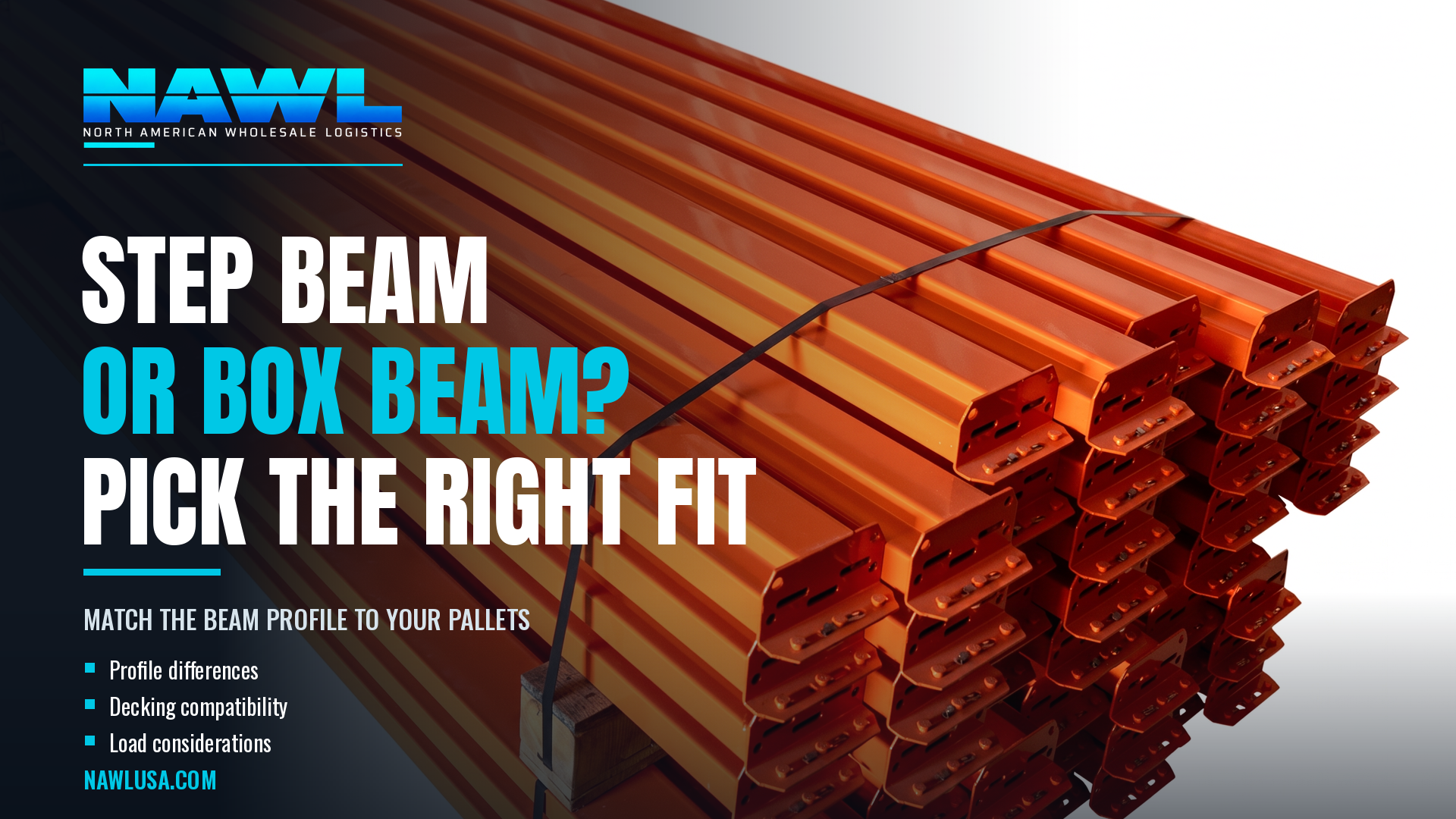
A step beam has a ledge along its inside edge that supports pallets or wire decking, while a box beam is a closed rectangular tube with a flat top. Step beams are common in teardrop rack that uses decking. Capacity depends on the specific beam, so compare load tables rather than profile names.
Many buyers focus on beam length and capacity and never ask about profile until they need decking and discover the beam does not support it the way they expected. Knowing the difference early prevents a surprise at install.
What is a step beam?
A step beam has a stepped cross-section. The upper edge steps inward to form a ledge, which gives a seat for wire decking or a pallet support to rest on. Because the deck sits down in the step rather than on top, it stays flush with the beam. That keeps usable vertical space between levels and helps decking stay put.
NAWL's stocked beams are step beams in face heights of 3 to 6 inches and lengths from 48 to 144 inches. If your project needs another profile, ask us what is available.
What is a box beam?
A box beam is a closed rectangular tube. It has a flat top surface and is often described as resisting twisting well. Pallets rest directly on the flat top, and decking, where used, sits on top of the beam rather than recessed into it.
Some systems pair box beams with pallet supports or deck clips to keep decking from sliding. Always follow the manufacturer's instructions for the combination you choose.
How do step and box beams compare?
| Feature | Step beam | Box beam |
|---|---|---|
| Profile | Open section with an inside ledge | Closed rectangular tube |
| Wire decking | Sits in the step, flush with the beam | Sits on top of the beam |
| Pallet support | Pallets rest on the beam or ledge | Pallets rest on the flat top |
| Typical use | Teardrop rack with decking | Heavy-duty or pallet-only layouts |
| What to verify | Capacity at your length | Capacity at your length and decking method |
Profile
- Step beam
- Open section with an inside ledge
- Box beam
- Closed rectangular tube
Wire decking
- Step beam
- Sits in the step, flush with the beam
- Box beam
- Sits on top of the beam
Pallet support
- Step beam
- Pallets rest on the beam or ledge
- Box beam
- Pallets rest on the flat top
Typical use
- Step beam
- Teardrop rack with decking
- Box beam
- Heavy-duty or pallet-only layouts
What to verify
- Step beam
- Capacity at your length
- Box beam
- Capacity at your length and decking method
This table describes general patterns. Beam capacity depends on steel gauge, face height, length, and the connector, so confirm numbers for the exact beam. For reference, NAWL lists 4-inch step beams at 4,027 lbs per pair at 96 inches and 5-inch step beams at 6,264 lbs per pair at the same length. Those figures are for evenly distributed loads.
Which should I choose for my pallets?
Start with your load and your deck plan:
- Will you use wire decking? If yes, a step profile is the usual match. See wire decking sizes and wire decking vs. pallet supports.
- How heavy are your loaded pallets? Check beam capacity per pair at your bay width. Our guide to beam capacity and load ratings explains how to read those numbers.
- Do you reconfigure often? Teardrop connectors on either profile make reconfiguration easy, but you must match beam connectors to your uprights.
- Do you have non-standard pallets? Damaged or unusual pallets may need deck support. See pallet condition and real capacity.
Can I mix step beams and box beams in one system?
Mixing profiles can work if the connectors fit the same uprights, but it can also create confusion about capacity, decking, and inspection. Mixing makes compatibility checks harder. If you must mix, label bays clearly and confirm each beam's rating. Our teardrop compatibility guide covers connector matching.
What are the common mistakes?
- Assuming any decking fits any beam
- Comparing beams by length alone and ignoring face height and gauge
- Forgetting beam locks or safety pins, which prevent accidental dislodging (see safety pins)
- Using an unmarked beam with no clear capacity label
Frequently asked questions
Is one profile always stronger? No. Strength depends on the specific beam's design, gauge, and length. Compare load tables.
Do I need a different upright for each profile? Not necessarily, but connectors must match the upright's punch pattern.
Can I add decking later to an existing system? Often yes, if the beam profile and spacing support it. Measure first, and see our measuring guide.
Not sure which beam fits your pallets?
Send us your pallet size, weight, and whether you plan decking, and we will recommend a beam from stock.