Pallet Rack for High-Velocity DCs in AllianceTexas
August 15, 2026
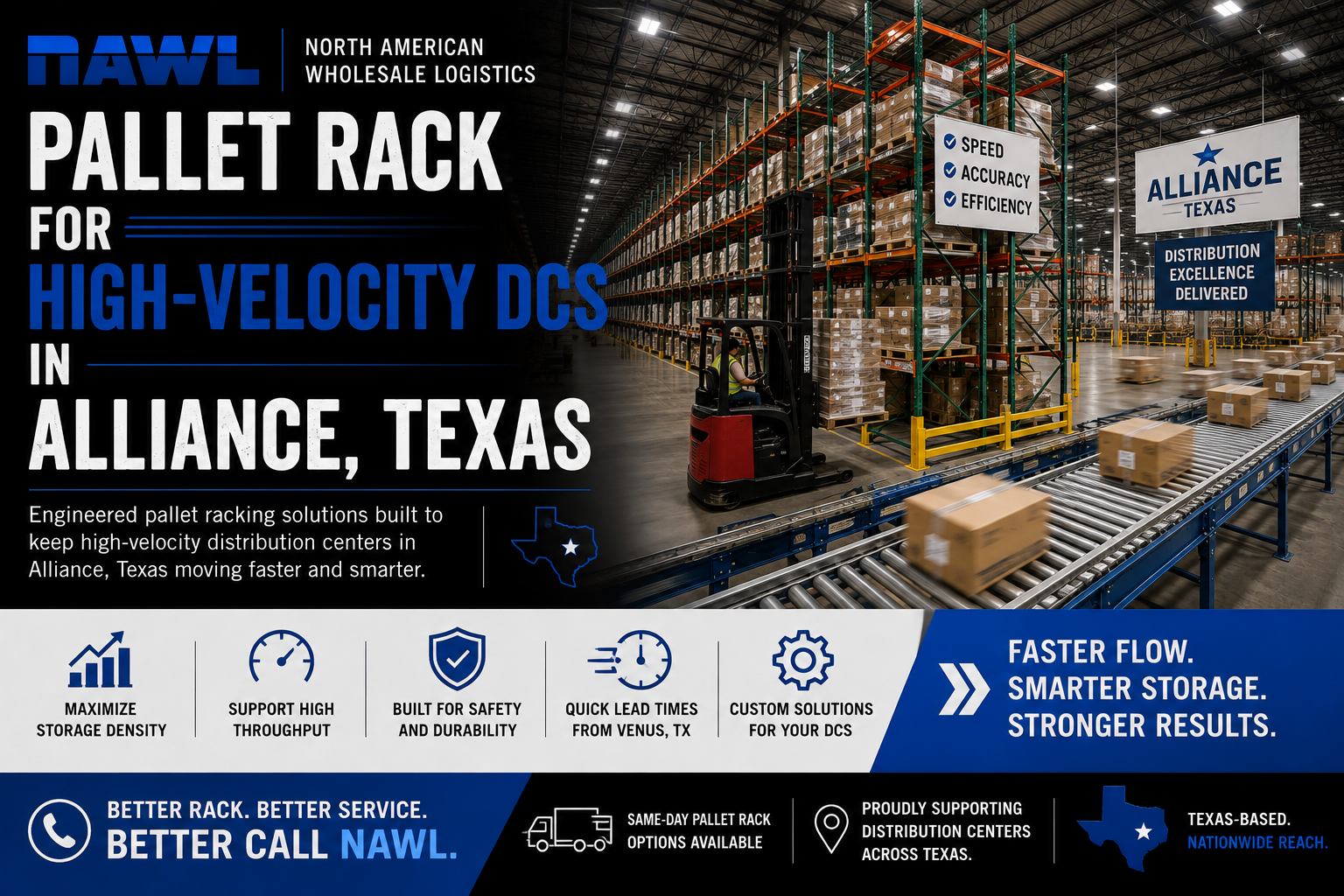
The AllianceTexas development in North Fort Worth has become a cornerstone of logistics and distribution in the United States. With its strategic location, robust infrastructure, and access to major transportation networks, it's home to some of the largest and most efficient distribution centers (DCs) operated by industry giants like Amazon, FedEx, and leading 3PL providers. For these high-velocity operations, the choice of pallet rack systems isn't just about storage; it's about throughput, efficiency, and maximizing every square foot and cubic inch. Selecting the right pallet rack for AllianceTexas warehouses is critical for operational success.
A rack layout that works in a slow-moving reserve warehouse can fail quickly in a North Fort Worth DC where dock doors are busy, trailers are turning, and pick faces must stay replenished. The right design has to match pallet profiles, lift truck equipment, aisle strategy, fire protection requirements, and growth plans. It also has to be available on a schedule that fits the project. In fast-moving DFW projects, quick-ship rack components from nearby stock can be the difference between a phased startup and an avoidable delay.
The Demands of High-Velocity DCs in North Fort Worth
High-velocity distribution centers are characterized by rapid inventory turnover, high SKU counts, and constant inbound and outbound activity. In these environments, every second counts, and any bottleneck in the storage or retrieval process directly impacts profitability and customer satisfaction. The AllianceTexas warehouse ecosystem thrives on speed and precision.
Key characteristics defining these demanding facilities include:
- High Throughput: Goods are constantly moving, requiring systems that facilitate quick put-away and retrieval.
- Dense Storage Needs: With real estate at a premium, maximizing storage density without sacrificing accessibility is crucial.
- Scalability: Operations often need to expand quickly to meet market demands, necessitating flexible racking solutions.
- Safety: The sheer volume of material-handling equipment and personnel requires robust, safe, and well-designed systems.
The challenge for warehouse managers in this region is to implement Fort Worth DC racking that can not only handle current demands but also adapt to future growth and evolving logistical strategies.
In practice, that means the rack cannot be specified in isolation. Aisle width, pallet overhang, beam elevation, lift height, sprinkler clearance, slab condition, dock staging, and replenishment methods all affect the final system. A common 48 x 40 pallet may behave very differently depending on whether it is loaded with stable cartons, drums, bulk bags, appliances, or mixed consumer goods. The pallet load weight, load footprint, and load quality should be confirmed before uprights and beams are selected.
High-velocity buildings also tend to change. Seasonal peaks, customer onboarding, SKU rationalization, and automation projects can all alter the storage profile. That is why many DCs in the area benefit from rack layouts with consistent bay widths, standardized beam lengths, and reserve capacity for future re-slotting. A layout that is slightly easier to modify is often more valuable than one that is optimized only for the first day of operation.
Pallet Rack Solutions for High-Velocity Operations
When designing or upgrading a high-velocity DC, several pallet rack configurations stand out for their ability to meet specific operational needs. The decision often boils down to balancing density, selectivity, and throughput requirements.
A good starting point is to group inventory by movement and pallet depth. Fast movers usually need easy access and short travel paths. Medium movers may support two to six pallets per SKU in deeper storage. Slow movers may belong in reserve, overstock, or high-density areas where access speed is less critical. The rack system should follow that logic instead of forcing every product into one storage method.
| Rack type | Selectivity | Density | Typical flow | Best fit |
|---|---|---|---|---|
| Selective pallet rack | Highest | Moderate | FIFO or LIFO by location | Many SKUs, frequent access, varied pallet profiles |
| Push-back pallet rack | Good by lane | High | LIFO within each lane | Several pallets per SKU, fast replenishment, space savings |
| Drive-in pallet rack | Low | Very high | Usually LIFO | Bulk quantities of fewer SKUs, staging, homogeneous inventory |
Selective pallet rack
- Selectivity
- Highest
- Density
- Moderate
- Typical flow
- FIFO or LIFO by location
- Best fit
- Many SKUs, frequent access, varied pallet profiles
Push-back pallet rack
- Selectivity
- Good by lane
- Density
- High
- Typical flow
- LIFO within each lane
- Best fit
- Several pallets per SKU, fast replenishment, space savings
Drive-in pallet rack
- Selectivity
- Low
- Density
- Very high
- Typical flow
- Usually LIFO
- Best fit
- Bulk quantities of fewer SKUs, staging, homogeneous inventory
Selective Pallet Rack: The Versatile Workhorse
Selective pallet rack is the most common and versatile storage system. It offers direct access to every pallet, making it ideal for operations with a high number of SKUs and relatively low pallet quantities per SKU.
- Pros: High selectivity, easy inventory management, adaptability to various product sizes, relatively low cost per pallet position compared to more complex systems.
- Cons: Lower storage density compared to deep-lane systems.
- Best Use Cases: High-SKU environments where immediate access to all products is paramount, such as fulfillment centers with diverse product lines.
For many AllianceTexas pallet rack installations, selective racking serves as the foundation, often complemented by other systems for specific product categories or areas.
Selective rack is also the easiest system to phase. A DC can install a first block of rows, start operating, and add more as volume grows. Upright frame depth is commonly matched to pallet depth, allowing safe pallet overhang front and rear when designed correctly. Beam levels can be adjusted as product heights change, although changes should still be reviewed against beam capacity, frame capacity, and clearance requirements.
Important selective rack details include beam length, beam capacity, frame height, frame depth, upright column gauge, base plate size, and anchor requirements. In a high-traffic DC, end-of-aisle protection and column protection deserve early attention. Damage from turning lift trucks is one of the most common rack maintenance issues, and it is easier to design protection into the layout than to retrofit it after impacts start occurring.
Selective rack is often the correct answer when the warehouse management system depends on precise location control. If every pallet position has a unique pick or reserve address, operators can find inventory quickly, cycle counts are simpler, and replenishment is more predictable.
Push-Back Pallet Rack: Density with Selectivity
Push-back rack offers a significant increase in storage density over selective rack while maintaining a good level of selectivity. Pallets are loaded onto nested carts that ride on inclined rails. When a pallet is loaded, it pushes the previous pallet back. When unloaded, gravity brings the remaining pallets forward.
- Pros: High density (up to 6 pallets deep), excellent selectivity (LIFO for each lane), efficient use of space, good for multiple SKUs with several pallets each.
- Cons: Higher initial investment than selective rack, not suitable for single-pallet SKUs or FIFO requirements.
- Best Use Cases: High-volume SKUs requiring storage more than one pallet deep, common in manufacturing or distribution where products are batched.
Many Fort Worth DC racking designs leverage push-back systems to optimize space for mid- to high-volume SKUs, striking a balance between density and ease of access.
Push-back rack is most effective when lanes are assigned to SKUs with enough pallet quantity to keep the lane full. For example, if a SKU normally has 12 to 18 pallets on hand, three-deep or four-deep lanes may work well. If that same SKU frequently drops to one or two pallets, the lane can become underutilized. That lost capacity is called honeycombing, and it should be considered during slotting.
Load quality matters in push-back systems. Pallets should be in good condition, reasonably consistent in size, and stable enough to ride on carts without shifting. Operators also need training because push-back loading and unloading require controlled fork movement. Slamming pallets into the lane can damage carts, rails, beams, and product.
Push-back rack can shorten travel time because more pallets are available from fewer pick aisles. In a high-velocity environment, that can matter as much as the added storage density. The tradeoff is that each lane follows last-in, first-out rotation, so it is not the right choice for every expiration-date or lot-control requirement.
Drive-In Pallet Rack: Maximizing Storage Density
Drive-in rack is designed for maximum storage density. Forklifts drive directly into the rack structure to load or unload pallets, which are stored on continuous rails. This system is typically last-in, first-out (LIFO).
- Pros: Extremely high storage density, ideal for bulk storage of homogeneous products, significant space savings.
- Cons: Low selectivity, potential for honeycombing (wasted space if lanes aren't fully utilized), slower access times compared to selective or push-back.
- Best Use Cases: Cold storage, bulk storage of similar products, or staging areas where high density is prioritized over immediate access to every SKU.
For an AllianceTexas warehouse dealing with large volumes of a limited number of SKUs, drive-in racking can be an extremely cost-effective solution for maximizing cubic storage.
Drive-in rack requires careful attention to lift truck dimensions and operator behavior. The forklift enters the rack bay, so rail height, bay width, upright protection, and guide clearances must be correct. Compared with selective rack, drive-in systems are more exposed to contact because equipment operates inside the structure. That makes good design, adequate aisle entry clearance, and ongoing inspection especially important.
Drive-in can be useful for temporary staging or reserve storage where pallet identity is less critical and quantities are large. It is not usually the best fit for high-SKU e-commerce pick operations where the team needs immediate access to many different products. When used selectively, however, it can free up floor space and reduce the overall building footprint required for bulk inventory.
Making the Right Choice for Your AllianceTexas Warehouse
The optimal pallet racking solution for your North Fort Worth distribution center depends on several factors:
- Inventory Characteristics: Number of SKUs, pallet quantity per SKU, product dimensions, and weight.
- Throughput Requirements: How quickly do products need to be moved in and out?
- Space Constraints: Ceiling height, column spacing, and overall footprint.
- Equipment: The types of forklifts and material-handling equipment already in use or planned.
- Future Growth: Anticipated changes in inventory, volume, or operational needs.
For many of the large-scale AllianceTexas pallet rack installations, a hybrid approach often proves most effective. This involves deploying a combination of selective, push-back, and potentially drive-in rack in different zones of the warehouse, tailored to the specific storage and retrieval demands of each product type.
A practical design process starts with clean data. Before requesting a rack quote, gather pallet weights, maximum load heights, pallet dimensions, SKU counts, average and peak pallet positions, turnover rates, equipment specifications, building clear height, slab information, column grid, dock locations, and sprinkler constraints. If the warehouse is already operating, include current travel paths, congestion points, damage locations, and replenishment pain points.
Worked example: zoning a fast-moving DC
Consider a 3PL operation with 1,200 active SKUs. About 150 SKUs account for a large share of daily movement, 400 SKUs move weekly, and the rest are slower reserve items. A single rack type may leave money on the table. A stronger plan may look like this:
- Use selective rack near shipping and pick modules for fast movers and mixed-SKU access.
- Use push-back rack for the 150 high-volume SKUs that regularly carry multiple pallets per SKU.
- Use selective reserve storage at upper levels for slower SKUs and overflow.
- Use drive-in rack only for a small group of bulk items with consistent pallet loads and low rotation complexity.
This type of zoning keeps the pick operation fast while improving storage density where it makes sense. It also reduces the temptation to bury slow-moving product in prime pick locations.
Specification points that should not be skipped
Rack capacity is not just a beam number. The system capacity depends on the full configuration, including upright frame design, beam spacing, frame bracing, floor anchorage, load placement, and seismic or building code considerations where applicable. Beam elevations affect upright capacity, so changing beam levels in the field can change the allowable load.
At minimum, the project team should confirm:
- Maximum pallet load weight, including product and pallet.
- Pallet type and condition, such as wood, plastic, CHEP-style, or captive pallets.
- Required beam clearances for safe placement and retrieval.
- Flue space and sprinkler coordination.
- Aisle width based on forklift type, turning radius, and load size.
- Building column interference and tunnel bay needs.
- Protection for row ends, corners, and high-impact traffic zones.
- Permitting, engineering, and installation sequencing requirements.
Lead time is another important factor in the AllianceTexas market. Large DC projects often move quickly once a lease is signed or a customer contract is awarded. Standardized selective rack components may be available faster than custom high-density systems, while push-back and drive-in projects typically require more design coordination and component planning. Working with a manufacturer that quick-ships from stock can help keep the project moving, especially when the first phase needs to be operational before the full buildout is complete.
Common mistakes in high-velocity rack projects
One mistake is designing only for pallet count. A layout can show enough positions on paper and still fail if travel time, aisle congestion, or replenishment labor is excessive. Throughput should be modeled alongside storage density.
Another mistake is ignoring pallet variability. Imported pallets, damaged pallets, undersized pallets, or unstable loads can cause handling problems in deep-lane systems. If product profiles vary widely, selective rack or a carefully zoned hybrid may be safer and more productive.
A third mistake is leaving protection out of the budget. In busy DCs, rack guards, end-of-row protectors, bollards, guardrail, and clear traffic rules help protect both the structure and the operation. These items may not add pallet positions, but they reduce downtime and repair costs.
Finally, many operators delay inspections until damage is obvious. Rack should be reviewed routinely by trained personnel, especially at aisle ends, lower beam levels, tunnels, and busy staging areas. Damaged uprights, missing safety clips, loose anchors, bent beams, and displaced load stops should be addressed before they become larger safety issues.
Conclusion
Operating a high-velocity distribution center in the AllianceTexas and North Fort Worth corridor demands strategic decisions at every level, especially concerning your storage infrastructure. The right pallet rack system directly impacts efficiency, safety, and ultimately, your bottom line. By carefully evaluating your operational needs and understanding the strengths of selective, push-back, and drive-in racking, you can build a system that supports maximum throughput and sustainable growth.
Ready to optimize your Fort Worth DC racking? Contact us today for a comprehensive assessment and quote to design a pallet rack system tailored to your high-velocity operations.
Related reading
- Quick-Ship Pallet Rack for Dallas-Fort Worth DCs
- Warehouse Pick Modules: Types, ROI & Design Guide
- Warehouse Racking in Arlington, Grand Prairie & Irving
- Choosing Pallet Rack Suppliers in DFW
Browse our selective pallet rack line, storage systems including pick modules, and quick-ship inventory from Venus, TX. Ready to spec a system? Request a quote.
Frequently asked questions
What rack type is best for a high-velocity AllianceTexas DC?
Most high-velocity DCs use a hybrid system. Selective rack supports high SKU counts and direct access, while push-back or drive-in rack can add density for products with deeper pallet quantities.
When should I choose push-back instead of selective rack?
Push-back is a good fit when you have several pallets per SKU and can accept LIFO rotation within each lane. It improves density and can reduce travel, but it is not ideal for single-pallet SKUs or strict FIFO needs.
How much pallet load information is needed before quoting rack?
At a minimum, confirm pallet weight, pallet dimensions, load height, pallet type, and whether loads are stable and consistent. Better data leads to safer capacities, cleaner layouts, and fewer field changes.
Can an existing warehouse be converted to higher-density rack?
Often, yes. The building clear height, slab, column spacing, sprinkler layout, forklift fleet, and inventory profile must be reviewed first. Some buildings can support a dense retrofit, while others perform better with selective rack and improved slotting.
Why does local quick-ship inventory matter for DFW projects?
High-velocity facilities often work under tight startup or expansion schedules. Nearby quick-ship rack inventory can reduce waiting time for standard components and help phase installations without holding up the operation.