Pallet Rack vs. Cantilever Rack: Inventory Fit
September 9, 2026
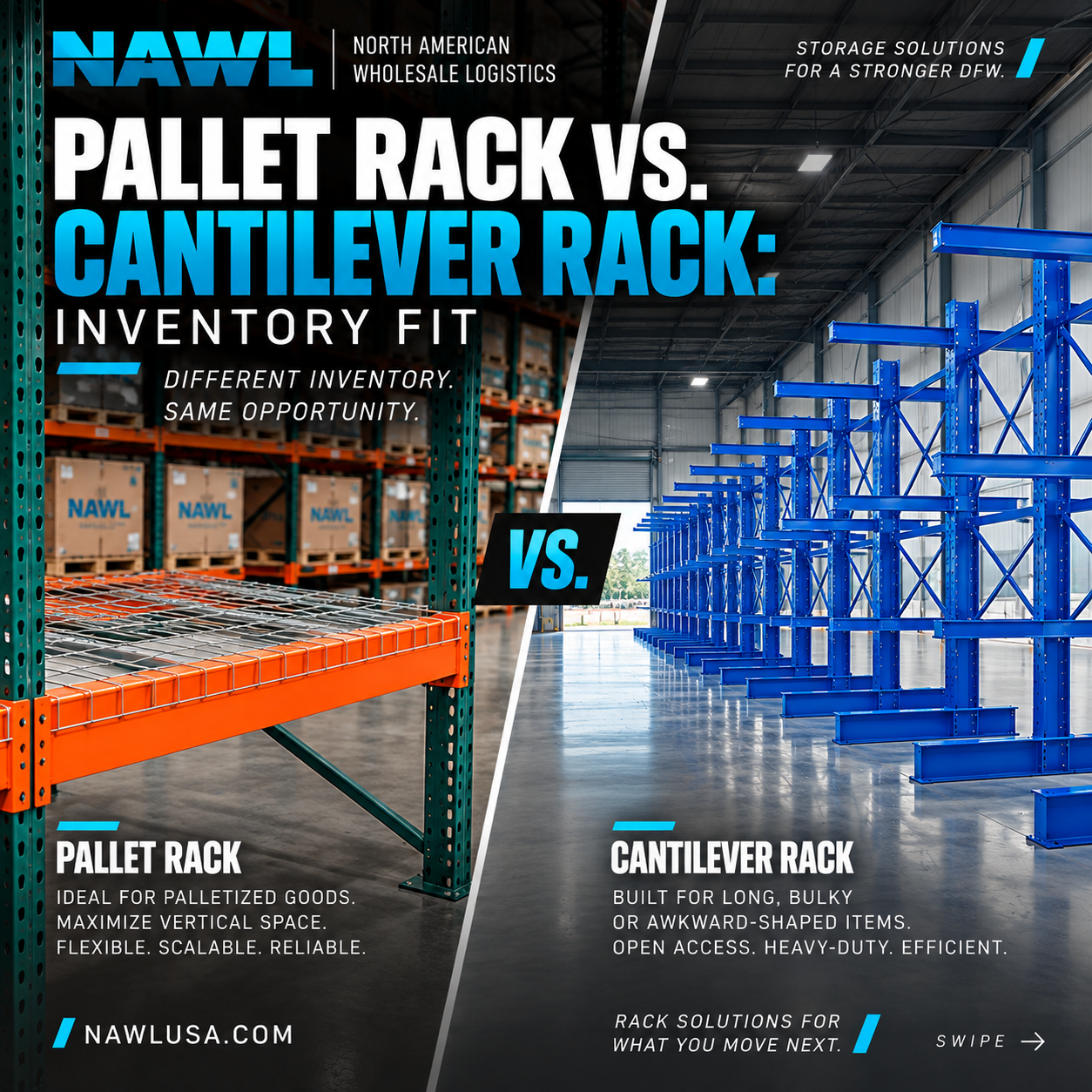
Selecting the right storage system is fundamental to warehouse efficiency and profitability. Two primary contenders often come up in discussions about industrial storage: pallet rack and cantilever rack. While both are designed to optimize vertical space, they cater to distinctly different types of inventory and operational workflows. Understanding these differences is key to making an informed decision that supports your business goals, especially if you're operating in the busy DFW logistics hub.
This guide will provide a clear comparison to help you determine which system—pallet rack vs. cantilever rack—best fits your specific inventory and handling requirements.
Understanding Pallet Rack Systems
Pallet rack is the workhorse of most warehouses. Its design focuses on storing palletized goods, offering high-density storage and direct access to individual pallets. It's a versatile system, capable of supporting various pallet sizes and weights, making it a staple for general-purpose storage.
Ideal Inventory for Pallet Rack
- Palletized Goods: Anything that arrives on or can be easily loaded onto a standard pallet is a prime candidate for pallet rack. This includes boxed goods, bulk items, manufacturing components, and consumer products.
- Uniform Sizing: Inventory with consistent dimensions, whether boxed or on pallets, works seamlessly within the structured bays of a pallet rack system.
- High Throughput: Operations with frequent incoming and outgoing shipments of palletized goods benefit from the organized, accessible nature of pallet rack.
- Diverse Product Lines: A wide variety of SKUs, each on its own pallet, can be efficiently managed within a pallet rack structure, offering good selectivity.
Handling Considerations for Pallet Rack
Standard forklifts (reach trucks, counterbalanced forklifts, turret trucks) are the primary equipment used to load and unload pallet racks. Aisles must be appropriately sized to allow for safe and efficient maneuverability. Flow-through systems (like push-back or pallet flow) can further optimize handling for FIFO/LIFO strategies within pallet rack configurations.
Understanding Cantilever Rack Systems
Cantilever rack, in contrast, is designed for long, bulky, or oddly shaped items that cannot be easily palletized or would be cumbersome to store on traditional shelves. Its defining feature is the absence of a front column, allowing for unobstructed storage and retrieval.
Ideal Inventory for Cantilever Rack
- Long, Bulky Items: This is where cantilever truly shines. Lumber, pipes, rebar, sheet metal, furniture, PVC tubing, steel beams, and rolls of carpet are perfect examples. These items often exceed the dimensions of a standard pallet.
- Varied Lengths: Since there are no front obstructions, items of different lengths can be stored on the same level, or even extend beyond the arms, without issue.
- Irregular Shapes: Goods that are difficult to stack or don't conform to a rectangular footprint can be easily placed on cantilever arms.
Handling Considerations for Cantilever Rack
Specialized forklifts, such as sideloaders, often make the most sense for accessing cantilever rack, especially when dealing with extremely long loads. Standard forklifts can also be used but require more precise maneuvering and wider aisles, particularly for very long items. Overhead cranes are another viable option for very heavy or extremely long loads in specialized operations.
Pallet Rack vs. Cantilever Rack: A Direct Comparison
Let's break down the key differentiating factors to help you make your decision.
Storage Density & Accessibility
- Pallet Rack: Offers high storage density for palletized goods, with various configurations (selective, drive-in, push-back, pallet flow) allowing for different balances of density and accessibility. Selective pallet rack offers 100% immediate access to every pallet.
- Cantilever Rack: Provides excellent density for long, bulky items that would otherwise take up significant floor space. Its open-front design offers easy access along the entire length of the stored material.
Cost & Installation
- Pallet Rack: Generally more cost-effective per pallet position, especially for standard selective configurations. Installation is typically straightforward for experienced teams.
- Cantilever Rack: Can have a higher upfront cost due to its robust design and specialized components (heavy-duty arms, bases, and columns). Installation often requires careful planning, especially for taller systems or very heavy loads.
Flexibility & Adaptability
- Pallet Rack: Highly adaptable to changing inventory needs, especially when using adjustable beam levels. Can be reconfigured to different rack types (e.g., from selective to drive-in) with additional components.
- Cantilever Rack: Extremely flexible for variations in product length. Arm levels are also adjustable, allowing for changes in product height. The core structure is stable across a range of item types within its design parameters.
Safety Considerations
- Pallet Rack: Requires proper load distribution, secure pallet placement, and adequate rack protection (guardrails, column protectors) to prevent damage and ensure safety. Beams must be secured with safety clips.
- Cantilever Rack: It is crucial to understand load capacities for arms and entire bays. Overloading arms or improperly distributing weight can lead to catastrophic failure. Use of safety pins on adjustable arms is critical. Proper load retention (e.g., end stops) for cylindrical items is also important.
Making the Right Choice for Your DFW Operation
For warehouse managers, distributors, and dealers in the DFW area, the decision ultimately boils down to the nature of your inventory and your operational flow.
-
If your operation primarily deals with standard palletized goods, requiring high density and straightforward access, a pallet rack system is likely your best bet. Consider options like selective, drive-in, or push-back based on your inventory turnover and FIFO/LIFO requirements. We offer a wide range of quick-ship pallet rack components to get your facility up and running efficiently.
-
If your inventory consists mainly of long, unwieldy, or irregularly shaped items that don't fit on pallets, then a cantilever rack system will provide the most efficient and safest storage solution, optimizing your vertical space and ensuring product integrity.
Many warehouses, particularly those handling diverse product lines, find value in incorporating both systems. A hybrid approach allows you to optimize storage for every SKU, maximizing overall warehouse efficiency. It's not uncommon to see pallet rack for packaged goods and cantilever rack for construction materials or large appliances within the same facility.
Partner with NAWL for Your Storage Needs
Choosing between pallet rack and cantilever rack is a significant decision. As a U.S. manufacturer, NAWL understands the nuances of warehouse storage and can help you design a system that precisely meets your DFW operation's demands. Our team has the expertise to guide you through this process, ensuring you invest in the most effective and durable storage solutions available. From initial assessment to final installation, we focus on delivering practical, high-performance systems.
Ready to optimize your warehouse storage? Request a quote today to discuss your specific needs and find the ideal pallet rack or cantilever rack solution for your inventory.